


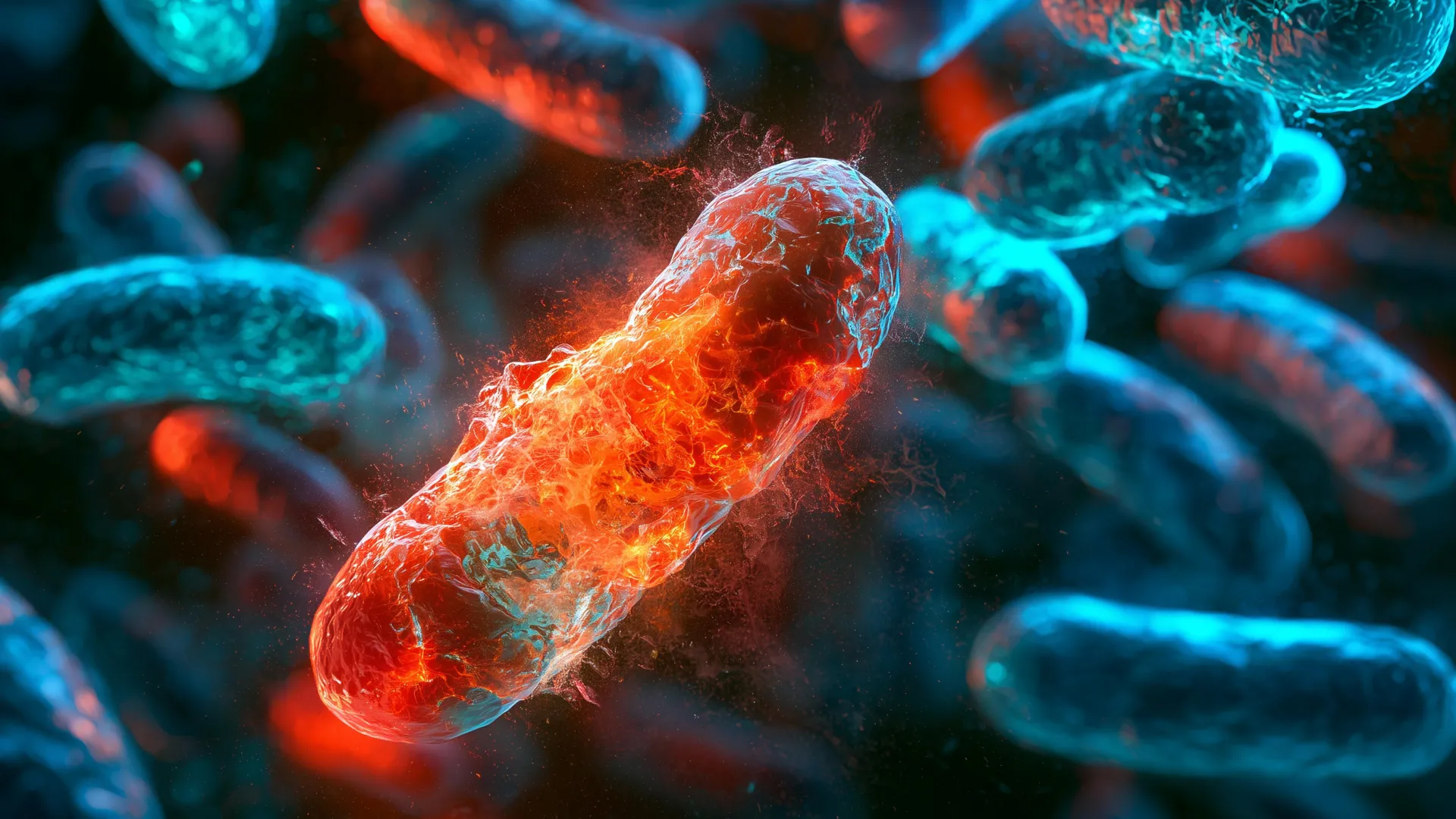
Scientists at the Gladstone Institutes have identified a rare bacterial immune system that works almost opposite to previously studied defenses. Known as a type VI retron, the system produces small amounts of single-stranded DNA in healthy cells, then sharply increases production when a virus attacks. The DNA activates the production of toxins that kill the infected bacterium, stopping the virus from replicating and spreading. The findings could also inspire new gene-editing tools, molecular sensors and antibacterial treatments.
A bacterial defense that sacrifices infected cells
Bacteria are constantly threatened by viruses called phages, which infect bacterial cells and use their machinery to reproduce. Over time, bacteria have evolved several defense systems that limit these infections.
Retrons are one such group of molecular systems. When they detect certain viral infections, they trigger the destruction of the infected cell. Although this sacrifice kills individual bacteria, it can protect the wider colony by preventing the phage from producing more copies and infecting nearby cells.
Retrons are also of interest to researchers developing genetic technologies. They can efficiently generate and deliver single-stranded DNA, making them potentially useful for editing DNA in human cells. Seth Shipman’s team and other researchers are investigating whether these properties could eventually help correct disease-causing mutations with greater precision.
Until now, scientists thought they understood the basic mechanism behind retron defense. In the retrons studied previously, a toxic protein is present in uninfected cells, but short pieces of single-stranded DNA suppress its harmful effects. When a phage infects the bacterium, that protective mechanism is disrupted, allowing the toxin to act and kill the cell before the virus can spread.
Type VI retrons did not appear to follow this pattern.
A molecular system that works in reverse
Researchers first suspected that type VI retrons were different because they could not detect the single-stranded DNA normally associated with these systems.
“A common way to detect retrons in uninfected cells is to look for this single-stranded DNA,” said Karen Chan, a doctoral student in Shipman’s lab and the study’s first author. “But the Type VI Retron caught our attention because it didn’t seem to have this feature. It was very strange and we thought it might be broken.”
Despite the lack of the expected molecular signals, experiments showed that bacteria carrying type VI retrons could still defend themselves against phage infection.
“This was the beginning of a long molecular adventure,” Shipman said. “Normally, when we try the experiments we use to study retrons, they always fail, so we had to keep thinking of new ways to understand how these retrons work.”
After extensive investigation, the team found that type VI retrons reverse key steps in the conventional retron defense process. Instead of maintaining substantial amounts of single-stranded DNA and toxins before infection, the systems produce little detectable DNA and no appreciable amount of toxin in healthy cells.
When a phage enters the cell, DNA production rises sharply. As the DNA accumulates, it interacts with RNA molecules that had been preventing toxin production. This interaction removes the block, allowing the bacterium to rapidly produce toxic proteins.
The toxin appears to be a very small protein that penetrates the bacterial cell membrane. By disrupting the membrane, it kills the infected cell and prevents the viral infection from spreading.
In this system, DNA acts as an activation switch rather than a repressor. Instead of preventing an existing toxin from acting, it helps the bacterium begin producing the toxin only after a threat is detected.
“This is almost a mirror image version of how we traditionally view retrons, because the DNA turns on toxin production rather than inhibiting toxins that have already been produced,” Chan said. “It will be interesting to explore how bacterial evolution has resulted in such a complex molecular system, and whether the type VI retron is older or newer than other retrons, or if it is a stepping stone between different types.”
A new method revealed trace amounts of DNA
Determining how type VI retrons work was difficult because many established techniques repeatedly failed to produce useful results. The researchers had to develop new experimental strategies and adapt existing methods.
One major challenge was detecting the DNA produced by type VI retrons in uninfected cells. After conventional tests failed, the team used a technique called spacer-seq, previously developed in Shipman’s lab. The method uses components of the CRISPR-Cas immune system to record molecular activity inside bacterial cells.
CRISPR-Cas is best known for its role in modern gene-editing technologies, but bacteria originally evolved the system as a defense against viruses. Spacer-seq uses this natural activity to help researchers investigate what is happening inside cells.
The approach ultimately revealed trace amounts of single-stranded DNA that had been missed in earlier experiments.
“We had almost given up hope that DNA was being made when this approach finally revealed very low levels of DNA production in uninfected cells,” Zhang said.
Additional experiments confirmed that type VI retrons produce DNA at very low levels under normal conditions and substantially increase production only after a phage enters the cell. The findings explain why the system appeared inactive in earlier tests and reveal the sequence of events behind its antiviral activity.
Potential applications in gene control and medicine
The discovery is now influencing research in Shipman’s lab, where scientists are exploring how the natural mechanism of type VI retrons could be adapted into useful technologies.
One potential application is the development of synthetic molecular sensors and switches that regulate gene activity. Such systems could allow researchers to control when specific genes are activated or suppressed, creating new possibilities for disease research and treatment design.
“This system represents a unique way to potentially build DNA- and RNA-encoded molecular sensors and switches that no one has thought of before,” Zhang said. “Synthetic sensors and switches have many potential applications, both in disease treatment and in experimental design to better understand how specific diseases work.”
The retron’s unusually small but powerful toxin may offer another avenue for research. Because the protein can disrupt bacterial membranes and kill cells, scientists are exploring whether related mechanisms could contribute to new antibacterial treatments targeting harmful bacteria that cause human infections.
These medical applications are still under development, but the discovery provides molecular designs that would have been difficult to conceive without examining solutions that evolved in nature.
“This study highlights why it is so important for molecular technology development labs like ours to continue to look to nature for inspiration,” Shipman said. “We can use what evolution has given us as a starting point to build complex machines that would have been very difficult to even conceptualize.”
The findings also raise questions about bacterial evolution, including how such elaborate defenses arose and whether type VI retrons represent an early, late or intermediate stage in the evolution of retron immune systems.
Study details
The study, “Reverse transcribed ssDNA derepresses translation of retron antiviral proteins,” was published in Molecular Cell on October 13, 2026.
In addition to Shipman and Zhang, the authors include Matías Rojas-Montero, Darshini Poola and Alejandro González-Delgado of Gladstone; Josefa Klass, Arturo Carabias, Dennis Zhang, Mario Mestre, Ruilien Chao, Ana Dávila-Hidalgo, Guillermo Montoya and Rafael Pinilla-Redondo of the University of Copenhagen; and Leesa Chan and Kliment Verba of the University of California, San Francisco.
The research received support from the National Science Foundation; the Robert J. Kleeberg Jr. and Helen C. Kleeberg Foundation; the Gordon and Betty Moore Foundation; the Lundbeck Foundation; the Fulbright U.S. Student Program; the Military Government of Castilla y León and the European Social Fund Plus; the European Molecular Biology Agency; the Novo Nordisk Foundation; the European Research Council; and the Villam Foundation.
Source: www.sciencedaily.com