


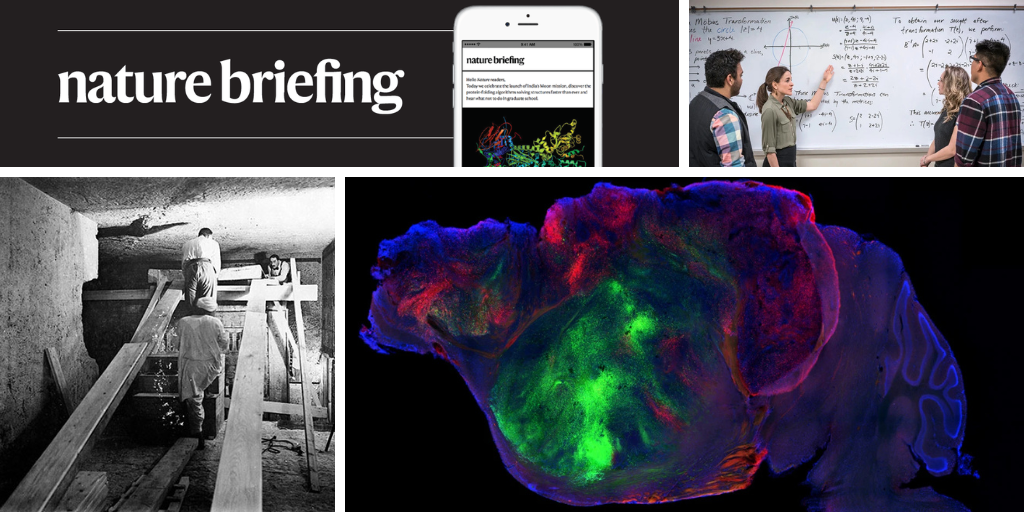
Nature Briefing: New Evidence of a Hidden Chamber in Tutankhamun’s Tomb
Hello Nature readers. Would you like to receive this briefing free in your inbox every day? Sign up here.
Geophysical evidence points to a hidden complex near Tutankhamun’s tomb
Howard Carter (right) and his team explored Tutankhamun’s tomb in 1922. If approved by Egypt’s Supreme Council of Antiquities, careful excavation using small tractors equipped with cameras could begin in November, study co-author George Ballard said. Nature. (David Cole/Alamy)
Researchers say they have discovered new evidence supporting the intriguing but controversial idea that Tutankhamun’s tomb contains an unexplored chamber that could hold the remains of Egyptian queen Nefertiti.
The research team carried out several geophysical investigations, including the first use of gravity techniques to examine the density of the ground around the site. The researchers say the results strongly support the existence of a “hidden complex” of corridors and rooms that predates Tutankhamun’s burial.
Nature | 9 min read
Reference: Extraordinary documents regarding the Amarna Royal Tombs project — paper

OpenAI faces questions over claims about researchers’ work
OpenAI’s claim to have solved a major puzzle in fluid mechanics, the Navier–Stokes problem, has raised concerns about how researchers may inadvertently share their work through chatbots.
Mathematician Tristan Buckmaster said the company may have had access to work he and his collaborators had discussed for a year using the company’s artificial-intelligence tools. An OpenAI spokesperson said: “No user input since July 3 has been able to have any impact on this system.”
“Maybe the academics were a little naive,” said Michael Jacobides, who studies digital ecosystems.
Nature | 9 min read
NASA lunar probe finds a crater created by a rare impact
NASA’s Lunar Reconnaissance Orbiter has identified a crater on the Moon that formed between 11 April and 22 May 2024. The crater is bigger than the Colosseum in Rome and was created when a rock, probably the size of a three- to six-storey building, struck the lunar surface.
Researchers estimate that an impact of this scale occurs only once every 132 years.
Associated Press | 5 min read
Reference: Science Advances paper
Human brain organoids are wired into mice
In the most extensive integration of human brain cells into animals to date, researchers have connected lab-grown brain organoids to mice to replace missing parts of their brains.
Neuroscientist and study co-author Serge Pashka said the hybrid animals provide an unprecedented way to test drugs and study diseases involving abnormal brain development, including cerebral palsy.
Scientists say human neurons could never function in mice exactly as they do in humans. The study also shows no risk of creating superintelligent mice.
Nature | 8 min read
Reference: Nature paper

Transplanted human brain tissue extends nerve fibres (green and red) into a mouse brain (blue) that lacks cerebral cortex.
Credit: S. Pařca lab, Stanford University
Features and impressions
Comb jellies and the evolution of life
Ctenophores, also known as comb jellies, appear to have played a major role in the evolution of the tree of life. These striking creatures are also exceptionally beautiful when viewed in the right light.
Explore this special feature on ctenophores to learn what these strange creatures can reveal about life on Earth, accompanied by rich illustrations.
Quanta | 10 min read
A proposed International Panel on Inequality
The proposed International Panel on Inequality has the support of the United Nations, the African Union, several governments and more than 700 economists and other inequality scholars.
Nature has also supported the proposal in an editorial. “While much is known about the causes and harmful consequences of deep inequality, this knowledge has failed to motivate politicians to take meaningful action,” the editorial said. “The proposed IPI is the best opportunity yet for inequality research to inform policy actions that can change lives for the better.”
Nature | 7 min read
Read more about why an International Panel on Inequality is needed in an article by authors including Nobel Prize-winning economist Joseph Stiglitz and Winnie Byanyima, head of the United Nations AIDS agency.
Nature | 14 min read
Explore Earth’s hidden fungal infrastructure
I’m having fun today with an immersive journey through Earth’s “hidden infrastructure”: a network of mycorrhizal fungi that supports much of plant life.
The model was fed data from thousands of soil cores. An estimate suggests that topsoil on Earth contains approximately 1.10 × 10¹⁷ metres of living hyphae. A single living hypha can extend several kilometres, and the total mass is estimated at about 300 megatonnes—four to six times the weight of the entire human race.
While plants have fungi to thank, why not send me feedback about this newsletter? Email [email protected] anytime.
Thank you for reading,
Flora Graham, Nature Briefing Editor-in-Chief
More Nature Briefing newsletters
- Nature Briefing: Careers — insights, advice and award-winning journalism to help you optimize your work life.
- Nature Briefing: Microbiology — microorganisms and their roles in health, the environment and our food system.
- Nature Briefing: The Anthropocene — climate change, biodiversity, sustainability and geoengineering.
- Nature Briefing: AI and Robotics — 100% written by humans, of course.
- Nature Briefing: Cancer — a weekly newsletter written with cancer researchers in mind.
- Nature Briefing: Translational Research — biotechnology, drug discovery and pharmaceuticals.
Source: www.nature.com