


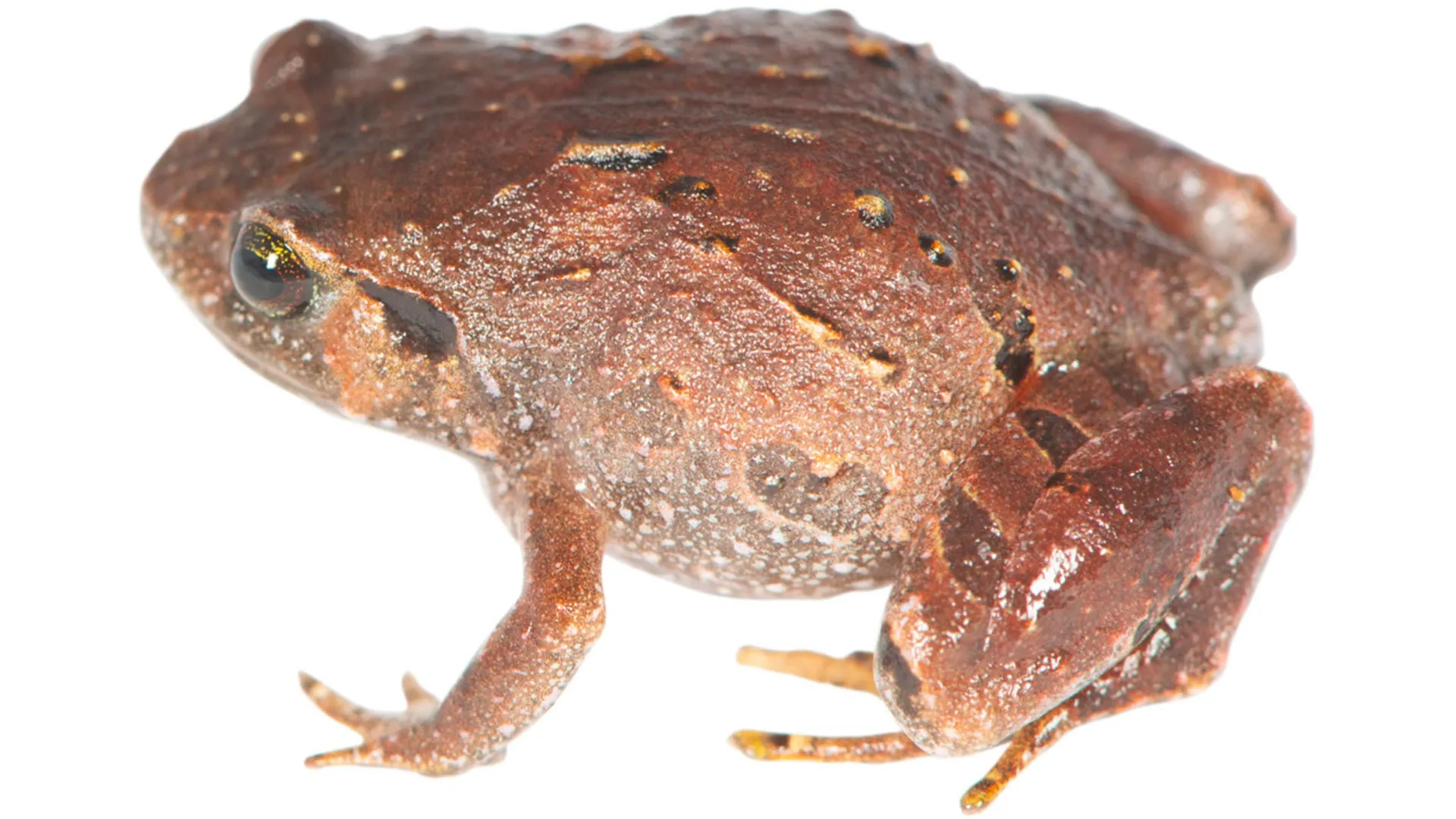
An international research team has identified seven previously undescribed species of Madagascar’s elusive diamond frogs, a discovery that shows these rare amphibians are far more diverse than scientists once believed. The findings provide important new insights into Madagascar’s biodiversity and could help guide future frog conservation efforts.
Accurately identifying species and understanding where they live are essential for measuring biodiversity and protecting threatened wildlife. To determine the identities of Madagascar’s diamond frogs, researchers combined field observations, museum specimens, external characteristics, skeletal anatomy, frog calls, and advanced DNA analysis.
This integrated approach revealed previously hidden species diversity and helped resolve taxonomic questions that had remained unanswered for decades. By determining which frogs belong to each species and mapping their distributions, the researchers created a stronger scientific foundation for conservation planning in Madagascar, where forests are disappearing rapidly.
“Diamond frogs have been hiding their diversity beneath our feet,” said Dr. Mark D. Schatz, Curator of Herpetology at the Natural History Museum of Denmark and lead author of the study.
“Many species spend most of their lives beneath leaf litter, and even when they emerge, they can look very similar at first glance,” he added.
Madagascar’s secret diamond frogs
Diamond frogs are among Madagascar’s most distinctive amphibians. Some species are round-bodied and resemble the rain frogs found in mainland Africa. These frogs spend much of their lives hidden beneath the forest floor. Other species have long legs and live among moss, while several are hardy ground-dwelling frogs adapted to life on the forest floor.
Most diamond frogs appear brown at first, but some species have bright markings that become visible when the animals move. These include vivid orange flashes and striking white-and-black patterns on the thighs and hips. Researchers believe these hidden markings may startle predators and help the frogs avoid attack.
Despite their unusual appearance and ecological importance, diamond frogs remain among the least studied vertebrates in Madagascar because they are extremely difficult to find and observe.
12 years of scientific investigation
The research began more than 12 years ago, when scientists started encountering frogs that appeared to represent species never formally described. Identifying them proved challenging because researchers had to match historical species names with genetic lineages found in modern specimens.
“When we started this project 12 years ago, we knew there were several species already waiting to be described, and almost every expedition to Madagascar revealed another,” Schatz said. “Some were relatively easy to describe, while others were complicated by uncertainty surrounding the names of older species. Solving that puzzle took years.”
A major breakthrough came through museumomics, the use of DNA sequencing to study historic museum specimens. Researchers compared genetic material from older collections with DNA from newly collected frogs. They also examined physical features, skeletal anatomy, and the frogs’ calls.
By combining these different lines of evidence, the team connected historical species names with the correct evolutionary lineages and resolved decades of taxonomic confusion.
Museum collections were especially important in confirming the identities of several species.
“Museum collections are not just archives of the past; they are essential scientific resources for understanding biodiversity today,” said Dr. Alice Petzold of the University of Potsdam, who led the museology study.
“By sequencing historical specimens, including the original type specimen, we were able to answer questions that had persisted for generations,” she added.
New diamond frog species could shape conservation
The study was conducted through close collaboration between scientists and institutions in Madagascar and Europe. It also demonstrates the direct connection between biodiversity research and wildlife conservation.
Many diamond frogs live in forests that are increasingly fragmented by deforestation. Scientists also know very little about the reproductive biology, population sizes, and ecological requirements of several species.
“For many species, we still know very little about their reproductive biology, population size, and ecological requirements,” said co-author Dr. Andralao Rakotoarison of Madagascar’s Sovinandriana Itasy Institute of Technology. “Without that knowledge, it will be much more difficult to assess their conservation status and protect them effectively.”
The discovery of seven new diamond frog species is already contributing to conservation planning in Madagascar. During a protected-area planning workshop held in March 2026 as part of the national biodiversity 30×30 program, researchers presented proposals aimed at strengthening and expanding protected areas that support these newly described frogs.
Many more Madagascar frogs may remain undiscovered
The identification of seven new species has significantly increased the known diversity of Madagascar’s diamond frogs. Even so, researchers believe many additional species may still be undiscovered or awaiting formal scientific description.
Although the study answers numerous long-standing questions, Schatz views the findings as the beginning of a much larger research effort.
“Each newly described species represents a unique evolutionary history spanning millions of years,” he said. “The more we learn about Madagascar’s remarkable amphibians, the clearer it becomes that there is still so much left to discover.”
Source: www.sciencedaily.com