


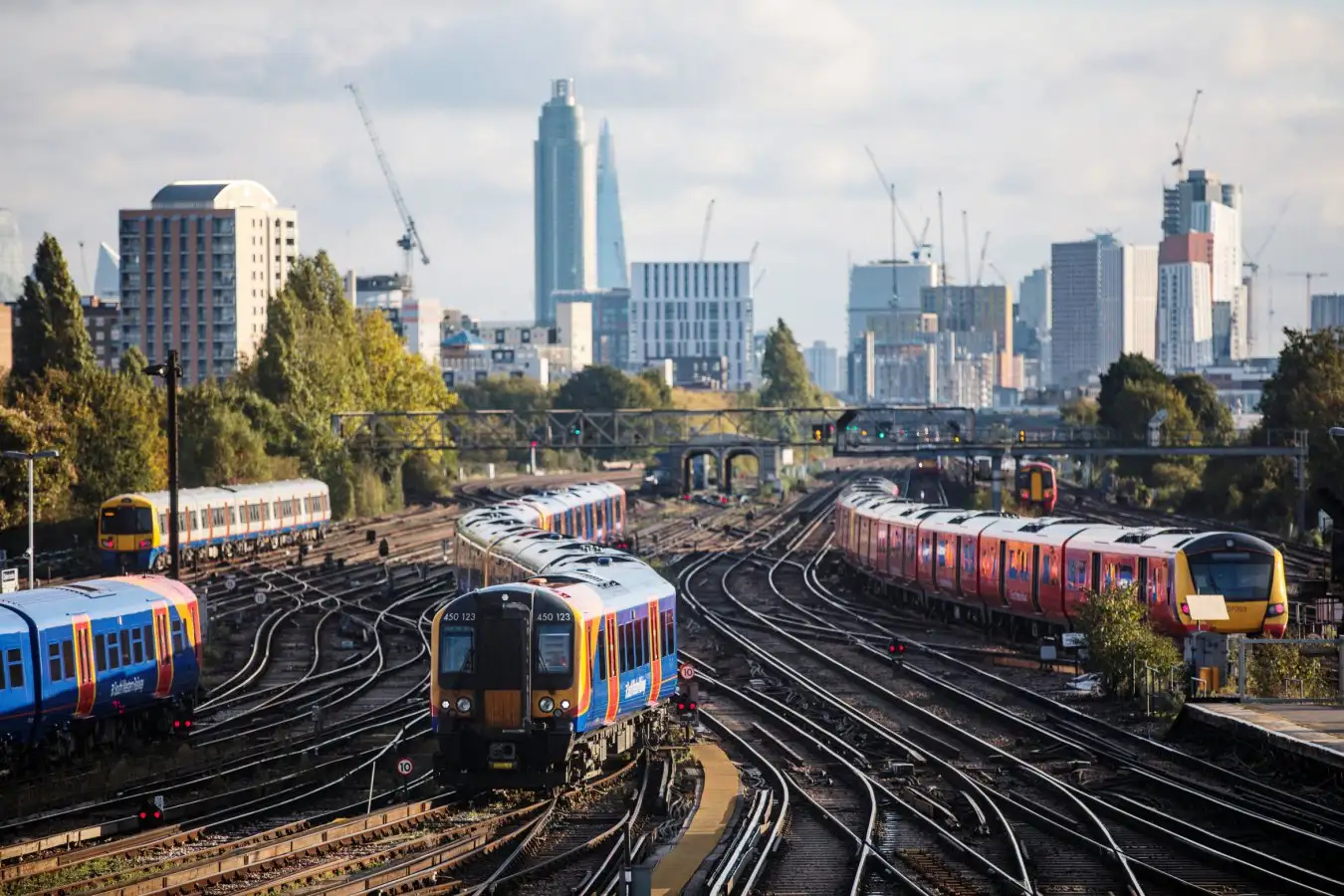

Trains entering and exiting Clapham Junction station in London
Jack Taylor/Getty Images
Electrical systems in railways globally, including the UK, are vulnerable to space weather. In critical scenarios, signal malfunctions could lead to catastrophic train accidents. Cameron Patterson from Lancaster University highlights the need for increased awareness and preparedness.
“Space weather can disrupt signaling systems, essential for railway safety,” he notes. “It’s crucial to prepare for these events proactively.”
The sun emits light and charged particles, known as solar wind, which can create auroras. When solar storms occur, they release more particles, potentially impacting Earth’s magnetic field.
While satellites are primarily at risk, solar storms can also influence terrestrial electrical systems by inducing unexpected currents in structures like railroad tracks.
This vulnerability is significant as many rail systems depend on direct current flowing through tracks to detect train presence. Patterson explains that changes in current occur when a train moves.
“The introduction of geomagnetically induced currents can lead to anomalies, including signals erroneously switching from green to red,” explained Cameron at a recent meeting of the European Geosciences Union in Vienna, Austria. “Trains operate at high speeds; thus, lacking timely warnings could lead to disastrous outcomes.”
The only documented case of signal disruption occurred during a solar storm in Sweden in July 1982, where signals changed as a result of geomagnetically induced currents. “This incident has likely occurred elsewhere, but engineers may overlook space weather as an influencing factor,” Cameron stated.
He believes there are numerous undetected instances of such anomalies, as by the time engineers assess a situation, solar storms often have subsided and abnormal signals are no longer evident. Research in Russia also indicates correlations between solar storms and signaling issues.
A red signal turning green poses the greatest risk; similarly, a green signal changing to red can cause chaos. If a train’s electrical system fails, stranded passengers might inadvertently place themselves in danger, Patterson warned.
Fortunately, the likelihood of significant disruption is low, as strong solar storms that could cause such problems occur roughly once every 30 years. However, Patterson cautions that a 100-year event could occur anytime. A massive storm could result in widespread blackouts and disruptions.
Some countries utilize different signaling systems that rely on magnetic sensors to detect train wheel counts, although it’s unclear if these systems are vulnerable to geomagnetic currents.
Many railway systems face exposure to disturbances from solar storms, including transformers linked to overhead wires, systems tipping trains on curves, and communication and navigation systems that track train locations.
Patterson is collaborating with Network Rail, the Railway Safety Standards Board, and a UK engineering firm to enhance system resilience. Initiating this dialogue has proven challenging, but there is a commitment to addressing the issue.
Magnus Wike from the Swedish Institute for Astrophysics agrees that signals from solar storms may go unnoticed. “They might experience brief interruptions, with systems reverting to normal, yet the cause remains unknown,” he remarked.
Wik added that Sweden upgraded its railway system following anomalies in the 1930s when traffic lights changed from red to green during geomagnetic storms. The 1982 incident was somewhat lesser in severity.
“The Swedish Transport Agency likely hasn’t assessed whether this scenario could recur or if it has occurred multiple times previously,” he indicated. “We are considering research to analyze past geomagnetic disturbances against historical error logs, although this has not been officially pursued.”
Topic:
Source: www.newscientist.com