


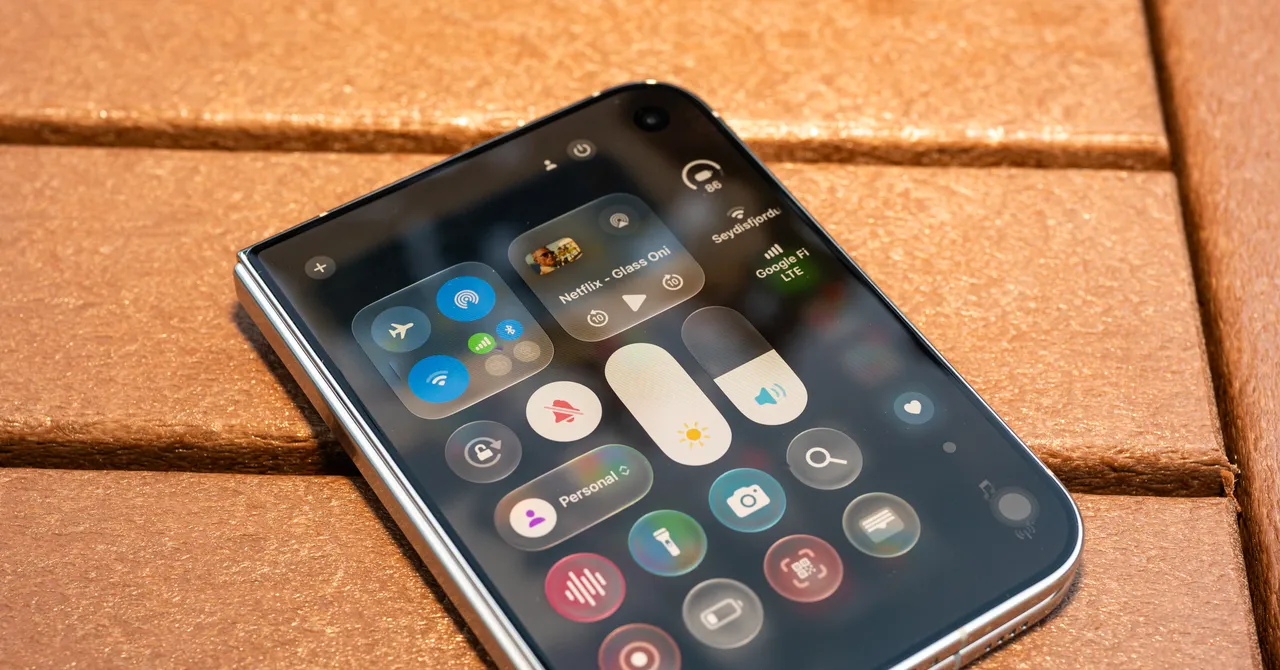
Apple’s updated software may offer an unexpected clue about its rumored foldable iPhone. Apps running on an iPad or Mac have been shown resizing into an unusually wide, squat format that resembles the reported internal display of Apple’s next foldable phone, referred to here as the iPhone Duo. The design also highlights how Apple’s Liquid Glass interface could support a device that changes shape and orientation.
Designed to flow across displays
When Apple unveiled the iPhone Duo, several design decisions appeared to fall into place. Its passport-shaped display breaks from the trend toward increasingly tall smartphones. The Duo is wider and more compact, and when opened it naturally defaults to landscape orientation, matching the display orientation of the iPad mini.
Apple also sought to avoid the distracting transitions between screens found on some competing foldable devices. Instead, content is designed to move seamlessly from one display to the other. The approach begins with the hardware. During a keynote in September, Molly Anderson, Apple’s vice president of industrial design, said: “To achieve this continuity, we designed iPhone Duo around the same consistent aspect ratio on both displays.”
Software built around Liquid Glass helps reinforce that continuity. Its most noticeable feature is the flowing animation, an approach that has also appeared in various forms across the Android ecosystem. The interface is designed to adapt as the device opens, closes and changes orientation.
Liquid Glass also gives Apple more flexibility over where important controls appear. On the Duo, controls can sit side by side when the device is open, while closing the phone creates more room for content. The controls remain in a consistent position when the device changes orientation, reducing the need for users to search for them.
Provided by Apple
The device’s function and its flexible interface appear closely connected. Although the Duo does not strictly require the Liquid Glass design language, the two seem suited to each other. Liquid Glass makes particular sense on the iPhone Duo, while Apple’s broader software changes are beginning to look more purposeful across its product range.
A clearer design purpose
It is difficult to determine how much of this relationship is coincidence. Given Apple’s long hardware and software development timelines, it seems unlikely that the connection is entirely accidental. Liquid Glass also adapts well to the Duo, even if the interface was not originally designed specifically for the foldable device.
The design language feels increasingly deliberate as Apple continues to adjust it for individual products instead of applying one universal aesthetic everywhere. That approach can make the operating system feel more robust and less brittle, while reducing competition between the interface and the user’s content.
On the Mac and iPad, the Liquid Glass redesign resembles a modern tribute to Aqua, Apple’s water-themed interface introduced in 2000. The design has also returned to the iPhone, where it takes on a more playful quality on the Duo.
Liquid Glass is not without problems. “There are some oddities that haven’t been fully resolved. We need to make all of this material consistent, or the metaphor breaks down,” McCarthy says. “But overall, liquid glass is a huge improvement.”
The iPhone Duo may be new, but Liquid Glass is still relatively recent. As developer Steve Troughton-Smith wrote, “For some iPhone apps, even the most dedicated developers will need six months to a year of work to properly support iPhone Duo. Many developers are still completing the transition to liquid glass that we started last year.”
That is a reminder that supporting a new form factor and interface takes time. For now, however, Apple’s direction appears clear: software should adapt fluidly as the device changes shape.
Source: www.wired.com