


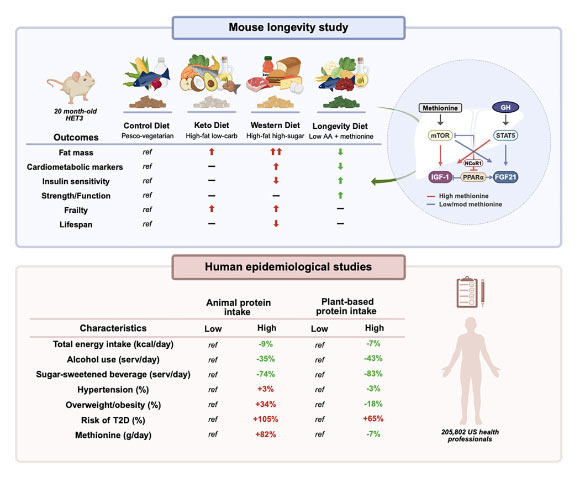
In recent animal studies published in the journal Cell Metabolism, researchers discovered that incorporating precise amounts of individual amino acids into a low-protein, plant-based diet significantly decreased frailty and fat in mice. A cross-sectional analysis of epidemiological data from over 200,000 individuals revealed similar health benefits.
A plant-based, low-amino acid diet shows strong effects on healthspan, with moderate methionine levels needed to minimize frailty. Image credit: Fanti et al., doi: 10.1016/j.cmet.2026.05.015.
“Our findings suggest that a ‘longevity diet,’ primarily vegan or vegetarian but inclusive of fish, may yield optimal health outcomes,” stated University of Southern California researcher Valter Longo and his team.
“The Mediterranean diet offers adequate amounts of methionine and other essential amino acids.”
Countries around the Mediterranean display some of the highest life expectancies globally, yet they still experience relatively high levels of frailty.
Given that plant-based foods contain lower levels of essential amino acids compared to animal products, Dr. Longo’s team devised a longevity diet enhanced with small quantities of methionine, aiming to assess its effects on frailty risk.
In the study, groups of 20-month-old mice were allocated one of four diets: a Western diet high in fat and sugar, a low-carbohydrate ketogenic diet, or a low-protein longevity diet supplemented with methionine (LDMM).
Mice on the LDMM regimen exhibited significantly improved outcomes, including an extended healthy lifespan (the proportion of their lives spent in good health), reduced fat mass, and lower frailty levels.
“Although we anticipated that different diets would yield varied results, we were amazed by the significant metabolic changes brought about by simply adjusting methionine levels in the longevity diet,” emphasized Maura Fanti, a researcher at the University of Southern California.
“This highlights that both the total protein quantity and the specific amino acid composition could serve as targets for metabolic interventions.”
“Additionally, the study identified several biomarkers indicating improved cardiometabolic health in LDMM mice, including higher levels of signaling molecules that regulate metabolism and aging across species, like GLP-1.”
“While pathways differ between mice and humans, it’s promising to observe coordinated changes across various metabolic hormones, and we are eager to investigate if similar significant effects are found in human studies.”
Interestingly, LDMM mice consumed more food than any other group, managing to maintain caloric intake while still losing fat without depleting lean body mass—provided methionine levels remained optimal.
Moreover, human data indicated that individuals with higher animal protein consumption, and thus higher methionine and other essential amino acids, reported greater obesity prevalence and double the diabetes rates compared to those with minimal or no animal protein intake.
“This trend persisted despite individuals consuming more animal protein having lower overall caloric intake and generally healthier diets,” noted Dr. Longo.
“This challenges the conventional notion that calorie reduction is essential for weight loss, while underscoring the need for a deeper understanding of the underlying mechanisms.”
“Insufficient methionine leads to weakness, whereas excessive methionine undermines the benefits of this diet, which is modeled after the diets of long-lived populations like the Italians and Okinawans.”
“These results suggest that focusing on specific amino acid intake might be more crucial than overall protein consumption.”
“The next phase for the team involves conducting controlled clinical trials of the LDMM diet in humans.”
_____
Maura Fanti et al. A longevity diet supplemented with methionine enhances growth hormone, GLP-1, and FGF21 levels, decreases frailty, and promotes a healthy lifespan. Cell Metabolism published online June 23, 2026. doi: 10.1016/j.cmet.2026.05.015
Source: www.sci.news