


Viking Slavery: How Raids, Trade and Human Sacrifice Shaped Norse Society
Slavery existed for thousands of years across ancient and modern societies, and the Viking world was no exception. Enslaved people were captured, traded and transported throughout the vast Viking network. Legal records indicate that people were sold in major trading centers much like other valuable goods.
In an excerpt from The Sea King and the Sorcerer: Life and Death in the Viking Age (Basic Books, 2026), archaeologist Neil Price examines the brutal lives of enslaved people in Viking society. His account follows the violence of raids, the kidnapping and trafficking of women and children, and the possible killing of enslaved women as part of elite funerary rituals.
Related: Neil Price on sea kings, magicians and Sami people during the Viking Age
Slavery was central to Viking society
Although most people in the Nordic world were farmers, another group may have been roughly equal in number, even though it is much harder to identify in the archaeological record: enslaved people. Their experiences have only recently begun to receive proper recognition.
Part of the difficulty lies in terminology. The Norse word þrælar is often translated into English as “slave,” but that translation may be too mild to convey the loss of freedom and rights experienced by the people it described.
Slavery in Northern Europe took many forms. Some forms may have been temporary, while others were permanent, but all involved the subjugation of one person to another through forced service. Many enslaved people were captured abroad during raids or warfare, while others were born into slavery. Some free people may even have sold themselves temporarily into servitude to repay debts or other obligations.
What did enslaved people do in the Viking Age?
Enslaved people in Norse settlements were placed in a strict hierarchy and assigned specific duties. They performed much of the labor required on farms and in households.
In rare cases, an enslaved person could take on senior responsibilities, including managing an estate. One man who ran a royal estate at Hovgården, across from the island settlement of Birka, was permitted to raise a runestone for himself and his wife. However, most enslaved people endured monotonous and demanding lives with little legal identity or personal freedom.
The poem Rígsþula, also known as Rig’s List, summarizes some of the work expected of them:
“They fixed fences, watered fields, tended pigs, herded goats, dug peat.”
Even the names given to enslaved people could be degrading, referring to traits such as bad breath, a stocky body, weight or poor hygiene. Enslaved women were especially vulnerable to sexual exploitation.
Viking raids fueled a human-trafficking network
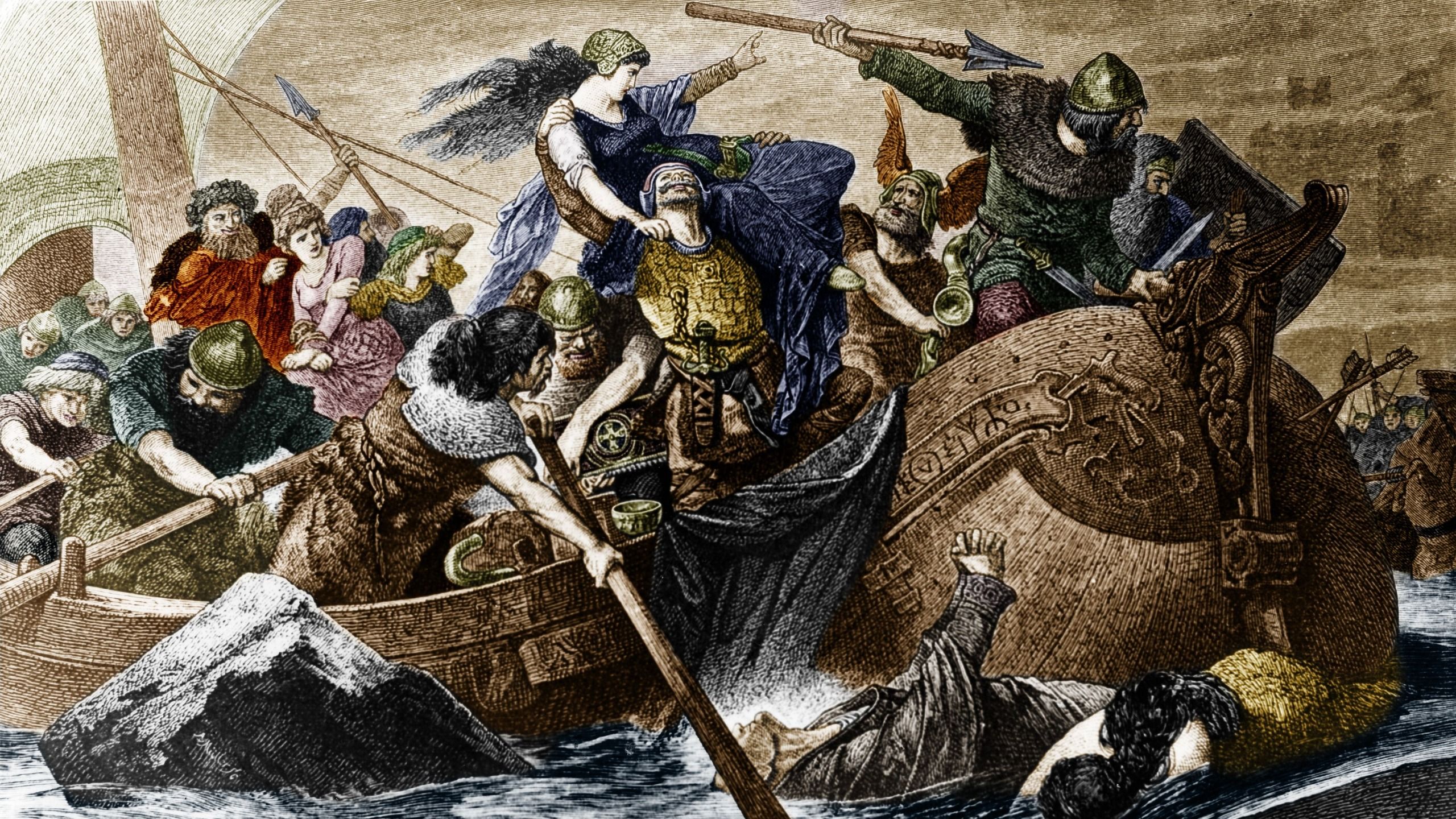
Written accounts from societies attacked by Vikings repeatedly describe the kidnapping and enslavement of women and children. During the ninth century, as Viking attacks intensified across Western Europe and along the eastern rivers, taking prisoners became a major objective.
Raiding, trading and enslavement formed a deadly cycle. In an account of the Viking raid on Barda’a, in present-day Azerbaijan, in 943, the Persian official Ibn Miskawayh wrote that the attackers “imprisoned women and boys, raped them, and enslaved them.” He added that they took any woman, boy or girl they wanted.
Some raids were planned to capture high-status individuals for ransom. Others appear to have been aimed specifically at the sex trade. Enslaved people, particularly those from the Baltic region, became some of the major goods transported eastward along the trade routes that connected the Viking world with the Arab world.
(Image source: Getty Images)
Shipbuilding and expansion increased the demand for labor
In Scandinavia during the second half of the ninth century, the growing scale of Viking raids created new demands for labor. Shipbuilding and related industries required workers to produce textiles, manage timber, make tar and work iron.
As economic expansion enabled larger naval expeditions and agricultural workers were freed to crew ships, the number of people captured during raids increased. This created a vicious cycle in which slavery supported raiding, while raiding supplied more enslaved labor.
Slavery was therefore one of the defining features of the Viking Age and an important part of the Norse diaspora.
Why enslaved people are difficult to identify archaeologically
Archaeologists cannot easily identify enslaved people in Viking graves. There were probably no objects used exclusively by enslaved people, and those without legal rights or significant possessions may not have received traditional burials.
Ibn Fadlan wrote that enslaved people who died during a journey were simply abandoned. Conditions may have differed in settled communities, but evidence remains limited. In some cases, enslaved people appear in the archaeological record because they were killed as part of a funeral ceremony.
A possible funerary sacrifice on the Isle of Man
One example comes from excavations at Ballateare in the parish of Jurby on the northwest coast of the Isle of Man. The site contains one of the best-preserved Viking Age tombs on the island.
The main burial belonged to a man between 18 and 30 years old who died in the early 10th century. He may have been among the early Norse settlers on the Isle of Man. He was buried in a deep wooden coffin with a knife, a cloak fastened by an Irish ring pin, a sword probably made in Norway, and a belt from the British Isles.
His weapons had been deliberately damaged. The sword had been cut into pieces, its handle was broken, and the spear placed at his feet had snapped because there was not enough room for its shaft. His shield had been struck twice, damaging its central boss, and had been placed outside the coffin. The damage was not caused by combat. The shield had been painted white, with black stripes and red dots, and two additional spears lay beside the coffin.
The burial was covered with fine white sand and a mound approximately 3 meters high and 22 meters in diameter. The mound was built from thickly cut grass brought from a wide area, suggesting a symbolic offering of the land to the dead.
On top of the mound, archaeologists found the body of a woman aged between 20 and 30 who had been deliberately killed. The back of her skull was missing, probably removed by a blow from a sharp object such as a sword. Rigor mortis had already set in, indicating that between 12 and 72 hours had passed between her death and the covering of her body.
She may have been left exposed on the mound for some time or killed elsewhere. Her position suggests that she may have fallen to her knees with her hands raised. A pillar, possibly a grave marker, stood beside her body.
The evidence cannot reveal the full story of the woman’s life. She may have endured years or decades of slavery and forced service before her death. Her body was covered with a thick layer of cremated animal bones, including remains of cows, horses, sheep and dogs. The mound was eventually sealed with grass over the body and ashes.
This article is excerpted from The Sea King and the Sorcerer: Life and Death in the Viking Age by Neil Price. © 2026 Neil Price. Published by Basic Books, an imprint of Hachette Book Group, Inc.
About the book
The Sea-King and the Sorceress: Life and Death in the Viking Age draws on archaeological research and scientific analysis to explore the lives and experiences of people during the Viking Age.
Buy The Sea-King and the Sorceress: Life and Death in the Viking Age
Source: www.livescience.com