


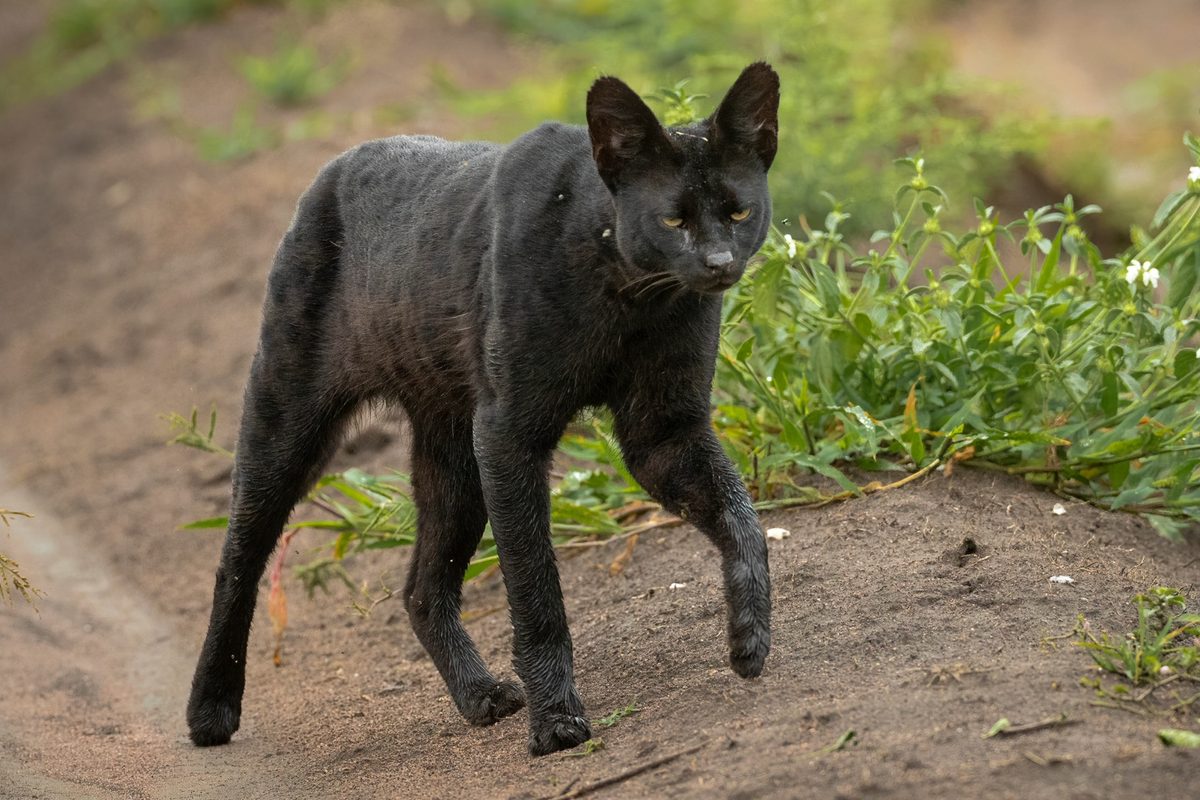
The black serval (Reptile Lus Serval) is an exceptionally rare melanistic variant of the African Serval, a medium-sized wild cat indigenous to Africa.
Standard servals are stunning in their own right, boasting long legs reminiscent of a supermodel, striking spots akin to a cheetah, and large ears perched atop a graceful neck.
However, a black serval elevates this elegance even further. Its unique coloration results from a genetic anomaly that alters pigment production. Black servals exhibit luxurious jet black fur, occasionally adorned with subtle “ghost” markings.
With an impressive physique, servals possess the longest legs relative to their body size among all cats. They measure approximately 0.5 meters (1.6 ft) in height, reach speeds of up to 40 mph (64 km/h), and can leap up to 3 meters (9.8 ft).
These adaptations are invaluable for pursuing small mammals, reptiles, and amphibians in their diet and provide crucial escape strategies from predators like leopards, hyenas, and African wild dogs.
In addition, servals boast the largest ears of any feline in proportion to their head size. If human ears were scaled like a serval’s, they would be the size of dinner plates—albeit much less efficient.
Equipped with 22 muscles, each serval ear can rotate independently by 180 degrees. This feature is vital for hunting in tall grass, where prey is often hidden from sight, allowing servals to accurately pinpoint sounds, even underground.
These remarkable traits make the serval one of the most effective hunters in the feline world. While lions and leopards have only a one in three chance of successfully hunting, servals boast a success rate exceeding 50%.
Historically, black servals have been located in densely wooded areas above 2,000 meters (approximately 6,600 feet) in altitude, like the Aberdare Mountains in Kenya and the Ethiopian Plateau, where their dark fur provides effective camouflage in shadowy environments.
More recently, however, a black serval was documented in the grasslands of the Tsavo Ecosystem, Kenya’s largest national park.
Research by Sheldrick Wildlife Trust and Wildlife Works from 2011 to 2016 found that 47 percent of servals observed in Tsavo exhibited melanism.
This percentage is significantly higher than those found in forested habitats, which prompts the question: Why are there so many black servals thriving in this bright, arid environment?
The answer remains elusive.
One theory posits that the distinct coloration of melanistic servals attracts more notice, while others consider it a result of random genetic fluctuations.
A third hypothesis suggests that specific genetic traits enhance the servals’ ability to tolerate heat and resist diseases, which may contribute to the survival and propagation of their melanistic characteristics.
Regardless of the reasoning, these captivating cats continue to intrigue observers and are a truly remarkable sight.
If you have any questions, please contact us at: [email protected] or reach out on Facebook, Twitter, or Instagram (please include your name and location).
Explore our ultimate fun facts and discover more amazing science content!
Read more:
Source: www.sciencefocus.com