


Survey Methods: How Three Studies Measured Support for White Nationalism
This research used three surveys conducted between 2021 and 2025 to examine support for white nationalism, related racial attitudes, and possible sources of survey-response bias among non-Hispanic white adults in the United States.
Study 1: 2021 YouGov Cooperative Election Study Survey
In November 2021, we fielded an extensive survey of N = 3,227 non-Hispanic white people as part of the Cooperative Election Study (CES), a widely used source of data in peer-reviewed political science research on US public opinion.
The CES’s in-depth Common Content questionnaire and respondent geocodes enabled us to document demographic and political predictors of support for white nationalism and evaluate our theories. YouGov conducted the CES online. Respondents were selected from an opt-in panel using sample matching and weighting methods intended to produce estimates approximating those from nationally representative probability samples of US adults37.
This approach assumes that, conditional on the demographic variables used for weighting, panel participation is independent of the attitudes measured in the survey. That assumption cannot be directly verified, particularly for stigmatized political opinions and identities.
The CES consists of modules containing original questionnaires developed by university-based research teams and fielded to approximately 1,000 respondents each. All respondents also complete the CES Common Content questionnaire, which includes questions about demographics, partisanship, vote choice, policy preferences, political knowledge and related topics.
We purchased questionnaire time across five CES modules, producing a total of 5,000 respondents. Our questionnaire was administered only to respondents who identified as white on the Common Content race question. That question also included response options for ‘Black’, ‘Hispanic’, ‘Asian’, ‘Native American’, ‘Two or more races’, ‘Other’ and ‘Middle Eastern’.
We further limited the analysis to respondents who answered ‘no’ when asked whether they identified as Hispanic or Latino. The resulting sample of N = 3,227 was designed to represent the US non-Hispanic white adult population, estimated by the Census Bureau at 161 million people in 2021, or 62.1% of all adults. Demographic, political and other relevant sample characteristics are provided in Supplementary Information B.
The complete Study 1 questionnaire is available in Supplementary Information A. The key survey items are summarized below.
White identity and support for white collective action
These items were adapted from previous research23,24 and presented in random order. Respondents indicated how much they agreed or disagreed with each statement using a five-point scale ranging from ‘strongly disagree’ to ‘strongly agree’.
-
Being white is important to my identity.
-
White people in this country have a lot to be proud of.
-
Whites in this country have a lot in common with each other.
-
Whites need to do more to remind the world about the challenges that white people face.
-
Whites need to start looking out more for one another.
-
We need a political party focused on advancing white power.
Perceptions of group power in the United States
Respondents were asked whether each group had too little power, too much power or the right amount of power in the US. Items were presented in random order.
-
Whites
-
Blacks
-
Asians
-
Hispanics
-
Evangelical Christians
-
Jews
-
Muslims
The response options were ‘too little power’, ‘the right amount of power’ and ‘too much power’.
Attitudes toward intimidation, harassment and violence
These questions were adapted from measures previously developed to study partisan political polarization55. Respondents indicated their stance on the following questions:
-
When, if ever, is it OK for whites to send threatening and intimidating messages to non-white leaders?
-
When, if ever, is it OK for an ordinary white person in the public to harass an ordinary non-white person on the internet, in a way that makes that person feel unsafe?
-
How often do you feel it is justified for whites to use violence in advancing their political goals these days?
Responses were recorded on a four-point scale: ‘never’, ‘occasionally’, ‘frequently’ and ‘always’.
Measuring support for white nationalist ideology
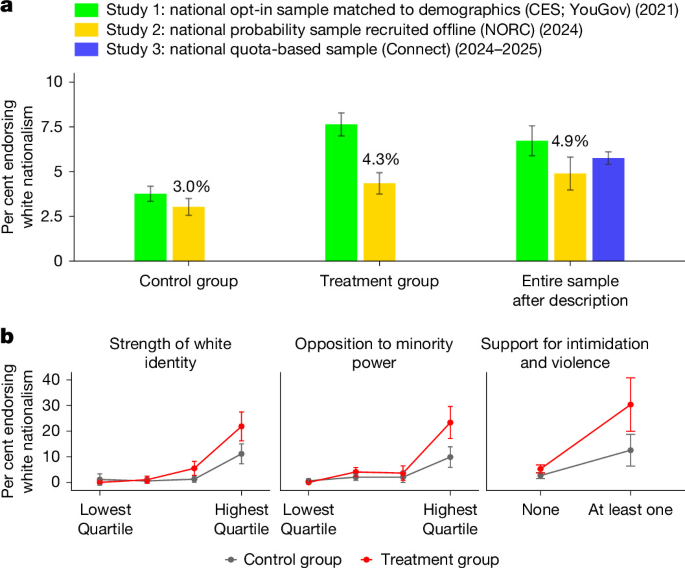
Respondents were randomly assigned in equal numbers to treatment and control groups. The treatment group received the following description of the white nationalist movement:
“The white nationalist movement holds that whites are under threat in the United States and seeks to ensure the survival of the white race in this country. White nationalists believe that white people should hold more political and economic power than other groups. They believe that whites should maintain their majority in the US and that white culture is superior to all other cultures.”
After reading the description, treatment-group respondents were asked: “Are you a supporter of the white nationalist movement?” They answered ‘yes’ or ‘no’ on their screens.
The control group answered the question before reading the description. Their responses were then recorded, and they answered the question again after reading the description. Except where otherwise noted, reported estimates of support for white nationalism combine the fully informed responses from the control group with responses from the treatment group.
Study 2: 2024 NORC AmeriSpeak Replication Survey
We replicated the key results with a brief nationally representative survey of N = 2,114 non-Hispanic white people conducted in May and June 2024 through NORC’s AmeriSpeak panel38.
AmeriSpeak randomly selects households from a national sampling frame using area probability and address-based sampling. Sampled households are recruited by US mail, telephone and field interviewers. Most respondents participated online; non-internet households, representing 3.3% of the sample, participated by telephone.
The survey measured support for white nationalism using the same wording and experimental procedure described above. Respondents were randomly assigned to treatment and control groups. The analysis also used demographic and political profile information collected by NORC from AmeriSpeak panelists.
The complete Study 2 questionnaire is available in Supplementary Information A. Demographic, political and other sample characteristics are provided in Supplementary Information B.
Study 3: 2024–2025 CloudResearch Survey
In late 2024 and early 2025, we conducted a supplementary survey of N = 2,548 non-Hispanic white people recruited through CloudResearch39. The sample used national quotas for sex, age and education corresponding to American Community Survey estimates for the US non-Hispanic white adult population. It also included a partisanship quota based on estimates from the 2024 CES.
The survey was administered through Qualtrics. Respondents first answered demographic and political questions. They then completed batteries measuring:
- White identity23
- Conspiracy beliefs56
- Denial of white privilege57
- Racial resentment58
- Belief in the ‘great replacement’ theory59
- ‘Old-fashioned racism’60
Question wording largely followed measures used in previous research on racial attitudes, as detailed in Supplementary Information B. Some battery items were reverse-keyed to address potential acquiescence bias.
Experimental design for testing survey-response bias
We used survey experiments to examine potential vulnerabilities in the measure of white nationalist support. Participants were randomly assigned to conditions described in Extended Data Table 5.
All participants received the short description of the white nationalist movement used in the earlier studies. They then answered variations of the question measuring support for the movement.
Participants in Condition A were asked, “Are you a [supporter/opponent] of the white nationalist movement?” Half received the ‘supporter’ wording used in Studies 1 and 2, while the other half received the ‘opponent’ wording.
Participants in Condition B were asked, “Do you [oppose or support/support or oppose] the white nationalist movement?” Half received each version of the question.
To assess possible priming effects, half of the participants answered their assigned white nationalism question at the beginning of the survey, before completing the racial-attitudes batteries. The other half answered it at the end of the survey.
How support for white nationalism relates to other racial attitudes
Our measure of support for white nationalism shares some characteristics with established measures of racial attitudes developed in political science, sociology and psychology23,57,58,59,60.
In Study 3, the measure was most strongly correlated with two established constructs. Its specification that white nationalists believe white people should “hold more political and economic power than other groups” and that “white culture is superior to all other cultures” overlaps with elements of the white identity battery23 (r = 0.40).
The measure also includes the ideas that white people are “under threat” and should “maintain their majority in the US”. These ideas are related to themes in the “great replacement theory” concerning immigration59 (r = 0.31).
White nationalism showed weaker but positive relationships with:
-
‘Old-fashioned racism’60: r = 0.26
-
Racial resentment58: r = 0.25
-
Denial of white privilege57: r = 0.15
These findings suggest that the measure captures a phenomenon related to, but distinct from, these established constructs.
Testing for upward bias in prevalence estimates
Estimates of low-propensity attitudes can be artificially inflated by inattentive respondents, acquiescence bias and priming effects. We investigated each potential source of upward bias.
Inattentive respondents
Respondents who answer randomly can inflate estimates of uncommon beliefs40. The vendors administering Studies 1, 2 and 3 used multiple techniques to identify and remove inattentive respondents.
We also reanalyzed Study 1 to examine the relationship between survey completion time, a measure previously associated with attentiveness41,61, and support for white nationalism. After controlling for the predictors described in the article, estimates were robust to inattentiveness and only slightly lower. The brevity of Study 2 prevented a response-time analysis. In Study 3, response time was not related to support for white nationalism.
Acquiescence bias
We examined whether the yes–no question asking respondents whether they supported the white nationalist movement was vulnerable to acquiescence bias, or the tendency to agree with survey statements regardless of one’s actual beliefs.
In Study 3, after reading the description of white nationalist beliefs, half of the respondents were randomly assigned the original question: “Are you a supporter of the white nationalist movement?” The other half received the question in the opposite direction: “Are you an opponent of the white nationalist movement?”
This experiment found no evidence that acquiescence bias inflated prevalence estimates. Additional analyses suggest that the findings are likely to generalize across samples regardless of respondent attentiveness, as described in Supplementary Information F.
Priming effects
Study 1 measured support for white nationalism at the end of a survey containing extensive questions about racial attitudes. Study 3 therefore tested whether question order affected estimates.
Half of the participants answered the white nationalism question before completing the other racial-attitudes measures. The remaining participants answered it at the end, after completing batteries concerning white identity, racial resentment and ‘old-fashioned racism’.
The question-order experiment found no evidence that priming effects inflated prevalence estimates. Further results are provided in Supplementary Information F.
Assessing statistically insignificant results
Several statistical tests in this research produced insignificant estimates, meaning they could not reject the null hypothesis that the association between a predictor or experimental treatment and support for white nationalism was zero. Because failure to reject the null does not necessarily provide evidence in favor of the null, we conducted additional analyses.
When a single experimental treatment or regression coefficient was statistically insignificant, we used an equivalence test to determine whether the association was small enough to be substantively negligible64.
We defined 2.5 percentage points as the benchmark for a substantively meaningful treatment effect or ceteris paribus association. This threshold was not preregistered but was established before the equivalence tests. It was selected because it was consistent with the approximately 2.5-percentage-point minimum detectable effect, at 80% power, in the Study 2 experiment.
Associations between −2.5 and +2.5 percentage points were considered negligible. The equivalence tests used two one-sided tests to determine whether the true association was greater than −2.5 percentage points and lower than +2.5 percentage points. We concluded that an estimate was statistically equivalent to zero within this margin only when both tests rejected their respective null hypotheses.
When a categorical predictor was statistically insignificant in a multiple regression model, we used Bayesian information criterion (BIC)-based model comparison to assess whether including the predictor meaningfully improved model fit65.
For each test, we calculated the difference between the BIC of the alternative model containing the predictor (BICA) and the null model (BIC0):
ΔBIC ≡ BICA – BIC0
We report ΔBIC and the corresponding strength of evidence for the null model. Under conventional standards, ΔBIC values greater than approximately 2, 6 and 10 indicate roughly positive, strong and very strong Bayes-factor evidence in favor of the null model.
Ethics statement
The study protocols were approved by the NYU Institutional Review Board. Study 1 received exempt approval on 20 August 2021 (IRB-FY2021-4955). Study 2 received expedited approval on 8 May 2024, and Study 3 received an expedited protocol modification on 4 November 2024 (IRB-FY2024-8846).
The research was conducted in accordance with relevant guidelines and regulations. Informed consent was obtained from all participants.
Reporting summary
Additional information about the research design is available in the Nature Portfolio Reporting Summary linked to this article.
Source: www.nature.com