


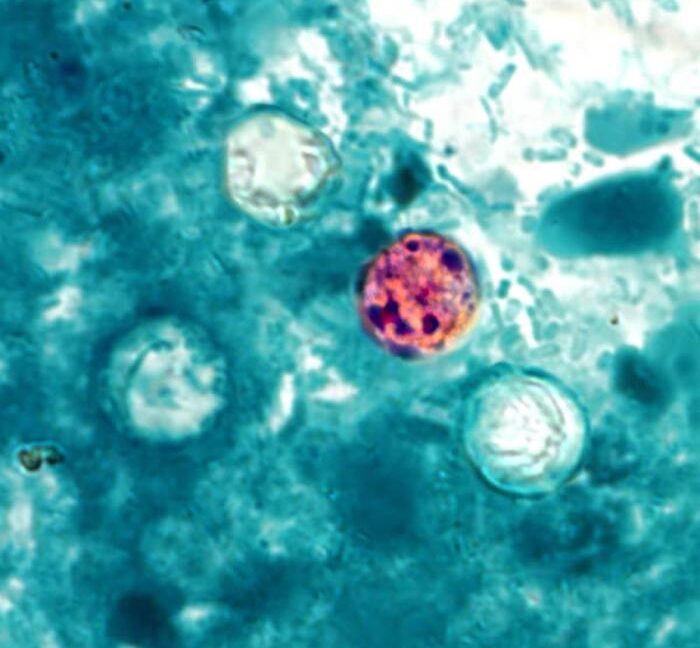
Trump administration halts key USDA research into foodborne parasite Cyclospora amid record outbreak
The Trump administration has halted or disrupted several federal research programs focused on Cyclospora, a foodborne parasite responsible for a record nationwide outbreak of diarrheal illness, according to Politico.
Three USDA research programs account for nearly all federally funded research into Cyclospora in the United States. Two former USDA scientists have reportedly lost funding for their work, while a third research program is expected to lose the scientists who have been conducting it.
The administration plans to close the USDA’s Beltsville Agricultural Research Center near Washington, D.C., and move its operations to Iowa. The relocation includes the remaining USDA research focused on Cyclospora.
Although funding for the research has not been eliminated entirely, officials told Politico that none of the scientists currently working on the project plans to move from Maryland to Iowa. Some are expected to retire, while others may be reassigned or leave the USDA’s Agricultural Research Service.
“They won’t have a parasitologist,” one USDA official told Politico. “There will be a huge knowledge gap.”
The disruption comes as the United States faces its largest recorded Cyclospora outbreak. The Centers for Disease Control and Prevention has counted approximately 30,000 confirmed and probable cases during the summer. At least 922 people have been hospitalized, and two deaths have been reported. In recent years, the United States typically recorded between 2,000 and 5,000 cases annually, although approximately 1,180 cases were reported in 2025.
Why Cyclospora research is difficult
Cyclospora is more challenging to study in the laboratory than other foodborne pathogens, including Escherichia coli and Salmonella. The parasite develops and reproduces only inside the human intestine, which means researchers cannot easily grow it in standard laboratory cultures.
Scientists can recover Cyclospora from stool samples, but detecting the parasite can be difficult. It may be shed intermittently or at low levels, often requiring repeated samples from infected patients. The parasite is also challenging to analyze with genetic techniques because its genome is much larger than those of many bacteria, making sequencing more expensive and time-consuming.
In addition, Cyclospora reproduces sexually, producing new genetic combinations with each generation. That makes it harder for investigators to trace an outbreak back to a single contaminated food source. By contrast, bacteria such as Salmonella often reproduce asexually, creating near-identical clones that can be easier to track.
Source: arstechnica.com