


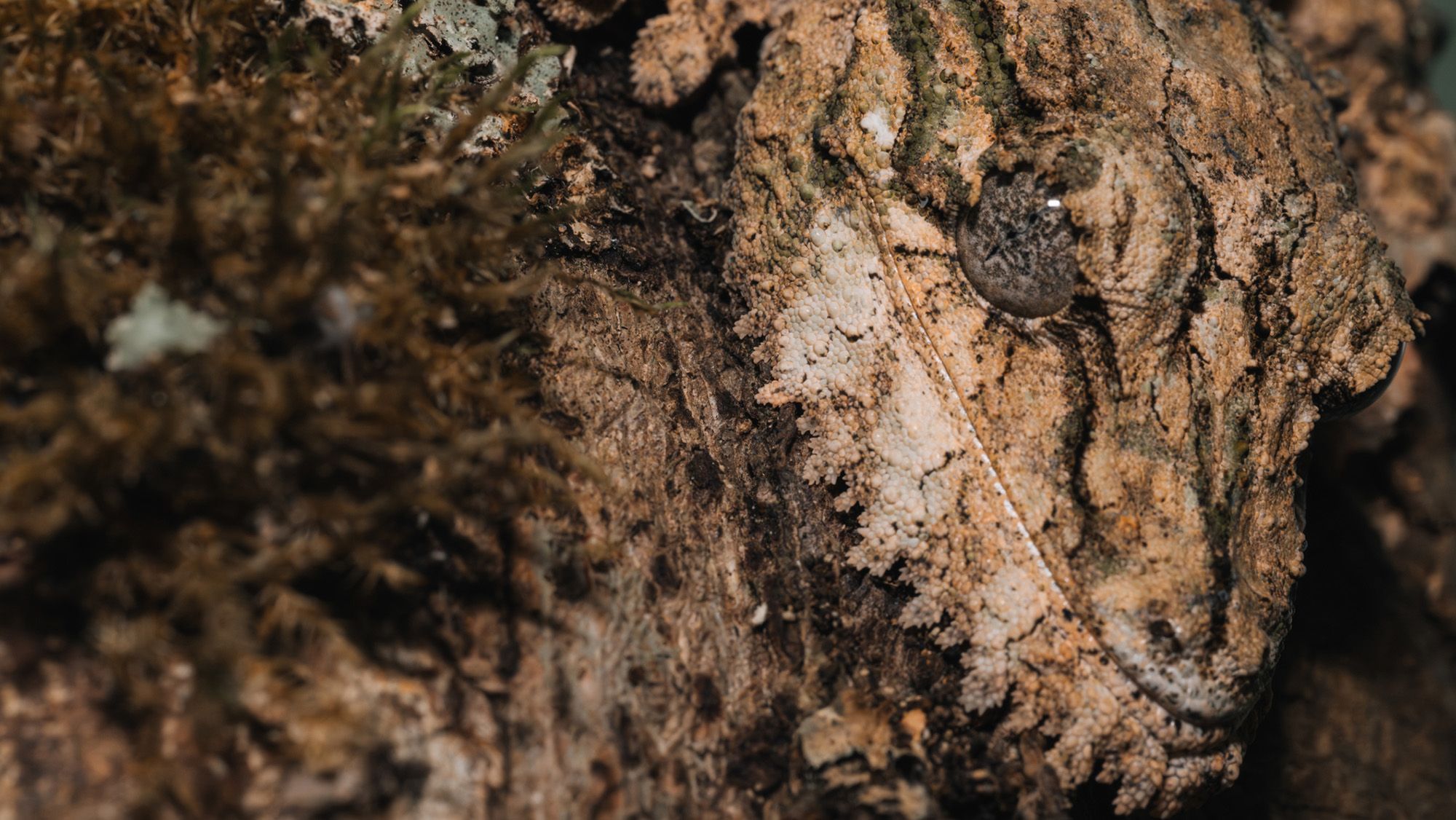
Animals routinely deceive one another, but not all deception involves conscious intent. A moth may evolve to resemble a hornet, an orchid mantis may look like a flower, and a tiger’s stripes may conceal it from view without the animal understanding what it is doing. In his 2026 book Liars, Cheats and Copycats: Trickery and Deception in Nature, biologist James O’Hanlon examines a more tactical form of deception: behavior that appears to manipulate what another animal believes. Live Science spoke with O’Hanlon about why scientists remain cautious about calling such behavior “lying,” and why he ultimately thinks animals can lie.
Where deception begins
Olivia Maule: The chapter opens with a question from a woman at a senior citizens’ club who asked, “How does the mantis know to look like a flower?” Why did that question stay with you?
James O’Hanlon: It was such a simple question, but I couldn’t give a simple answer. At the time, I was thinking about what might be happening in the brains of the animals I was studying. Does a camouflaged animal know that it is camouflaged? Does an insect that resembles a leaf know what a leaf is?
Then I realized that it does not need to know. The camouflage works regardless. That is very different from the kind of deception discussed elsewhere in the chapter: behavior that may involve an animal knowing that it can mislead another animal and choosing to do so.
OM: Do you have an answer to that question now?
JO: If I had to answer, I would say yes. It looks like animals can lie. But scientists are paid to be pedantic, so the answer will always be “yes, but” or “possibly.” Many behaviors look as though animals can lie, and they are very good at them. But in science, we can never know for certain what is happening inside an animal’s brain. It is a best-guess situation.
Deception without human morality
OM: How can readers understand that camouflage is genuine deception in an evolutionary sense, without necessarily being “lying” in the human sense?
JO: When we talk about human lying, we attach a value judgment to it. We judge people as good or bad and their actions as right or wrong. We need to relax that judgment when we are talking about other animals.
Deception becomes an ethical question for humans because we see it as morally good or bad. But ethics and morality are systems we developed to help us live together in our own societies. We do not know what is happening in animal societies.
There is an example in the book involving golden snub-nosed monkeys that use deceptive alarm calls to frighten other members of their group away and steal their food. Eventually, the other monkeys begin to ignore those individuals, and the group stops responding to their calls. Perhaps that suggests that animal societies have their own rules and regulations that keep lying in check. Perhaps. We will see.
Do bigger brains make better liars?
OM: A chimpanzee study found that chimpanzees intentionally misled competitive handlers toward boxes containing no food. A 2017 study of dogs found that dogs learned to mislead handlers much faster than chimpanzees. What does that suggest about the assumption that larger brains produce better liars?
JO: There has always been an idea that lying is cognitively complex. An animal must recognize what is happening in the real world, imagine a false possibility and then present that false possibility as though it were real. We treated that as something requiring a large brain. There was also a little self-congratulation in the idea that humans lie so much because we are particularly intelligent.
But the more we learn about animals, the more we realize they can do far more than we thought possible with the brains they have.
OM: Does that suggest that lying is less about raw intelligence and more about surviving in a social group?
JO: Most of the examples of apparently intentional tactical deception in the book come from social animals. We do not seem to see it in solitary animals. That is an important sign that deception may have evolved because individuals can exploit it in social settings.
It is still early, however, and it is difficult to say definitively how different levels of sociality—or how closely bonded individuals are within groups—relate to the amount of deception they use.

Camouflage, choice and consciousness
OM: How do you distinguish tactical deception from camouflage, such as the tiger’s stripes?
JO: Camouflage works whether or not the animal is aware of it. The idea behind lying and tactical deception is that it works because it is intentional—there is some kind of choice involved.
Whether animals are aware of that choice is another question. Humans are not always fully aware of our own deception. If a friend asks whether you like a new haircut and you answer, “Yeah, it’s great,” you may not consciously think about the fact that you are probably lying. It is part of our social norms. The distinction quickly becomes a very blurry gray area.
OM: So does everything come down to whether an animal can choose to deceive, and whether that choice is conscious or unconscious?
JO: It is tricky. As soon as we describe deception as a conscious decision, we start imagining squirrels twirling their mustaches and giggling about how evil they are for pretending to hide nuts. That may not be the right way to think about lying and deception.
The drongo’s changing alarm calls
OM: Drongos are famous for deceiving meerkats. They cycle through different alarm calls and even imitate calls from other bird species. Is that a different category of lying from the behavior of squirrels or monkeys?
JO: It could be the same trick with a different toolbox. The drongo is essentially doing the same thing as the golden snub-nosed monkeys. Birds, however, are remarkable singers with highly flexible call structures, and many species can mimic other birds. Pair that ability with an adaptation for deception, and the behavior looks different even though it may be the same kind of trick.
OM: Are these behaviors inherited, or are they innate characteristics of drongos?
JO: I do not know, but I would be interested to find out. From an evolutionary perspective, individuals that can use the behavior may obtain more food and be better able to survive and reproduce.
It is also entirely possible that they learn it from their parents. We know that birds generally learn calls from their parents and social groups. Some studies even show that birds begin learning calls while they are still inside the egg, listening to their parents. As far as I know, it is therefore possible that drongos learn this trick socially.
What cuttlefish reveal about animal intelligence
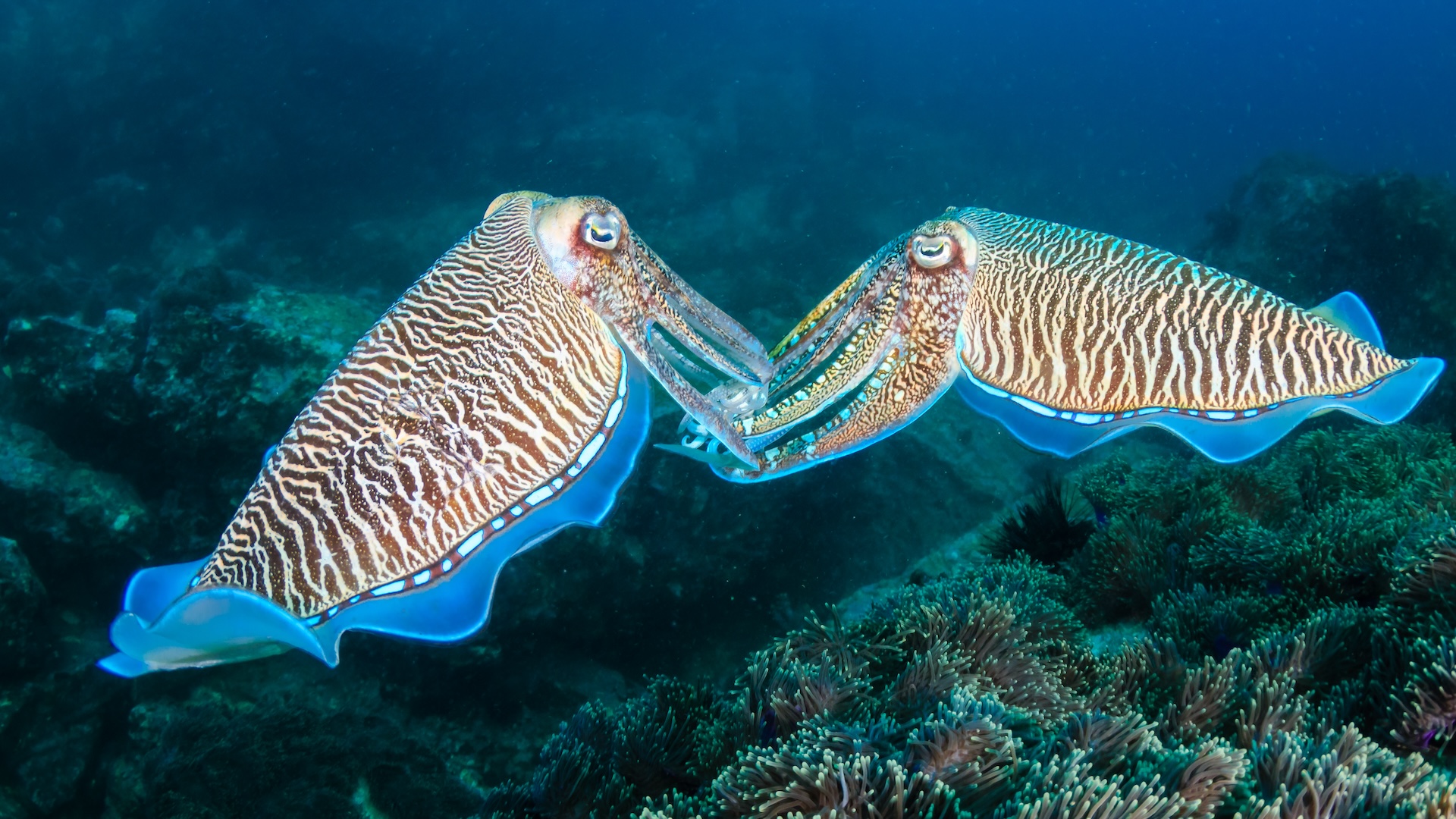
OM: In your book, you discuss male cuttlefish that change one side of their bodies to resemble a male and the other side to resemble a female. Why has this kind of behavior been difficult for scientists to accept in invertebrates?
JO: There is still some old-fashioned thinking that animals need large brains to be deceptive and devious. Some people continue to believe that only higher apes and great apes are capable of such behavior.
When researchers study deception in an invertebrate, it can be difficult to get the idea accepted. Other scientists may argue that the behavior must be something else, or that it merely looks like tactical deception. That happened with the researchers who conducted the work on cuttlefish that change one side of their bodies to look male and the other side to look female.
There was considerable resistance, seemingly because the animal was a small invertebrate and therefore was not thought capable of such cleverness. But based on the evidence and what we can observe, the behavior is not fundamentally different from what we see in large-brained mammals. So why not consider the possibility that the same thing is happening?
A great deal of this comes down to the culture and practice of science, as well as the people doing the research. Scientists are expected to be objective, but we are still humans and still animals. It takes time for ideas to change.
Balancing caution with anthropomorphism
OM: Is scientific caution itself sometimes a bias that assumes human uniqueness until animals are proven to be similar to us?
JO: Definitely. Scientific practice requires researchers to be as objective as possible, and as a general rule they should avoid anthropomorphism. At the same time, humans are animals—we are just another species of great ape. We share characteristics with many other animals, so it is not a huge leap to think that activity in our brains may sometimes resemble activity in other animal brains.
The question is when that approach is useful. Something similar happened in the study of pain in animals. Scientists were initially careful not to assume that animals experienced pain as humans do. As researchers learned more, however, it became increasingly clear that animals probably do experience pain. At that point, it became almost an ethical question: rather than continuing to reject the comparison as anthropomorphism, scientists had to acknowledge what the evidence indicated.
We will never be able to see exactly what is happening inside an animal’s brain, but that does not excuse us from recognizing what may be happening. It is possible to avoid unjustified anthropomorphism while still acknowledging similarities between humans and other animals instead of focusing exclusively on our differences.
“Do you think animals can lie?”
OM: At the end of the chapter, you say that if you buy a scientist a few drinks, they will eventually admit that animals can lie. I cannot buy you a drink over email, so I will ask directly: do you think animals can lie?
JO: Yes. I will give a straightforward yes, because I can.
Scientists need to step outside their professional mindset, in which they are trained to give the most technically correct answer possible. “Yes” is a broad answer for a scientist in professional mode, which is why it may take getting out of the laboratory and into a bar or café to get people talking in human terms again.
OM: What is your favorite example from the book, and what do you hope readers remember?
JO: I would choose the cuttlefish example, in which a male cuttlefish displays male color patterns on one side of its body and female patterns on the other to deceive other males.
It is probably my favorite because, as a young student, I worked on that species of cuttlefish. We watched all of their remarkable color-changing abilities and wondered what they were communicating and what was happening. Years later, when the research was published, it created a lightbulb moment: that was what I had been watching them do all along.
The example has a personal connection for me. I spent so much time observing these animals and being mesmerized by them without understanding what was happening. It was wonderful to see scientists work it out and answer those questions.
About James O’Hanlon
James O’Hanlon is the author of Liars, Cheats, and Copycats: Trickery and Deception in Nature. He is an award-winning science communicator who has published more than 30 academic papers. His popular science writing has appeared in ABC News Australia, Australian Geographic, The Conversation and Biosphere Magazine. He is also the author of Eight-Legged Wonders: The Surprising Lives of Spiders (2024).
This interview has been condensed and edited lightly for clarity.
Read an excerpt: Can animals lie? This sneaky bird might be proof.
Source: www.livescience.com