


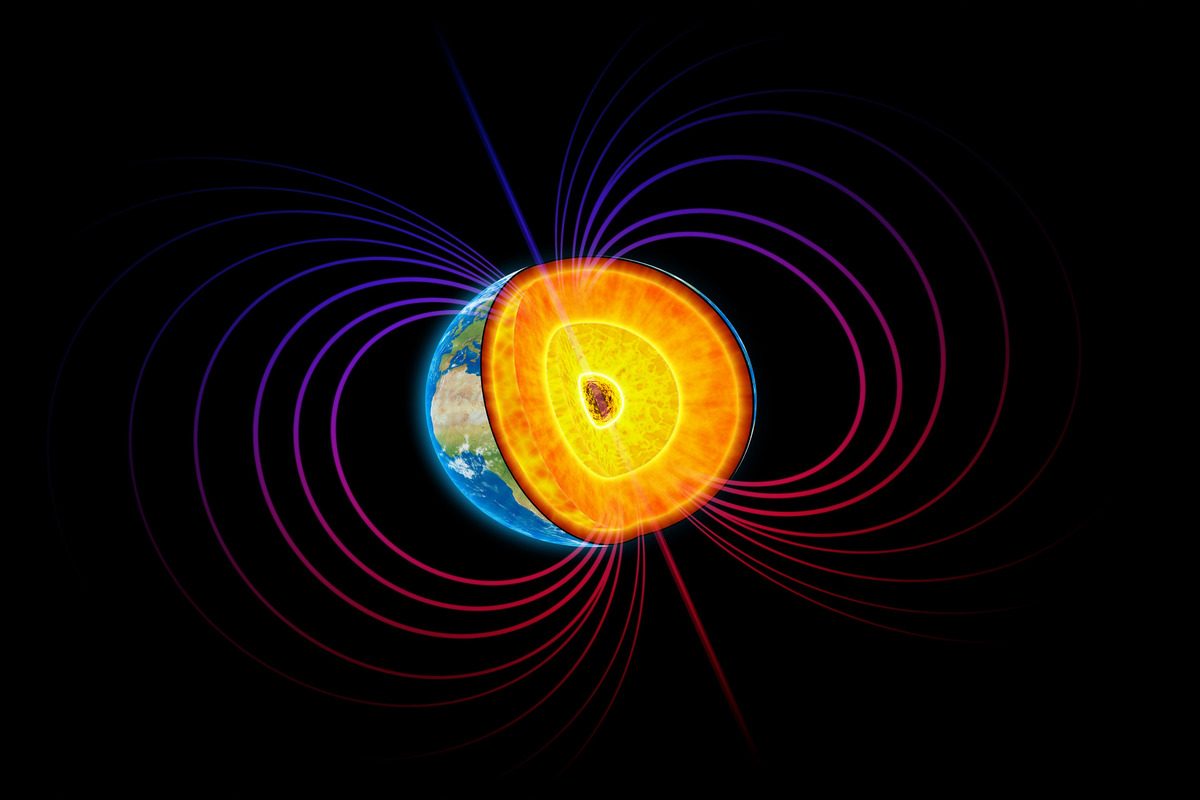
A river of molten iron, flowing 1,400 miles beneath the Pacific Ocean in Earth’s outer core, has startled scientists by changing its direction.
This remarkable observation offers new insights into the dynamics of the liquid outer core, which is essential for generating Earth’s magnetic field. Without this protective magnetic shield, our planet would face severe exposure to harmful solar radiation.
Researchers at the University of Edinburgh analyzed ground-based observations and satellite data spanning from 1997 to 2025. A study published in the Deep Earth Research Journal in 2010 revealed that a significant region of iron-rich fluid in the equatorial Pacific Ocean transitioned from weak westward migration to strong eastward migration.
Frederik Dahl Madsen, the study’s lead author, noted: “The significant flow reversal beneath the Pacific Ocean raises new questions about the behavior of Earth’s deep interior.”
“Scientists now aim to determine whether this reversal is a short-lived event, part of a repeating cycle, or a new stable equilibrium in the nuclear circulation.”
Elisabetta Iorfida, a geoscientist with the European Space Agency, emphasized that this Pacific inversion challenges the notion that the outer core operates under a stable westward flow.
“This study reveals that regional changes can develop swiftly within a span of just 10 years,” she stated. “This discovery may facilitate research into potential interactions between Earth’s outer core, inner core, and lower mantle, enhancing our understanding of the core-mantle boundary, a crucial area for deep Earth dynamics.”
Recent data from ESA indicates that the eastward flow may be weakening after its peak in recent years, suggesting that this phenomenon could be a temporary fluctuation or part of a longer natural cycle of nuclear activity.
These shifts take place deep beneath the Earth’s surface and pose no immediate threat to human life or climate. However, scientists believe these changes are vital for comprehending the Earth’s inner workings and how the outer core sustains its protective magnetic field.
The magnetic field is dynamic, gradually evolving as core flows adjust, influencing everything from navigation systems to spacecraft operations and models of near-Earth space weather.
Read more:
Source: www.sciencefocus.com