


If you’ve been keeping up with space science, you’re likely familiar with the groundbreaking news about the discovery of DNA building blocks on an asteroid. This pivotal finding underscores the significance of astrobiology and the origins of life in the universe.
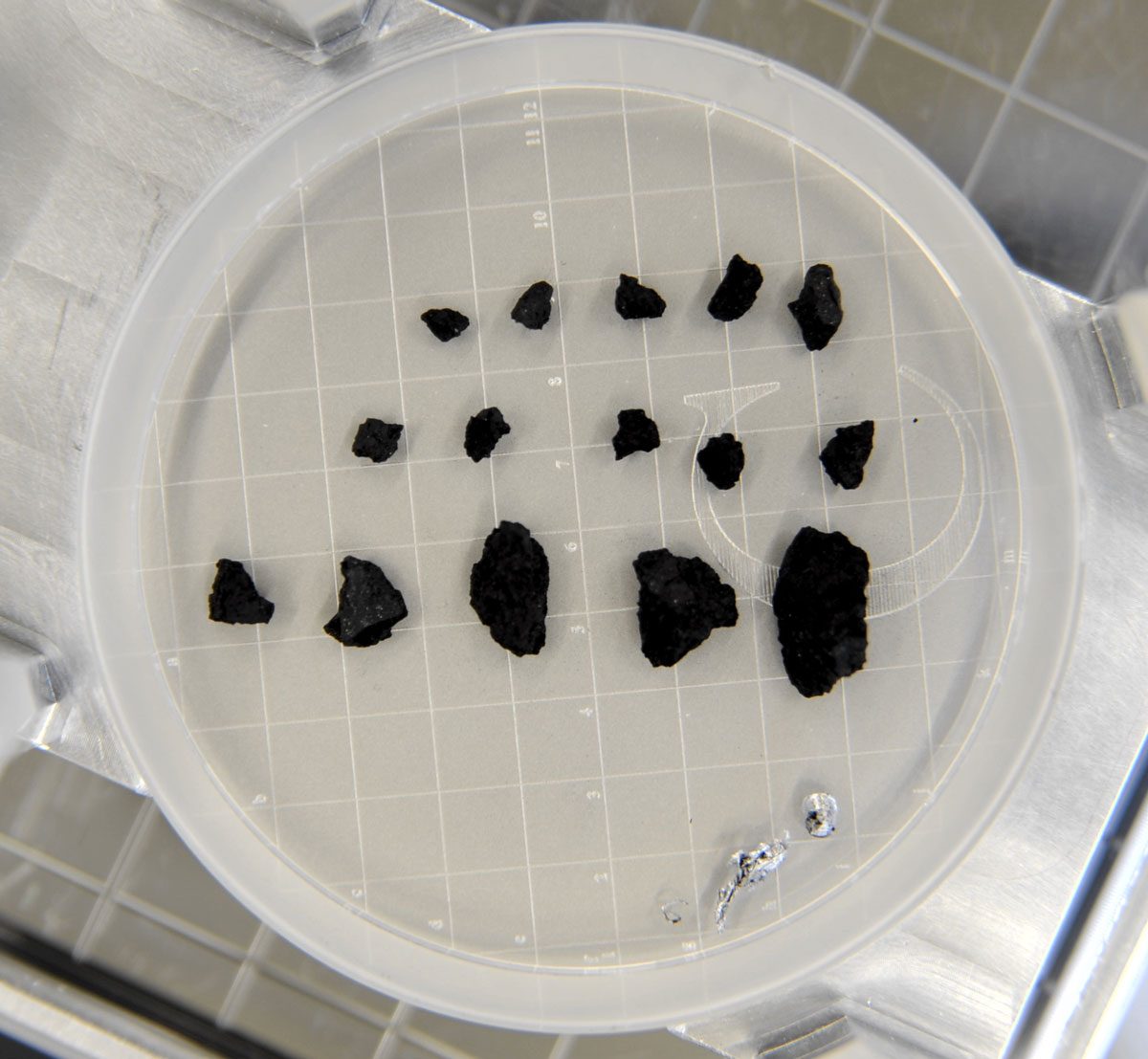
The recent discovery originates from the carbon-rich near-Earth asteroid Ryugu, which was extensively studied by JAXA’s Hayabusa2 spacecraft that returned samples to Earth in 2020.
A recent study published in Nature Astronomy confirms the presence of all five standard nucleobases—the molecular “letters” essential for encoding genetic information in DNA and RNA—within these samples.
Coupled with similar findings from asteroid Bennu and the Murchison meteorite, this discovery suggests a budding pattern of astrobiological significance rather than mere coincidences.
The Letters of Life Written in Stone
Nucleobases are nitrogenous compounds that encode genetic information. The five standard nucleobases—adenine, guanine, cytosine, thymine, and uracil—pair along the DNA and RNA backbone, providing the instructions for life as we know it. Without these molecules, genetic codes and evolution as we understand them would not exist.
While the discovery on an asteroid doesn’t imply the presence of life, it evidences that the chemistry responsible for producing life’s essential ingredients is occurring naturally throughout the universe, a phenomenon known as abiotic synthesis.
Dr. Toshiki Koga, a postdoctoral fellow at the Japan Agency for Marine-Earth Science and Technology (JAMSTEC) and lead author of the study, states, “The important point is that nucleobases formed naturally on primitive asteroids and may be widely distributed throughout the solar system.”
Notably, the identification of life’s building blocks in meteorites has historically raised concerns regarding potential contamination by Earth’s biology during their descent or after landing.
For instance, a meteorite landing in a field might encounter organic compounds from terrestrial life. How can this be prevented?
The solution lies in direct sample collection from the asteroid. Hayabusa2 collected samples in space, which were subsequently sealed and processed in a dedicated clean room under an inert gas atmosphere, ensuring minimal contamination.
“The samples were collected in space and sealed to avoid exposure to Earth’s environment,” Koga explained, noting that every step of the analytical process adhered to strict contamination controls.
NASA’s OSIRIS-REx mission followed a similar protocol with asteroid Bennu, returning samples in 2023 that also contain all five nucleobases.
Rock Ratio
What makes the new findings from Ryugu noteworthy is the exploration of what researchers found when comparing different asteroids.
The various asteroids exhibit different ratios of two classes of nucleobases: purines (adenine and guanine, which have a two-ring structure) and pyrimidines (cytosine, thymine, and uracil with a simpler single-ring structure).
Murchison is abundant in purines, while Bennu is heavily weighted towards pyrimidines. Ryugu falls somewhere in between.
As researchers sought explanations, they discovered a significant correlation between the ratio of purines to pyrimidines and the ammonia levels in each sample.
This indicates that a shared, yet environmentally sensitive formation pathway likely exists, suggesting similar chemical reactions were involved in nucleobase formation across these asteroids.
“By comparing the nucleobase compositions of Ryugu, Bennu, and the meteorite, we identified evidence for an unknown formation mechanism,” Koga stated, adding that laboratory experiments are currently underway for further investigation.
The Beginning of Life
Professor Critie Grice, a Geochemistry Professor at Curtin University not involved in the study, remarked that the accumulating evidence suggests a rethinking of the origin of life narrative.
“Life did not start from scratch on Earth,” she asserts. “The molecules necessary for life, such as nucleobases, likely formed in space and could have been delivered to Earth early on.”
This reframing alters the fundamental inquiry of origin of life research. Instead of questioning how life synthesized essential chemistry from nothingness on a young Earth, we should be asking how our planet organized its pre-existing molecular toolkit into replicable and evolving forms.
In this perspective, Earth operates more as an assembly line than a chemical lab.
The ingredients vital for nucleobase production—carbon, nitrogen, water, and radiation—are prevalent throughout the universe.
The processes occurring in molecular clouds and primitive asteroids are not unique to our solar system; they are commonplace in the formation of celestial bodies.
“The ingredients are abundant throughout the universe, and the processes we are discussing are fundamental to planetary formation,” Grice adds.
“There’s no reason to believe this chemistry is exclusive to our solar system.”
If the molecular foundations of life tend to be constructed where planets form, then the question surrounding the dispersion of life across the universe shifts from whether the ingredients exist to whether the optimal conditions for their utilization will eventually materialize.
That said, it’s crucial to specify which nucleobases are involved. They are not DNA itself, nor do they equate to life as we know it. Transitioning from nucleobases to self-replicating molecules capable of Darwinian evolution requires sugars, phosphates, water, and perhaps a substantial dose of chance.
It’s also worth noting that some molecules carried by asteroids may disintegrate upon atmospheric entry, resulting in concentrations too low to be impactful.
Nonetheless, the emerging narrative from Ryugu, Bennu, and an expanding catalog of asteroid and meteorite analyses is remarkable.
About 4.6 billion years ago, when the solar system was in its infancy, the fundamental materials for genetics were already being synthesized in rocks adrift between planets.
The ultimate question remains: how were these materials assembled, and can such processes happen elsewhere in the cosmos?
Increasingly, we can assert with confidence that there has never been a scarcity of necessary materials.
Read more:
Source: www.sciencefocus.com