


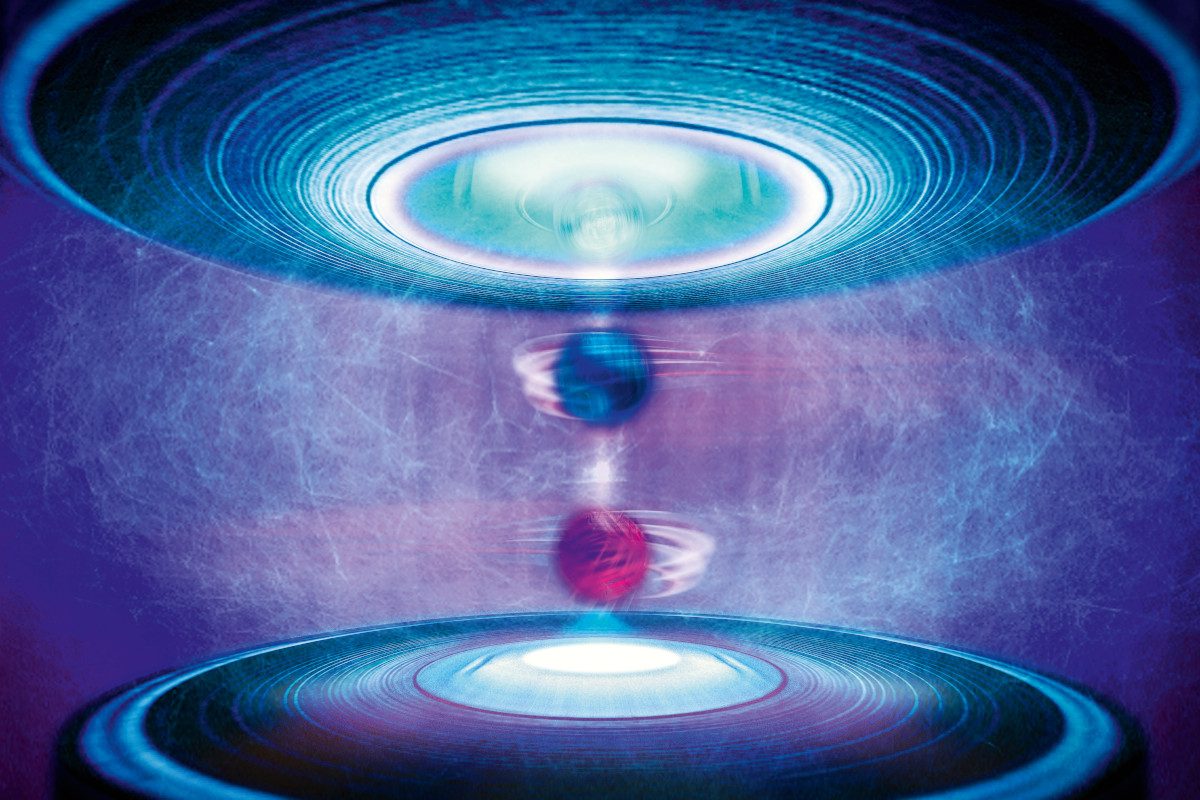
Gravity is one of the four fundamental forces that govern interactions in our universe. This vital force plays a crucial role in holding celestial bodies and structures together.
While three non-gravitational forces—electromagnetic, weak, and strong nuclear forces—are well-described through the exchange of force-carrying particles, theorists hypothesize that a similar quantum description exists for gravity.
Photons serve as the carriers of electromagnetic forces that keep atoms in the body together. The weak nuclear force within an atom’s nucleus is mediated by three force carriers: W–, W+, and Z0 bosons. The strong nuclear force comprises eight types of gluons.
The proposed particle responsible for transmitting gravity is known as the “graviton.”
Understanding the nature of gravitons is not overly complex. In quantum theory, the greater the energy needed to produce a force-carrying particle, the quicker that energy must be replenished. Consequently, heavy particles like W+ bosons are short-lived and move slowly, which explains the limited range of the weak force.
Conversely, gravity’s infinite range indicates that no energy is necessary to create a graviton; thus, its mass must be zero.
Another vital attribute of gravitons is their “spin.” In quantum mechanics, spin corresponds to spatial rotation. Quarks and leptons—the fundamental components of matter—exhibit half-integer spin (1/2). This property indicates that they do not return to their original state after a single 360-degree rotation, but rather only after a full 720-degree turn. Non-gravitational force carriers, on the other hand, possess integer spin (1) and revert to their original state after a 360-degree rotation.
However, gravitons must exhibit a unique spin of 2, as only spin-2 particles can interact with all matter—an intrinsic aspect of universal gravity. They require a 180-degree rotation to return to their original state.
It’s possible that no gravitational exchange of gravitons occurs. Yet, a majority of physicists believe that gravity can be quantized; however, traditional mathematical approaches that work for other forces fail when applied to gravity.
The most promising framework to address this challenge is string theory, which proposes that fundamental particles aren’t point-like but rather different vibrations of a mass-energy string.
One of string theory’s attractions is the idea that a vibrating string can replicate graviton properties. Nevertheless, significant challenges exist within this theory, including the assumption that strings are smaller than atoms—making them undetectable—and the requirement for strings to vibrate in ten dimensions, six of which aren’t perceptible to us.
Moreover, the complex mathematics of string theory currently provides no testable predictions.
Read more:
Challenges in Detection
Just because a quantum theory of gravity remains elusive does not imply that gravitons are non-existent. For instance, light waves consist of photons that travel in groups. Analogously, it’s believed that gravitational waves—ripples in spacetime first detected in 2015 from black hole mergers—are made up of gravitons.
While light sources can be dimmed until sensitive detectors pick up individual photons, detecting single gravitons poses a formidable challenge. This difficulty arises because gravity is substantially weaker—over ten trillion billion billion times—than electromagnetic forces. In the framework of quantum theory, lower interaction rates equate to infrequent matter encounters.
Gravitons are elusive because they rarely interact with atoms. For context, consider neutrinos, which are produced by nuclear reactions in the sun, with about 1 trillion neutrinos passing through the human body every second without interaction. Gravitons, in turn, interact with matter even less frequently—by a trillion-fold compared to neutrinos.
By leveraging high-mass detectors and positioning numerous neutrinos along the path, scientists could improve the odds of stopping neutrinos with particles. This might also work for detecting gravitons, albeit with detectors exhibiting phenomenally weak interactions with matter, leading most neutrino detection systems to be relatively compact.
The largest neutrino detector is the IceCube Observatory located in Antarctica, spanning 1 cubic kilometer of ice. However, to have any hope of detecting gravitons, the detector would need to possess a mass comparable to Jupiter, an arrangement that risks collapsing into a brown dwarf due to gravitational forces.
In 2006, Tony Rothman from Princeton University and Stephen Bourne from Haverford College discussed the potential use of a Jupiter-mass detector. Their analysis suggested that the strongest graviton source, Hawking radiation from evaporating black holes, could yield about 1% of its particles as gravitons. However, this radiation is minimal for stellar-mass black holes while being more significant for smaller ones.
The most promising graviton source might be a hypothetical mini-black hole formed under extreme conditions during the Big Bang and still existing today.
With the assumption that the mass of mini-black holes could rival the mass of stars in the Milky Way, and considering their average distance from Earth to the galaxy’s center, Rothman and Bourne calculated it would take a Jupiter-mass detector longer than the age of the universe to detect even a single graviton.
A Step Forward
This hypothetical detector aims to identify electrons ejected from atoms by gravitons, analogous to the photoelectric effect, where photons displace electrons. A significant challenge lies in differentiating these electrons from those produced by neutrinos.
To achieve this differentiation, an impractically thick shielding layer—several light years deep—around the detector would be necessary. Rothman states, “I believe that no one in this universe will detect gravitons. Perhaps we should perceive them as metaphysical rather than physical entities.”
Despite these difficulties, recent advances have sparked optimism about the potential to experimentally investigate gravitons. Previously, researchers successfully created a liquid model of a black hole to search for potential Hawking radiation within it. Recently, a team of scientists led by Professor Jiehui Liang from Nanjing University, China, proclaimed they found a fractional quantum Hall effect analogue of spin-2 particles in liquids.

Within this ultracold system, confined in two dimensions by a strong magnetic field, electrons exhibit collective behavior akin to a flock of starlings. Notably, this phenomenon displays properties of a spin-2 particle.
While this is not an authentic graviton, it does pave the way for deeper insights into these elusive particles. Such understanding could lead physicists closer to overcoming current barriers in their quest for a unified quantum theory of gravity that integrates all fundamental forces.
Read more:
Source: www.sciencefocus.com