


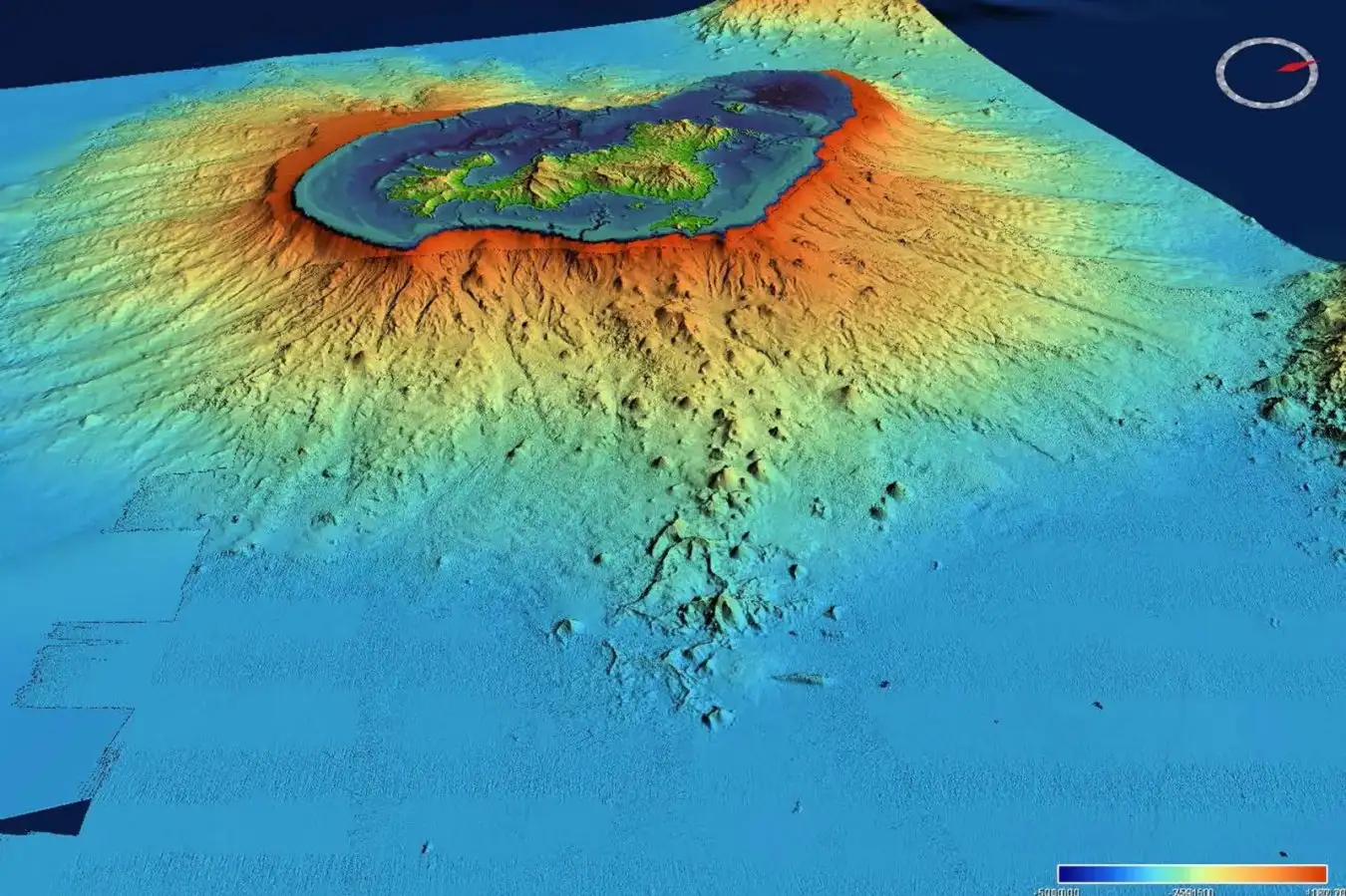

Undersea Relief Detected off Mayotte Coast in 2019, Featuring the Newly Discovered Volcano Fani Maoré.
Photo Credit: Campagne MAYOBS2
Recent studies reveal that undersea volcanoes near Madagascar are releasing chemical remnants from the original magma ocean dating back to Earth’s early history, approximately 4.5 billion years ago.
Researchers generally propose that Earth’s mantle—a hot rock layer beneath the crust—has been in motion for over four billion years, gradually obscuring evidence of the planet’s primordial history.
“The new findings will significantly impact earth science. Evidence showing that materials dating back 4.5 billion years are still present and can be accessed through volcanic eruptions is groundbreaking,” states Catherine Chauvel from the French National Center for Scientific Research (CNRS) in Paris.
According to scientists, during the Hadean era, a Mars-sized object collided with Earth, resulting in debris that formed the Moon. This cataclysmic event heated the early planet, enveloping it in a global magma ocean, which cooled over millions of years, leading to the formation of the planet’s crust.
While there were suspicions about the existence of primordial remnants in Earth’s mantle, the analytical tools required to confirm this were not available until now, explains Chauvel.
In May 2018, an unusual earthquake swarm near France’s Mayotte island revealed a new volcano named Fani Maore, situated about 50 kilometers eastward. The subsequent eruptions released significant magma, causing a noticeable sinking of the island by approximately 20 centimeters over three years.
Chauvel and her team collected volcanic rock samples from both Fani Maore and nearby Mayotte Island to assess the chemical differences with older volcanic systems. Collaborating with Claudine Israel, they are employing advanced ultra-high precision techniques at the University of Cambridge to investigate minute neodymium isotope variations. These isotopes are vital for understanding the chemical history of Earth’s primordial magma ocean as the planet cooled.
The study found that the lava from Fani Maore contained a higher percentage of neodymium-142 and neodymium-144 compared to that from Mayotte, indicating the presence of ancient mantle pockets that have avoided extensive mixing and remain rich in bridgmanite— a mineral thought to have crystallized from the primordial magma ocean.
“Finding what you’ve been searching for is always thrilling, especially when it’s something that hasn’t been reported before,” shares Chauvel.
This discovery implies that the Earth’s mantle has not blended as thoroughly as many geologists have assumed, which may assist in reconstructing how the primordial magma ocean solidified, according to Israel.
“For the first time, we experimentally demonstrate how the mantle crystallizes from a magma ocean and how this crystallization leads to chemical diversity from the outset,” she remarks.
Tim Johnson from Curtin University, Perth, Australia, notes that the findings provide credible evidence for the presence of ancient materials within Earth’s mantle. “This is an exciting development,” he states.
“Achieving such technological advancements is challenging, but they have truly excelled,” adds Bernard Bourdon from the CNRS in Lyon.
The study offers an unprecedented window into a chapter of Earth’s history that has scarce direct evidence remaining, Bourdon adds. “It’s akin to uncovering a sample of Earth’s core that somehow made its way to the surface,” he explains.
For Richard Carlson from Carnegie Science in Washington, D.C., the accuracy of these findings is impressive. “Anyone familiar with these measurements will recognize this as a remarkable achievement,” he concludes.
Topics:
Source: www.newscientist.com