


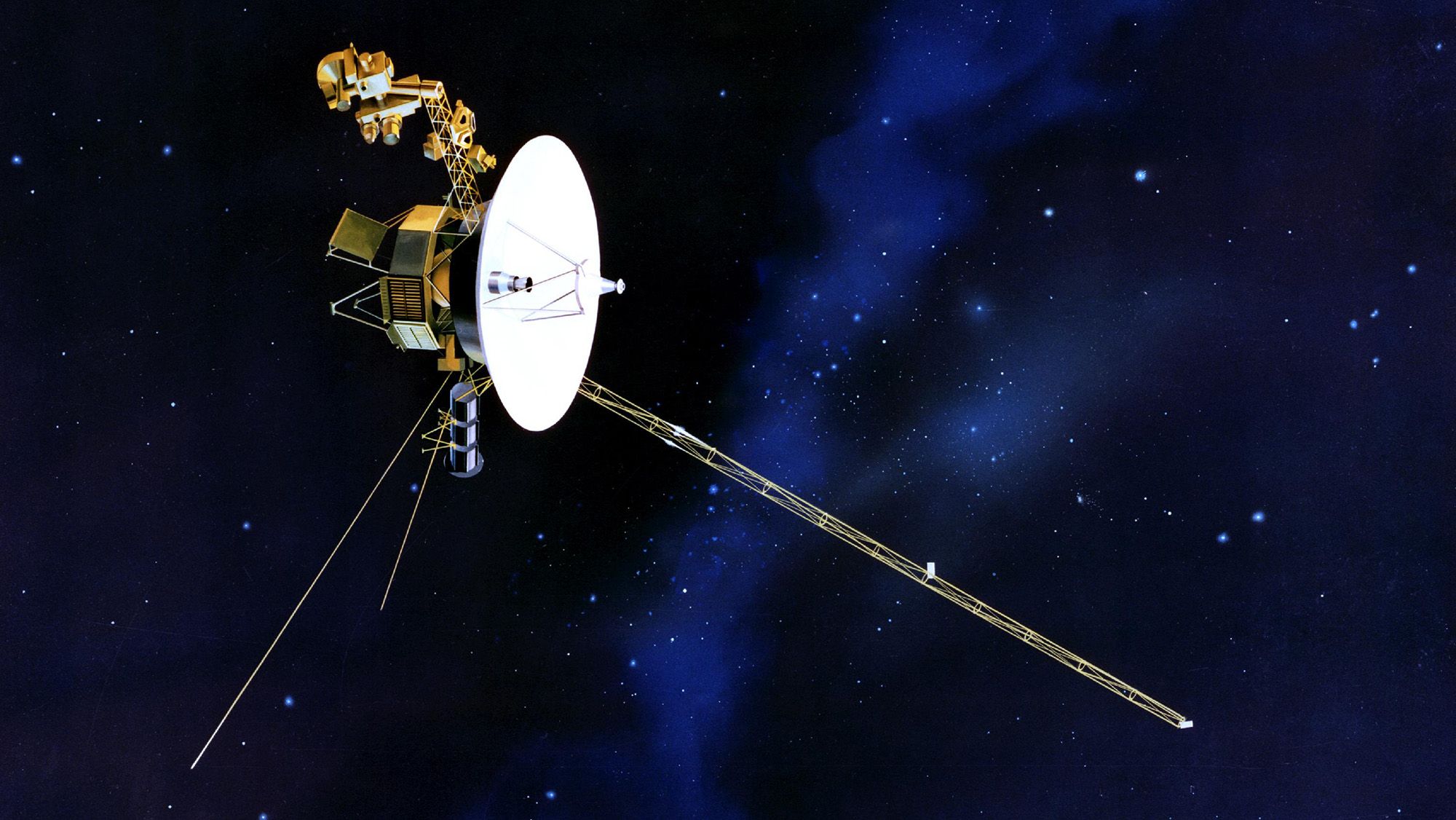
NASA has confirmed that Voyager 1 has reached a record-breaking distance of one light-day from Earth, about 16.1 billion miles (25.9 billion kilometers) away. The milestone comes as engineers work to restore the nearly 50-year-old spacecraft’s scientific data transmissions after a new communications problem was detected on November 14.
Voyager 1 stopped transmitting scientific data to Earth, although it continued sending a “carrier” signal. That signal confirmed that the spacecraft remained powered and was still pointing in the correct direction. According to NASA, the mission team had not resolved the problem as of Thursday, November 19.
Voyager 1 reaches one light-day from Earth
NASA announced on Wednesday, November 18, that Voyager 1 had reached the one-light-day milestone. At that distance, a radio signal traveling at the speed of light takes about 24 hours to reach the spacecraft, and another 24 hours to return to Earth.
No human-made object has ever traveled farther from Earth. Voyager 2, the spacecraft’s twin, is expected to reach a distance of one light-day in 2035.
Mission teams use carrier signals to confirm that a spacecraft is operating and oriented correctly, even when it is not transmitting usable science data. The carrier signal from Voyager 1 indicated that the probe was still functioning despite the loss of scientific information.
Diagnosing problems across interstellar space
The spacecraft’s extreme distance and aging hardware make troubleshooting exceptionally difficult, Suzanne Dodd, Voyager’s project manager, explained. A command sent from Earth can take a day to reach Voyager 1, and engineers must wait another day to learn whether it worked.
“It takes two days to diagnose something on a spacecraft, so you can’t do anything quickly and the data rate is very low,” Dodd said. “We’re in an area where we’re going to see more anomalies on Voyager because of its distance and age.”
In a NASA press conference, Dodd described the situation as “unusual” and said it was one the team had never seen before. On Thursday, she added that she was “confident” scientific data would begin flowing again soon.
More distance, more problems
NASA said the latest glitch was likely caused by Voyager 1’s onboard computer. The computer gathers information from the spacecraft’s scientific instruments and converts it into a format that can be transmitted to Earth.
The team encountered a similar problem in November 2023, when Voyager 1 could no longer send usable scientific data. Engineers resolved that issue in June 2024. NASA said the mission team is addressing the new problem using the same approach it used to solve earlier faults.
“We’re in an area where we’re going to see more anomalies on Voyager because of its distance and age,” Dodd said.
Keeping Voyager 1 operating
If the repair succeeds, Voyager 1 will continue transmitting data from interstellar space. Two scientific instruments remain active: a magnetometer, which measures the magnetic field, and a plasma-wave detector, which measures charged particles in the interstellar medium.
To conserve power, the mission team shut down some equipment earlier this year while activating other, more efficient systems. The operation, known as “Big Bang,” is intended to keep the spacecraft operating until at least 2027.
Voyager 1 will eventually run out of energy and stop communicating with Earth. The spacecraft will then continue drifting through interstellar space, carrying its golden record, which contains images, music and information about life on Earth.
In the meantime, Voyager 1 will continue studying the interstellar medium—the space between stars that has been visited by only Voyager 1 and Voyager 2.
Voyager 1 officially entered interstellar space in 2012, after transforming scientists’ understanding of Jupiter, Saturn and other objects in the solar system.
Source: www.livescience.com