


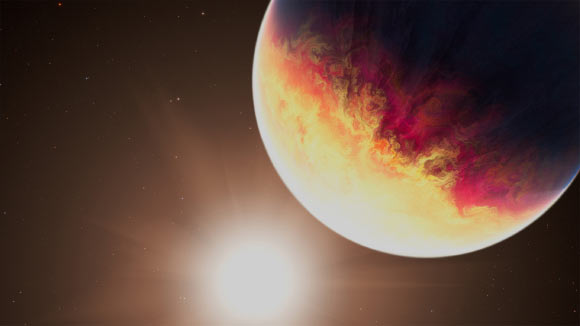
HD 80606b boasts one of the most extreme orbits among known exoplanets, recently captured in a stunning flash by NASA/ESA/CSA’s James Webb Space Telescope as it navigated close to its star.
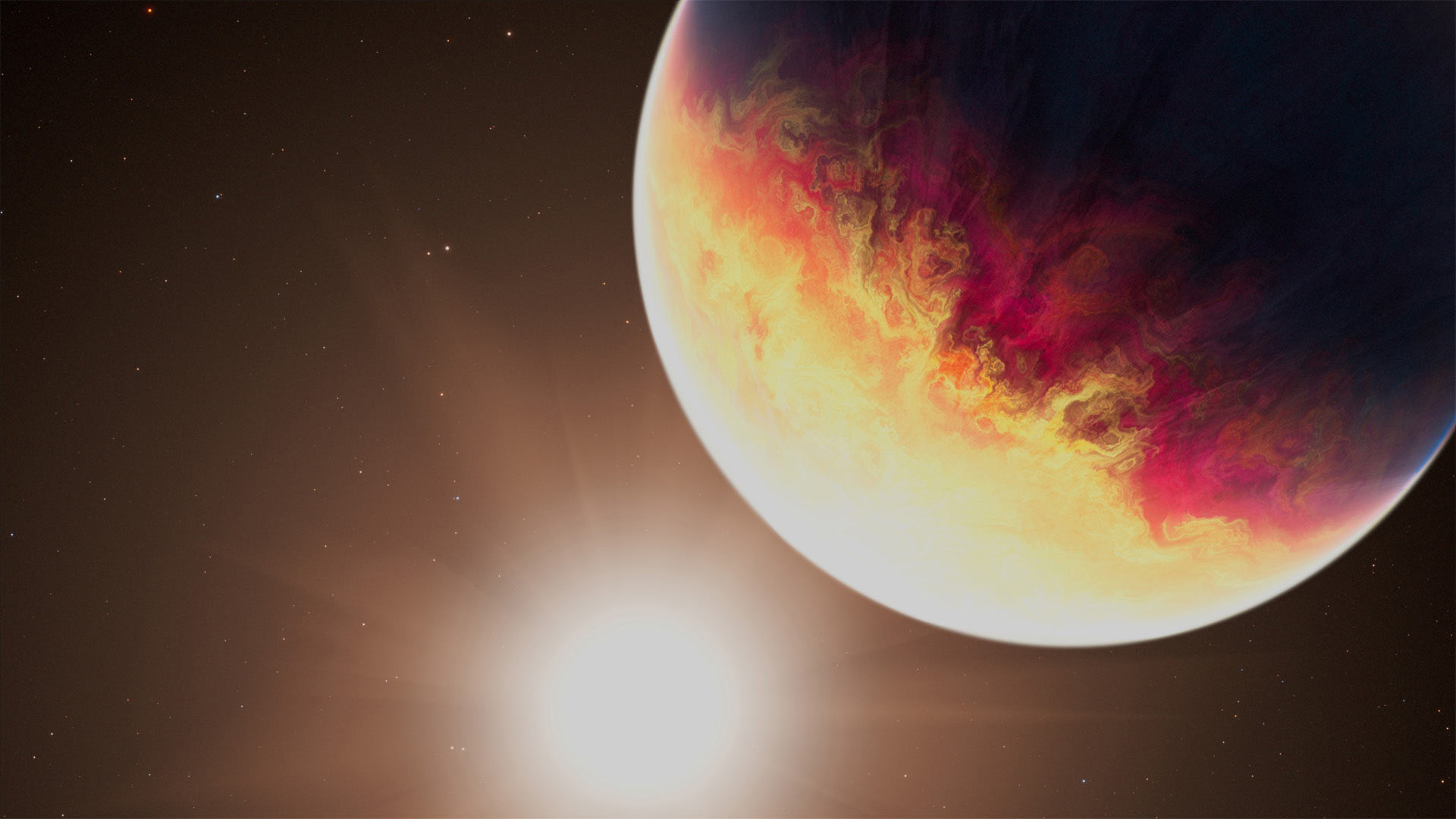
Artist’s impression of the hot Jupiter exoplanet HD 80606b. Image credit: NASA/ESA/CSA/Joseph Olmsted, STScI.
Discovered in April 2001, HD 80606b is an exoplanet with a highly eccentric orbit, weighing in at roughly four times the mass of Jupiter.
This distant world is situated around 217 light-years away in the constellation Ursa Major.
Classified as a hot Jupiter, it completes an orbit around its host star, HD 80606, every 111 days.
“Hot Jupiters are renowned for being some of the most extreme exoplanets in existence, and HD 80606b represents one of the most extreme among this category,” stated Dr. Tiffany Kataria, an astronomer at NASA’s Jet Propulsion Laboratory.
“While we typically envision hot Jupiters as gas giants closely orbiting their stars, this planet’s eccentric orbit presents a unique situation,” Dr. Kataria elaborated.
As HD 80606b approaches its star, its temperature surges by an astonishing 1,100 degrees Fahrenheit.
Previous studies indicate that such rapid temperature changes can instigate chemical reactions and alterations in the exoplanet’s cloud structures in real time.
The dynamic environment of HD 80606b makes it a prime subject for observation using Webb’s advanced instruments, according to astronomers.
“Studying planets like HD 80606b is highly efficient because their unique orbits lead to significant temperature and chemical shifts, allowing us to gather valuable data in just a few hours under varying conditions, which can be applied to other hot Jupiters and typical exoplanets,” explained Dr. Laura Mayorga, an astronomer at Johns Hopkins University Applied Physics Laboratory.
The research team utilized Webb’s MIRI (Mid-Infrared Instrument) to observe HD 80606b during its orbital phases: before, during, and after it reached its closest approach to the star.
During this Periastron event, the planet also passed behind its star from Webb’s viewpoint, a phenomenon known as a secondary solar eclipse.
“Dr. Webb’s findings illustrate that global warming on HD 80606b is even more pronounced than previously determined using Spitzer’s data,” Dr. Kataria remarked.
Scientists will present their findings on June 16th at the 248th American Astronomical Society (AAS) General Meeting in Pasadena, California.
_____
Tiffany Kataria and others. 2026. Flash Heating of Burnt Planets: Time-Resolved Characterization of HD 80606b Using JWST/MIRI. AAS248 Abstract #426
Source: www.sci.news