


Explore the SETI Institute’s Allen Telescope Array, a sophisticated 42-element radio interferometer located at the Hat Creek Radio Astronomy Observatory in California. Astronomers used 3I/ATLAS to search for artificial radio transmissions, but only detected human-made interference.
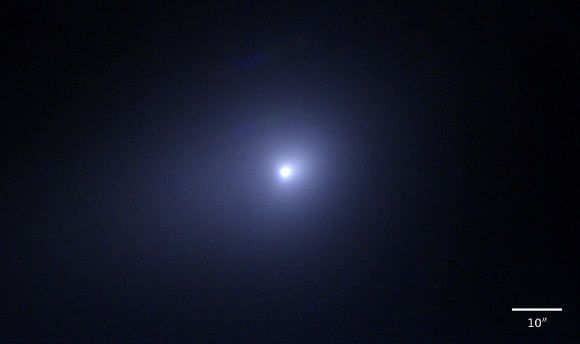
This image from the Subaru Telescope showcases the interstellar comet 3I/ATLAS. Image credit: National Astronomical Observatory of Japan
3I/ATLAS is recognized as the third confirmed interstellar object to enter our solar system, following 1I/’Oumuamua and 2I/Borisov.
While evidence suggests that 3I/ATLAS is a natural object, it also serves as a promising target for technosignature searches, as man-made objects could provide the earliest indications of extraterrestrial life.
“On July 1, 2025, the interstellar object, initially designated as C/2025 N1 (ATLAS) and now popularly known as 3I/ATLAS, was discovered by the Asteroid-Earth Impact Final Alert System (ATLAS) in Rio Hurtado, Chile,” said SETI Institute astronomer Dr. Sofia Sheikh and her team.
“Numerous telescopes worldwide are tracking the orbit of 3I/ATLAS, revealing notable cometary activity during these observations.”
“If it is indeed a comet, as anticipated based on initial findings, it should be rich in volatiles and develop a prominent tail now that it has passed perihelion.”
“Early observations indicated the object appeared red and exhibited a coma due to its luminescence as it approached the Sun.”
“Although it reached perihelion on October 29, 2025, observations from Earth were significantly hindered from September to early November due to its close proximity to the Sun.”
“There remains a wealth of information to glean about this interstellar object, making continued observation during its approach a scientific advantage.”
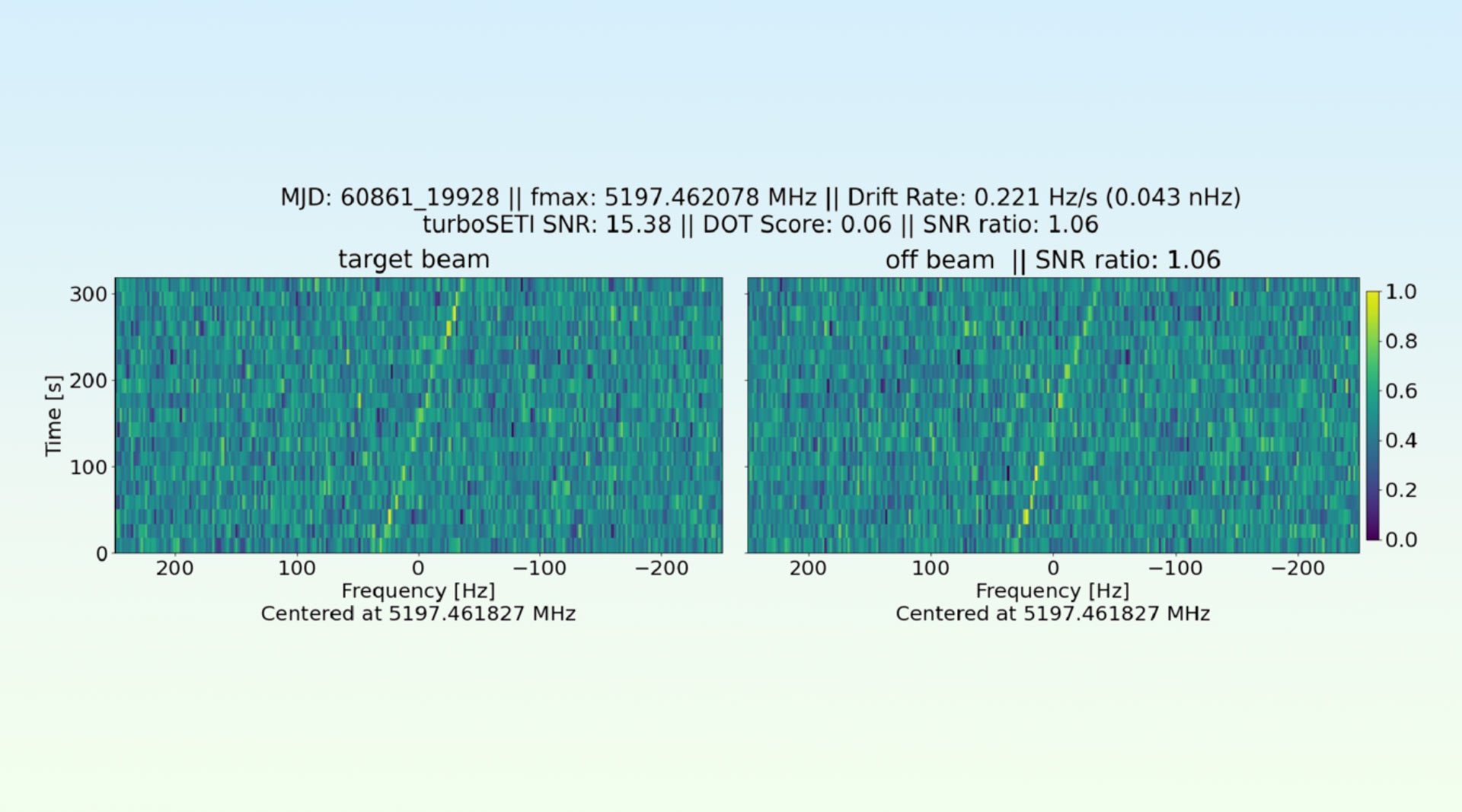
Output waterfall plot from a 3I/ATLAS observation showing 0 signals above the SNR ratio threshold. The signal seems narrowband and may indicate local interference. Image credit: Sheikh et al., doi: 10.3847/1538-3881/ae6651.
During this observational campaign, astronomers monitored 3I/ATLAS for more than seven hours using the Allen Telescope Array, spanning frequencies from 1 to 9 GHz.
They detected approximately 74 million narrowband signals; however, after filtering out human interference and matching object motions, only about 200 signals warranted further review.
The findings highlight that detected signals are likely attributable to terrestrial technology or satellites.
Although no definitive technosignatures were identified, this study reinforces the notion that 3I/ATLAS is a natural phenomenon.
Additionally, this observation provides constraints on the potential power of radio transmissions emanating from or near 3I/ATLAS, revealing signals weaker than approximately 10 to 110 W—equivalent to that of household appliances—across the detected frequencies.
“The 3I/ATLAS results exemplify the potential for detecting signals with current technology,” stated Dr. Valeria García López, an astronomer at Furman University and director of the Breakthrough Listening Initiative.
“This emphasizes the importance of continuing our search for technosignatures, even in objects where signals may not be anticipated.”
The team’s research will be featured in Astronomy Magazine.
_____
Sophia Z. Sheikh et al. 2026. Retrieval of radiotechnical signatures from interstellar object 3I/ATLAS using the Allen Telescope Array. A.J. 172, 1; doi: 10.3847/1538-3881/ae6651
Source: www.sci.news