


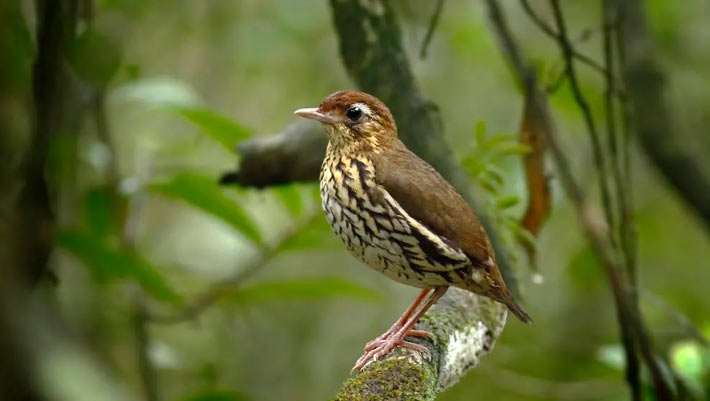
New Species of Antthrush Discovered in an Isolated Highland Rainforest in Northeastern Brazil
A previously unrecognized species of antthrush (Chamaeza) has been identified in an isolated highland rainforest in northeastern Brazil.
“Antthrushes in the genus Chamaeza are terrestrial forest birds specialized for life in the understory of Neotropical forests,” said ornithologist Wagner Cavalcanti of Paulista University and his colleagues.
These secretive birds inhabit forest floors from lowland habitats to mid-elevation mountains. They primarily forage for arthropods in leaf litter and among fallen branches and decaying logs.
Although antthrushes may follow army-ant swarms, this behavior is less common than in other ant-following birds. Their cryptic plumage provides effective camouflage in leaf litter, and the species generally show no obvious sexual dimorphism.
Antthrushes typically nest in natural cavities in decaying logs and rely on biparental care from hatching through fledging. They are solitary foragers with limited dispersal abilities, reflecting their close association with stable, mature forest interiors.
The genus Chamaeza includes six species distributed across the forested regions of South America.
In a new study, the researchers found that populations of the Short-tailed Antthrush (Chamaeza campanisona) in Brazil’s Baturité Mountains are sufficiently distinct to be recognized as a separate species: Chamaeza baturitensis, commonly known as the Baturité Antthrush.
Chamaeza campanisona has traditionally been divided into 12 subspecies and has a broad but fragmented distribution across northern and central South America, the scientists explained.
To investigate the birds’ diversity, the researchers analyzed 183 audio recordings representing two Chamaeza campanisona subspecies from across the Atlantic Forest region. They combined traditional acoustic analysis with machine-learning tools.
The results revealed three distinct song patterns among eastern South American populations. Birds from the Baturité Mountains produced faster and longer songs than their southern relatives, with no overlap in song tempo between the groups.
The team also examined 134 museum specimens representing two Chamaeza campanisona subspecies, along with an additional 80 specimens documented through photographs.
The researchers found that the newly recognized species lacks the small black spot on the bill that is present in southern populations. It also shows differences in the throat and upper breast coloration.
“Morphologically, Chamaeza baturitensis is similar to Chamaeza campanisona. However, it differs by lacking the species’ characteristic black frontal spot and yellowish lores,” the researchers said.
Chamaeza baturitensis is currently known from only two locations within a rainforest enclave covering fewer than 100 km2.
These isolated forests are considered “sky islands.” They formed during ancient climate shifts, when Atlantic Forest habitat expanded into the region and later retreated. The remaining cool, humid mountain forests now provide a refuge for species that are absent from the surrounding landscape.
“This species is restricted to the Baturité Mountains, a highland rainforest complex locally known as the Brejos de Altitude,” the scientists said. “The area is surrounded by seasonally dry caatinga in northeastern Brazil, north of the São Francisco River, including the municipalities of Guaramiranga and Pacoti in Ceará State.”
The authors warn that Chamaeza baturitensis may face threats from poaching, while its official conservation status has not yet been assessed.
“Until now, it had not been recognized as a distinct lineage, so Chamaeza baturitensis is not included in current national or global threat assessments,” the researchers said.
“Nevertheless, given its estimated range of less than 100 km2 and its apparent dependence on well-preserved forest understory, this species should currently be treated as Data Deficient until population surveys allow its conservation status to be assessed more accurately.”
The discovery of Chamaeza baturitensis is reported in a paper published in the journal zoo.
_____
Lucas Romero et al. 2026. Uncovering puzzling diversity: vocal and morphological evidence for a new species of Chamaeza (Aves: Formicariidae). zoo 43: e25083; doi: 10.1590/S1984-4689.v43.e25083
Source: www.sci.news