


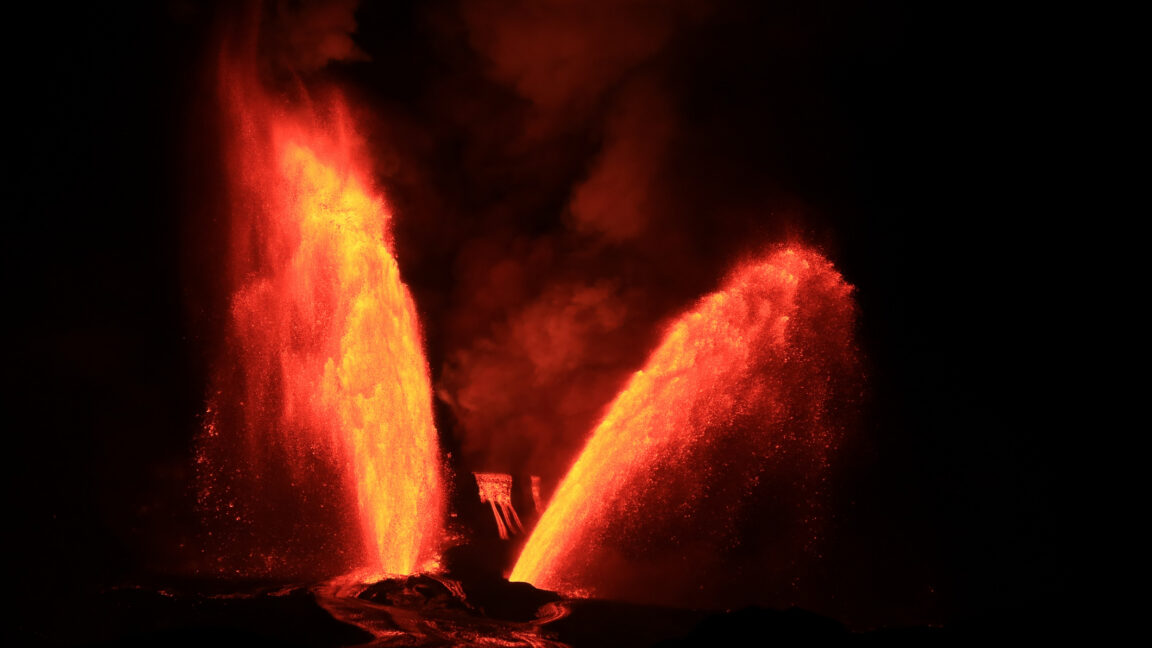
What Makes Kilauea’s Lava Fountains So Powerful?
Volcanic activity from hotspots is usually relatively calm. Lava often flows slowly down a mountainside, giving people enough time to move out of the way. But at volcanoes including Mount Etna, Kilauea in Hawaii, and Iceland’s active volcanic areas, lava can erupt in dramatic fountains hundreds of meters high.
Scientists still do not fully understand what gives these lava fountains their power. A series of recent eruptions at Kilauea, however, has produced some of the most detailed records ever collected of spewing lava. In a recent issue of Science, researchers from the U.S. Geological Survey documented the activity and compared it with leading ideas about how lava fountains form.
Kilauea’s Recent Eruptive Activity
Dramatic videos of red-hot lava erupting from Earth are frequently captured in three active volcanic areas known for fountain activity. Despite being Hawaii’s newest and most active volcano, Kilauea has erupted only three times since 1823. Those eruptions have enabled intensive research and improved scientists’ understanding of the volcano’s internal structure.
Previous research identified lava debris within a few kilometers of the surface. Kilauea also has 35 separate data-collection stations, including seismic, very-low-frequency, geodetic, gas, visual, and thermal-camera instruments.
How Kilauea’s Underground Reservoirs Changed
One of Kilauea’s underground lava reservoirs had been partially drained, while signs indicated that it was gradually being refilled. Beginning in 2019, however, the backfilling accelerated. Local peaks expanded by more than 22 centimeters per year before the rate doubled to 57 centimeters per year in 2023 and spread into the nearby caldera.
These detailed observations are helping researchers compare real-world lava-fountain behavior with models of the underground processes that may drive the spectacular eruptions.
Read more about the major 2018 eruption.
Source: arstechnica.com