


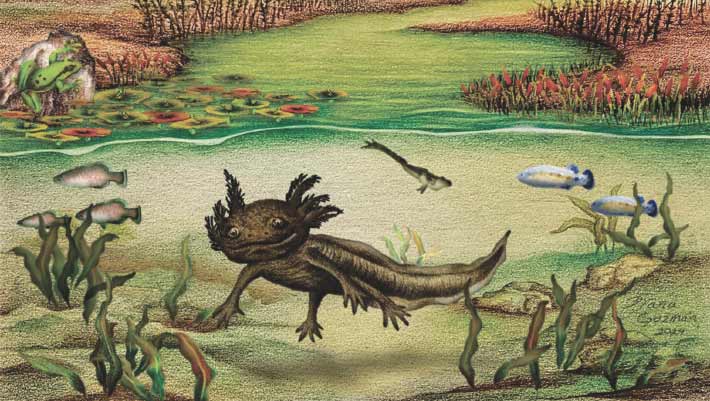
Paleontologists have identified a new species of axolotl, Ambystoma, from multiple fossil specimens unearthed within a rocky outcrop in Hidalgo, Mexico. This newly named species, Ambystoma quetzalcoatli, is closely related to living species found in the central Trans-Mexican volcanic belt, encompassing modern volcanic formations, including the Mexican axolotl (Mexican Ambystoma) and various lake species.
Ambystoma quetzalcoatli, Palaeocaracodon guzmanae, and various terrestrial and aquatic plants. Image credit: Diana Guzmanán-Madrid.” width=”580″ height=”368″ srcset=”https://cdn.sci.news/images/2026/06/image_14811_1-Ambystoma-quetzalcoatli.jpg 580w, https://cdn.sci.news/images/2026/06/image_14811_1-Ambystoma-quetzalcoatli-300×190.jpg 300w, https://cdn.sci.news/images/2026/06/image_14811_1-Ambystoma-quetzalcoatli-80×50.jpg 80w” sizes=”(max-width: 580px) 100vw, 580px”/>
A reconstruction of the late Pliocene paleolake Santa Maria Amajac, revealing its rich paleobiodiversity, including Ambystoma quetzalcoatli, Palaeocaracodon guzmanae, and various flora. Image credit: Diana Guzmanán-Madrid.
Ambystoma quetzalcoatli thrived approximately 4.2 million years ago during the late Pliocene, residing in an ancient mountain lake in what is now the Santa Maria-Amajac region of Hidalgo state.
This captivating species marks the oldest known record of the Ambystoma genus in Mexico.
“Ambystoma is a genus of salamanders endemic to North America, first named in 1838,” stated paleontologists Jorge Herrera Flores and María Patricia Velasco de Leon from the Autonomous University of Mexico.
“This genus is distinguished among modern salamanders by its unique developmental biology, with certain species manifesting neoteny, retaining larval characteristics into adulthood.”
“The geographical distribution of living Ambystoma species spans from southern Canada to much of the United States and the Mexican plateau.”
“The Ambystoma genus comprises 38 extant species, with 18 of them being native to Mexico and 17 endemic to the country.”
“The fossil record of Ambystoma is relatively well-documented, especially in the United States, where fossils are frequently found. For instance, the Tiger salamander (Ambystoma tigrinum) is common, alongside multiple extinct species.”
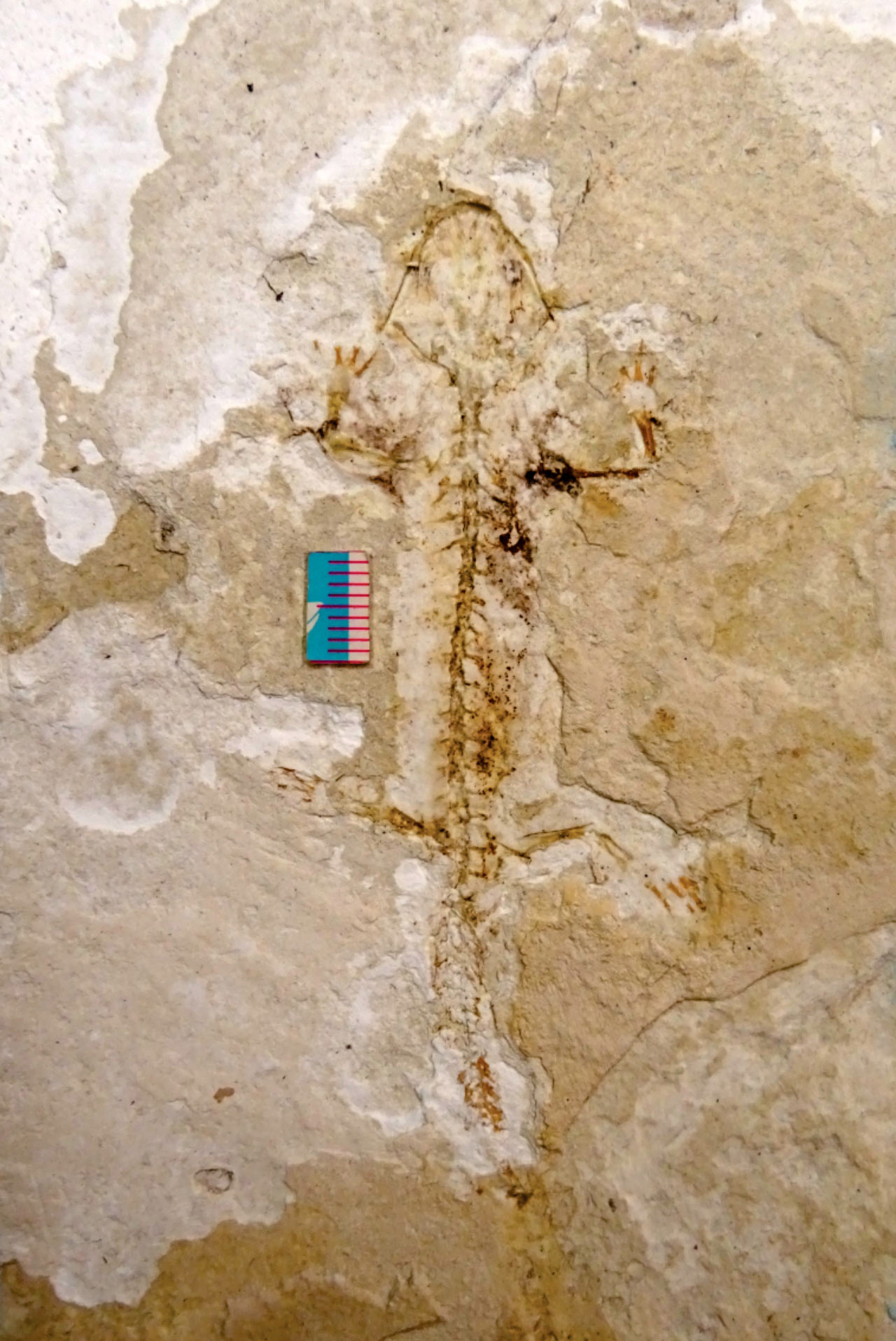 The subadult skeleton of Ambystoma quetzalcoatli. Image credit: Jorge A. Herrera-Flores & María Patricia Velasco-de León, doi: 10.26879/1644.
In their detailed study, researchers examined various salamander fossil specimens collected in the early 2000s from the Sanctorum Fossil Site in Santa Maria Amajac.
Upon comparison with several Mexican relatives, they confirmed this material as a new Ambystoma species.
This groundbreaking species exhibited a unique combination of skeletal characteristics not found in living relatives.
The first unique feature is the distinctive V-shaped opening located on the anterior surface of the premaxilla.
The second feature is a persistent gap on the top of the skull throughout various developmental stages, a trait indicative of pedomorphism, where juvenile characteristics are retained into adulthood.
Lastly, the third characteristic is an unusually shaped parasphenoid bone at the skull base.
“We identified three critical morphological aspects that validate the classification of Ambystoma quetzalcoatli as a distinct species,” said the scientists.
The discovery of Ambystoma quetzalcoatli also enhances our understanding of the ancient biodiversity within the Amajac Lake ecosystem.
This area has previously yielded several fossil species unique to this locale, including extinct oaks, beetles, diatoms, and goodaid fish.
The researchers suggest that the geographic isolation provided by surrounding mountain ranges may have aided in the evolution of these unique species.
“The fossil description of this new ambystomatid species underscores the high diversity and morphological variance within the group, particularly across the evolutionary history of Mexican species,” they concluded.
“Moreover, the Santa María Amajac region is vital for understanding Mexico’s modern megadiverse fauna, heightening the potential for further discoveries.”
The team’s study was published in May 2026 in the online journal Old Trogia Electronica.
_____
Jorge A. Herrera Flores and Maria Patricia Velasco de Leon. 2026. Ambystoma quetzalcoatli, a newly discovered species of axolotl fossil (Caudata: Ambystomatidae) from the Pliocene era in Santa Maria Amajac, Hidalgo, Mexico. Old Trogia Electronica 29 (2): a19; doi: 10.26879/1644.
Source: www.sci.news