


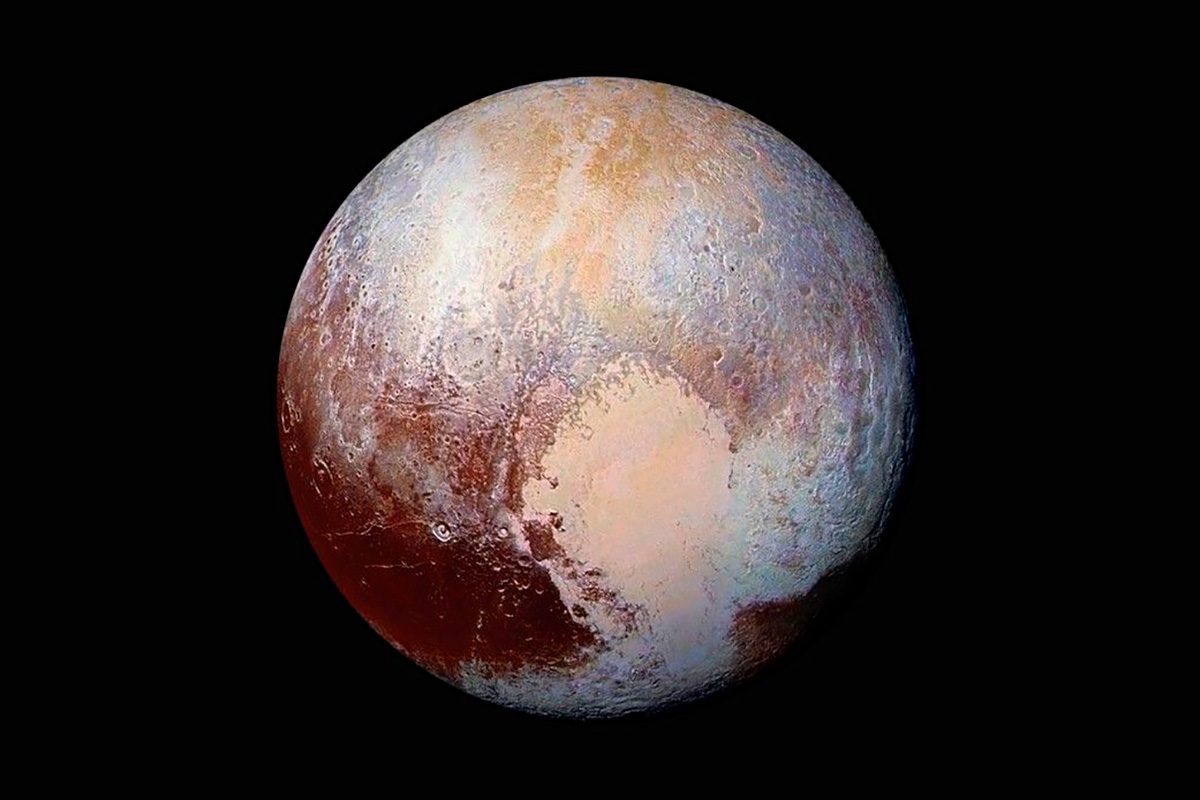
Pluto’s status in the solar system is once again a topic of heated debate, fueled by recent comments from NASA Administrator Jared Isaacman during a Congressional hearing.
“I fully support the movement to reinstate Pluto as a planet,” he stated, highlighting a growing push among some planetary scientists to overturn Pluto’s controversial reclassification.
Since the International Astronomical Union (IAU) voted to strip Pluto of its planetary designation in 2006, many scientists and members of the public have advocated for its reconsideration.
The justification is straightforward: Pluto is spherical and showcases complex geological features like mountains, glaciers, and a tenuous atmosphere. To many, it embodies what we associate with a planet rather than a mere collection of space rocks.
Despite Isaacman’s endorsement, numerous astronomers remain hesitant, cautioning that reinstating Pluto’s planetary status could lead to a cascade of reclassifications within our solar system.
If Pluto is reinstated as a planet, then numerous other celestial bodies—including potentially our own Moon—might warrant the same status.
The Divided Planet Debate
The dilemma regarding Pluto’s classification dates back to the early 2000s. The advancement of telescopes and exploration of the outer solar system led to the discovery of numerous icy bodies beyond Neptune, many of which bore striking similarities to Pluto. For instance, Eris, discovered in 2005, is estimated to be roughly one-third the mass of Pluto.
This raised a crucial question for astronomers: if Pluto is considered a planet, then shouldn’t Eris be classified the same way? Where would the line be drawn if that were the case?
This question prompted the IAU to clarify the definition of a planet. On August 24, 2006, the organization established that a celestial body must:
- Orbit the Sun
- Have sufficient mass for its gravity to make it round
- Clear its orbital neighborhood
Pluto’s failure to meet the final criterion resulted in its demotion to “dwarf planet” status—an issue that has sparked debate among planetary experts for nearly two decades.
The challenge lies in the fact that to “clear the neighborhood,” a planet must exert gravitational dominance sufficient to dislodge other significant space rocks from their orbits.
Yet, the farther a body is from the Sun, the larger its orbit becomes, creating a larger area to clear. Thus, in the far reaches of the solar system, a planet would require significantly more mass to meet this criterion.
This has led critics to argue that the definition unfairly disadvantages Pluto.
“By the IAU’s definition, Earth is a planet in its current orbit, but position it outside the solar system, and it loses that designation, which seems illogical,” said Dr. Alan Stern, a leading planetary scientist at the Southwest Research Institute.
“The classification changes entirely based on location,” he added.
Dr. Stern is not alone in his opinion. Just five days after the new definition was announced, more than 300 planetary scientists signed a petition protesting this decision, an impressive number considering that only 411 individuals had voted on the definition.
This controversy has not faded over time. A 2018 paper revealed that twelve years later, many planetary scientists still disregard this definition.
Additionally, a 2024 study identified a fundamental flaw in the first criterion, which states that a planet must orbit the Sun, thereby excluding exoplanets orbiting other stars.
“There is no official definition of an exoplanet according to any recognized scientific body,” stated Dr. Hannah Wakeford, an astrophysicist at the University of Bristol.
“The IAU definition is inadequate for categorizing celestial bodies outside our solar system. For example, applying this definition to the Proxima system—which has three stars in mutual orbit—could absurdly classify the stars themselves as planets.”
Proposing a New World Order
What could be a possible solution? Instead of focusing on where a celestial body resides, Dr. Stern and other planetary scientists argue that the definition of a planet should concentrate on what a body is.
“It’s quite simple,” Stern explained. “A planet is a space object that is a) large enough to be rounded by its own gravity, and b) not massive enough to undergo nuclear fusion—those are classified as stars. That’s the bottom line.”
This definition would not only reinstate Pluto as a planet but also classify Eris, the very object that contributed to Pluto’s demotion. It would encompass numerous dwarf planets discovered over the last two decades, including Haumea, Makemake, Sedna, and Ceres—the sole dwarf planet located in the inner solar system.
Under Stern’s definition, it turns out there could be over 100 planets within our solar system, including Earth’s contested Moon. After all, it is round under its own gravity, geologically rich, and boasts six times the mass of Pluto.
“It’s astonishing to realize how many planets we have discovered in our solar system and beyond,” Stern remarked. “The belief that there were only a handful of planets is a quaint, outdated notion from the 19th and 20th centuries.”

However, many believe this unrestricted approach could lead to chaos. Mike Brown, known for leading the team that discovered Eris and several other dwarf planets, has branded himself “the man who killed Pluto.” He concerns that such a broad definition undermines the significance of what it means to be a planet.
“Classification is one of the foundational steps in science to understanding phenomena,” Brown notes. “If we categorize incorrectly, we risk asking the wrong questions.”
Instead of embracing a chance to delve into the diversity of our solar system, Brown views the push for a new definition as an attempt to “reinstate Pluto as a planet.” He asserts that this discussion never arose until after Pluto’s demotion.
In the United States, there are particularly strong sentiments regarding Pluto’s demotion. After all, Pluto was discovered in 1930 by American astronomer Clyde Tombaugh. During his Congressional speech, Isaacman expressed his desire to “ensure that Clyde Tombaugh receives the credit he rightfully deserves once more.”
Isaacman’s advocacy to reinstate Pluto as a planet parallels political sentiments, suggesting that emotions surrounding this issue are as much about politics as they are science.
While the support of NASA’s administrator undoubtedly carries weight in this discourse, the fate of Pluto doesn’t rely solely on Isaacman or Stern. The IAU is an independent international entity, showing no clear intent to revisit this issue.
Ultimately, whether Pluto is classified as a planet may hold less significance than it seems. That demotion hasn’t diminished Pluto’s presence in scientific study and popular culture. It even lends its name to a whole subclass of celestial objects—referring to those dwarf planets that orbit beyond Neptune.
“In my view, Pluto has ascended to the title of ‘king of dwarf planets.’ It exemplifies its category and showcases intriguing features; but does that status hold greater value than being deemed a mediocre planet?” Wakeford reflects.
Read More:
Source: www.sciencefocus.com