


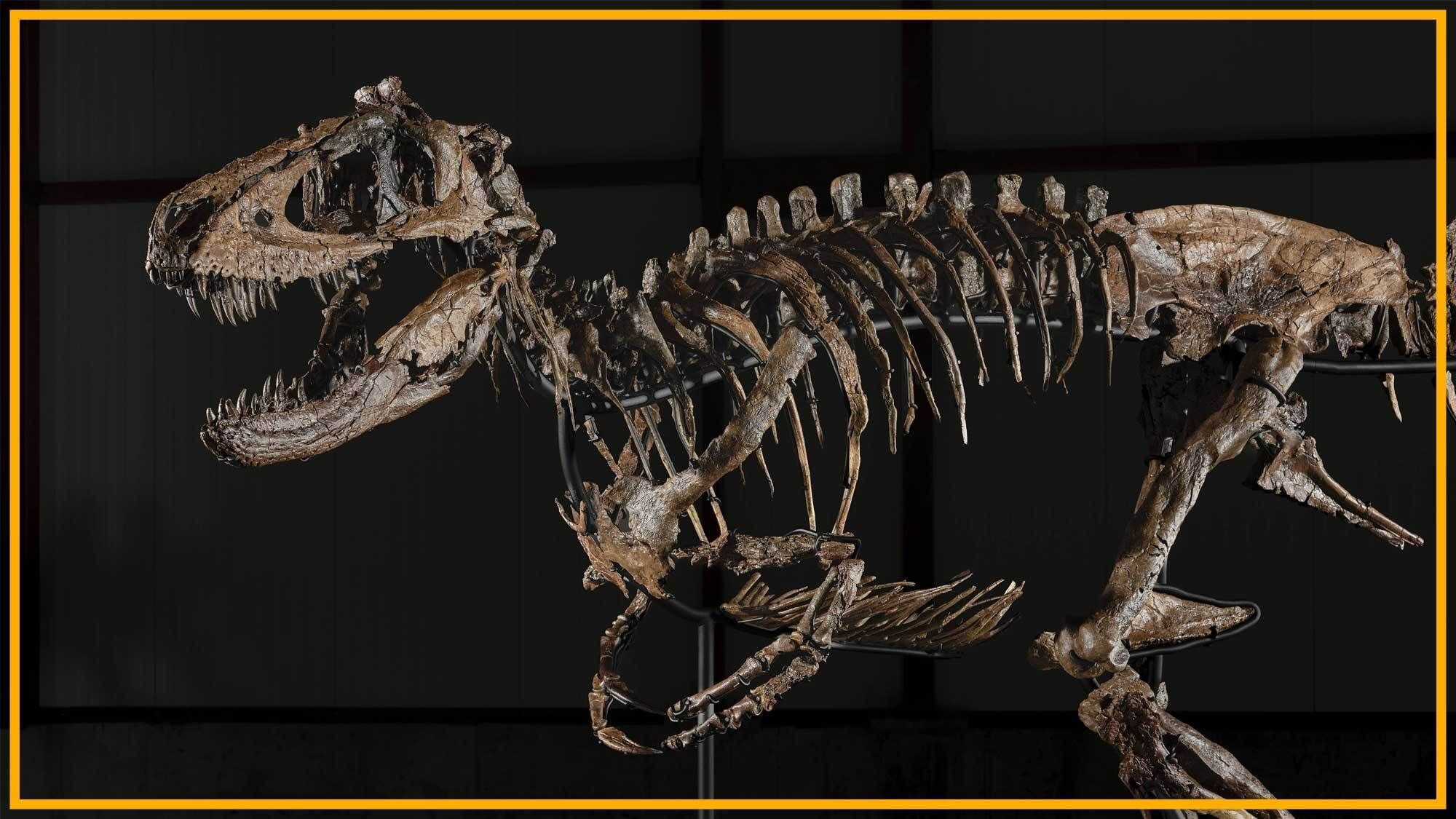
The sale of a 19.6-foot (6-meter) Nanotyrannus lansensis skeleton known as “Jody” for $47,255,000 at Sotheby’s has renewed concerns about the private ownership of scientifically important fossils. Although the auction price was far above the $6 million to $9 million estimate, the specimen’s greatest value lies not in its commercial appeal but in the scientific evidence it may contain—and whether researchers and the public will be able to access it in the future.
Dinosaurs are not merely luxury objects with hefty price tags. They are irreplaceable records of Earth’s history and our own scientific journey. When important fossils become private commodities, the evidence that makes them valuable can become inaccessible.
Jody’s sale highlights a long-running scientific debate
On October 27, Sotheby’s sold “Jody,” a 19.6-foot (6-meter) skeleton identified as Nanotyrannus lansensis, in New York. The fossil brought $47,255,000, well above the auction house’s estimate of $6 million to $9 million. The buyer and seller have not been identified.
The sale followed a series of multimillion-dollar dinosaur auctions, including the $50.1 million sale of a Tyrannosaurus rex in July and the $44.6 million sale of the Stegosaurus known as “Apex” in 2024.
Sotheby’s listed Jody as a mounted Nanotyrannus skeleton. But the fossil’s identity is part of a debate that paleontologists have pursued for nearly half a century: Was Nanotyrannus a distinct dinosaur, or was it simply a juvenile Tyrannosaurus?
That question illustrates why access to physical fossils matters. Dinosaur bones can reveal how animals grew, moved, fed and lived. They can preserve evidence of injury and disease, help scientists reconstruct ancient ecosystems, and provide clues about the “laws of life” that researchers are still working to understand.
A fossil discovered in 2006 helped shift the debate. Found in Montana alongside other fossils, including a Triceratops, the remains became known as the “Dueling Dinosaurs.” It took an appeal to the state Supreme Court in 2020 before the fossils could be fully studied by the Museum of Natural Sciences.
That research offered a powerful new perspective and argued that Nanotyrannus lansensis was a distinct dinosaur species that once lived in the American West. Fossils such as the Dueling Dinosaurs, Apex and Gus belong in public collections, where they can contribute to science and remain accessible to future generations.
“Reproducibility cannot be guaranteed and science cannot advance if access is dependent on the permission of private owners. A specimen may be available today, but may not be available tomorrow.”
The interpretation of Nanotyrannus is based on a limited number of specimens held in public collections. A specimen such as Jody could support that hypothesis or challenge it. Without access to the fossil, however, researchers and the public may remain uncertain about its true identity.
Digital scans cannot replace the original fossil
Scientific progress depends on researchers being able to compare specimens, test hypotheses and reconsider earlier conclusions. A fossil that is privately held might be available for study today but inaccessible tomorrow if it is sold, inherited or withdrawn from a research agreement. For scientific evidence to remain useful, access must be permanent.
Three-dimensional scans and digital models are valuable tools. Researchers use them to measure bones, compare anatomy, share information and educate the public. But digital models capture only some aspects of a fossil.
To understand dinosaur growth, scientists examine the internal microstructure of fossilized bones using a technique called osteohistology. Other researchers analyze fossil chemistry to investigate diet, migration patterns and metabolism. These studies require physical samples, not just images of a bone’s surface.
Researchers also need contextual information, including details about surrounding sediments, preservation patterns and ancient environments. That information can be lost when fossils are excavated and prepared for sale as quickly as possible.
Future researchers may develop techniques that do not yet exist or ask questions that scientists have not yet considered. Scans made today cannot guarantee that those researchers will have the physical evidence needed for tomorrow’s discoveries. Digital access should complement the preservation of original specimens, not justify their loss.
Private ownership cannot guarantee lasting access
Some private collectors support research and education financially, and some donate the specimens they purchase. Those contributions can be valuable. But the central question is not whether private owners are generous; it is whether access can be guaranteed over the long term.
Loaned fossils can be withdrawn, sold or inherited by someone with different priorities. That situation is becoming increasingly common in the United States and abroad, including in France. By contrast, fossils held by responsible public research institutions can be documented, managed, studied and made available to researchers and educators in perpetuity.
The issue is not whether people can admire dinosaurs. It is whether the evidence that helps us understand them remains available to everyone.
Museums also should not treat scientifically important fossils as ordinary assets to sell when budgets are tight. Selling an irreplaceable specimen may provide a one-time payment, but it sacrifices future scientific potential. Museums need sustainable funding for collection management, research and education—not pressure to dispose of the resources they are meant to preserve.
Jody’s future remains uncertain
Although the sale of Jody is complete, the fossil’s long-term future is unclear. Because the buyer’s identity is private, the public does not know what arrangements, if any, will ensure continued access for researchers and educators.
The new owner could make Jody available for scientific research and public education, ideally through permanent placement at a public research institution. But hope is not a substitute for assurance.
There are better ways to support paleontology. Enthusiasts can fund fieldwork and research, support curatorial positions, strengthen museum collections and donate important fossils to public institutions so that everyone can learn from them.
Dinosaurs inspire wonder because they connect us with a world very different from our own. Their significance, however, extends far beyond their ability to fascinate us. They are part of our shared natural heritage and an irreplaceable record of Earth’s history.
A dinosaur’s value should be measured not by the price it brings at auction, but by the knowledge it helps scientists build and the opportunity to preserve that knowledge for future generations. Earth’s history belongs to all of us, not just the highest bidder.
Lindsay Zanno is a vertebrate paleontologist, National Geographic Explorer and director of paleontology at the North Carolina Museum of Natural Sciences, where she leads research and public engagement efforts, including the award-winning Dueling Dinosaur Experience. She is also an associate research professor at North Carolina State University, president of the Jurassic Foundation and chair of the Ethics Committee of the Society of Vertebrate Paleontology. Her work champions transparency, inclusivity and public access to science.
Source: www.livescience.com