


Hubble Finds Chemical Clues to a Possible Second-Generation Planet Around a White Dwarf
A long-overlooked observation in NASA’s Hubble Space Telescope Data Archive has revealed unusual chemical clues suggesting that the white dwarf star HS 0209+0832 may host a second-generation planet.
In a study published in Nature Astronomy, researchers report that the star’s atmosphere contains an unexpected abundance of niobium. The finding could indicate that a planet formed from material expelled when the star reached the end of its life.
What is a second-generation planet?
A white dwarf is the dense remnant of a low-mass star that has exhausted its nuclear fuel and shed its outer layers of gas and dust into space. Unlike Earth and the other planets in our solar system, which formed from material left over from the birth of the Sun, second-generation planets may form from material ejected after a star dies.
“Rather than the white dwarf phase being a kind of epilogue to the story of stars and their planets, this study shows that the star systems we know so well are just the first chapter of a potentially much longer story with some new characters. That’s a very exciting prospect to pursue,” said Jamie Williams, an astronomer, first author and PhD candidate at the University of Warwick in the UK.
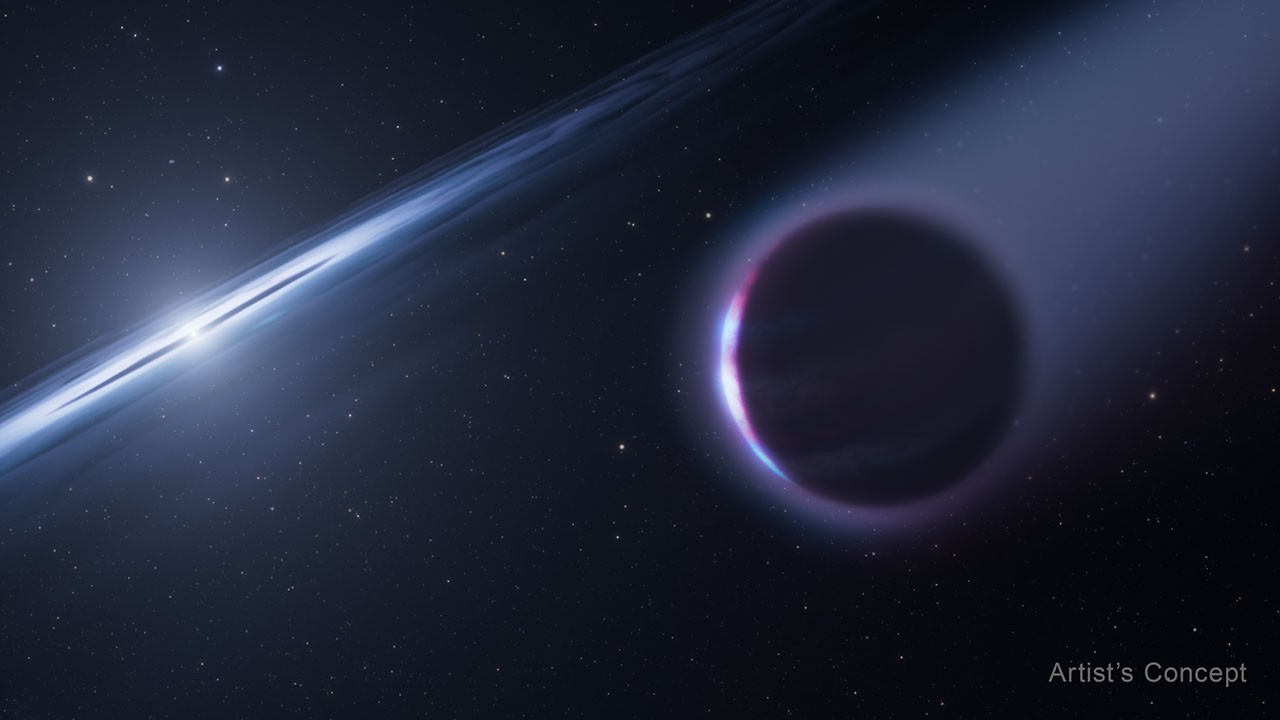
The artist’s concept, not to scale, imagines a Sun-like star evolving into an aging red giant star, which then forms a small, bright white dwarf surrounded by an ejected outer disk. A second generation of planets may form from that material.
Illustrations: NASA, ESA, Leah Hastak (STScI)
Hubble detected an unusual abundance of niobium
“What Hubble is showing us in this white dwarf system is something we’ve never seen before: the abundance of the element niobium, a feature I wasn’t familiar with when I first found it in archival data,” Williams said.
When Hubble observed HS 0209+0832 in 1999, its data contained about 100 chemical signatures that researchers could not identify. Williams revisited the archival observations using information from the latest chemical database and found that niobium matched many of the unexplained features.
Niobium occurs in the solar system and has applications on Earth, including in jewelry and medical imaging devices. However, the amount detected in the HS 0209+0832 system suggests that the material associated with the possible planet was expelled as the star died, rather than left over from the star’s birth.
“Niobium and other elements heavier than iron are astronomically special because, unlike many common elements, they do not form in the centers of stars through thermonuclear fusion,” said Nicholas Stone, a theoretical astrophysicist at the University of Wisconsin–Madison and a member of the research team.
“Instead, these heavy elements can only be synthesized under unusual conditions, where they appear temporarily inside a dying star. The presence of niobium is a signpost to the throes of these ‘deaths’ and the ejection of the dying star’s interior into space.”
How the possible planet may have formed
The researchers theorize that some of the chemically concentrated material ejected by the dying star eventually came together to form a gas giant planet. Although most of the stellar ejecta has since dispersed, the planet may have survived.
“When Jamie asked me about niobium in relation to this study, I was really taken aback, because that element had not been reported in any other white dwarf stars analyzed so far. Once I realized it was there, everything fell into place,” said Boris Gaensicke, an astronomer and study co-author at the University of Warwick.
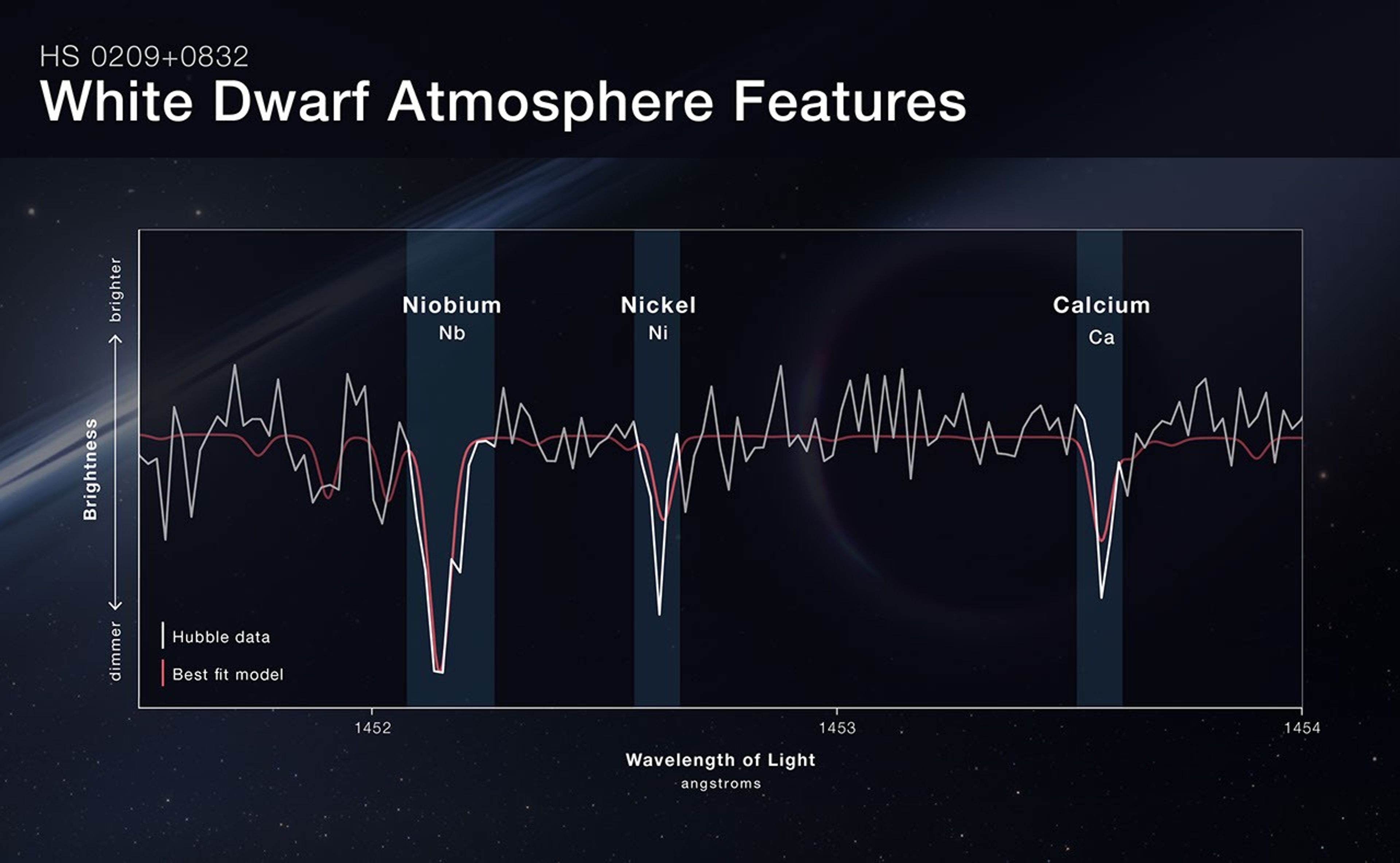
Spectra from NASA’s Hubble Space Telescope show unusual abundances of elements in the HS 0209+0832 system. The dips indicate where niobium, nickel and calcium absorbed light before it reached Hubble.
Illustrations: NASA, ESA, Leah Hastak (STScI)
A Jupiter-sized planet with a comet-like tail
The research team confirmed Hubble’s observations with data from NASA’s retired Far Ultraviolet Spectroscopic Explorer, or FUSE, mission. Those observations also showed strong niobium signatures in the HS 0209+0832 system.
NASA’s Transiting Exoplanet Survey Satellite, or TESS, observed the white dwarf for four months. The spacecraft detected periodic changes in brightness that indicate a planet may orbit about 3.7 million miles, or 6 million kilometers, from the star—much closer than Mercury orbits the Sun.
Researchers estimate that the candidate planet is a gas giant roughly the size of Jupiter and is rapidly losing its atmosphere. Because the white dwarf is relatively young and still extremely hot, its energy may be stripping material from the planet’s outer layers.
That escaping material could create a comet-like tail. Some of it may form a disk around the white dwarf before falling back onto the star’s surface, potentially explaining how Hubble detected niobium in the system.
Despite its atmospheric loss, Williams said the planet is unlikely to be a temporary feature.
“If there’s a second-generation planet out there, I think it’s likely to survive. Eventually the white dwarf will cool down and maintain a constant temperature, and the planet will remain in a stable habitable zone for millions of years,” Williams said.
More research is needed
The candidate planet has not yet been definitively confirmed. Researchers still need to determine how second-generation planets form, how common they are and how they evolve while orbiting white dwarfs.
Williams hopes to use Hubble to study similar systems over the next few years and build a larger set of observations about these unusual planetary objects.
“I think this study is an important example of the fact that scientific discovery is not a straight path,” Gaensicke said. “It often takes a magical moment when people talk about the big questions in their hearts and realize that together they can find unexpected answers.”
The Hubble Space Telescope has been in operation for more than 30 years and continues to make groundbreaking discoveries that shape our fundamental understanding of the universe. Hubble is an international cooperation project between NASA and ESA, the European Space Agency. NASA’s Goddard Space Flight Center in Greenbelt, Maryland, manages telescope and mission operations. Lockheed Martin Space also supports mission operations at Goddard. The Space Telescope Science Institute in Baltimore, operated by the Association of Universities for Research in Astronomy, conducts Hubble science operations for NASA.
Source: science.nasa.gov