


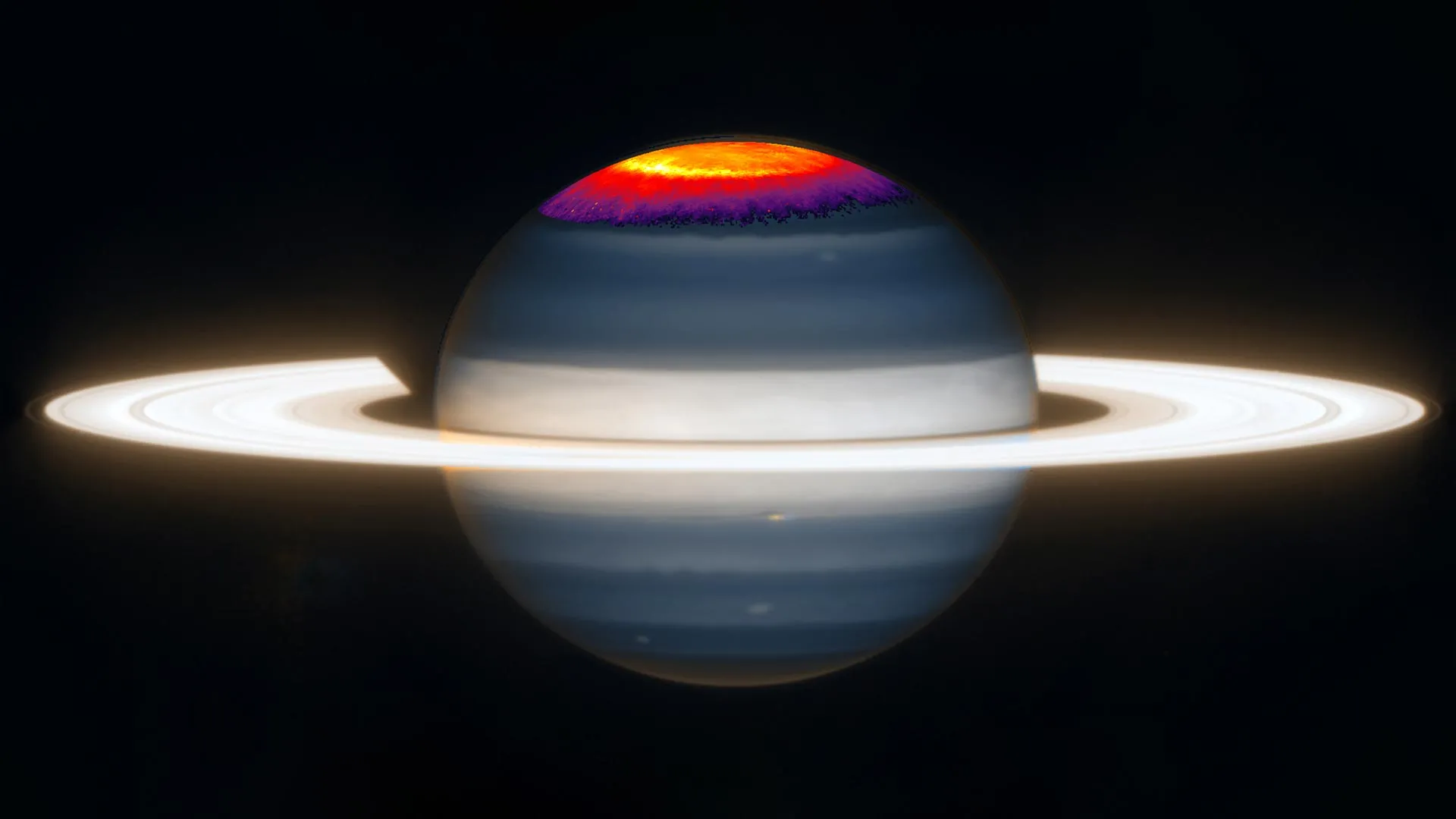
Scientists analyzing data from NASA’s Cassini-Huygens mission have discovered an unexpected feature in Saturn’s magnetosphere, the giant magnetic bubble that shields the planet from the solar wind.
The discovery strengthens evidence that the magnetospheres of giant planets such as Saturn operate in fundamentally different ways from Earth’s magnetosphere.
The study, published in Nature Communications, was conducted by Dr. Licia Ray and Dr. Sarah Badman of Lancaster University, together with Dr. Chris Arridge, formerly of Lancaster University.
The Cassini mission investigated Saturn, its rings, moons and surrounding space environment. The mission was a collaboration between NASA, the European Space Agency (ESA) and the Italian Space Agency (ASI). Cassini orbited Saturn from 2004 until 2017.
Saturn’s Rapid Rotation Reshapes Its Magnetosphere
The findings support a longstanding theory that the rapid rotation of giant planets such as Saturn can play a greater role than the solar wind in shaping their magnetospheres.
The solar wind is a continuous stream of charged particles released by the Sun. A magnetosphere is the region around a planet where its magnetic field interacts with and helps shield the planet from those particles.
Near a planet’s magnetic poles are funnel-shaped regions called “magnetospheric cusps.” These openings allow charged particles from the solar wind to enter the atmosphere more directly.
Researchers examined Cassini observations collected between 2004 and 2010 to determine the location of Saturn’s magnetospheric cusp. When they compared the results with equivalent observations from Earth, they found a significant difference.
Saturn’s powerful rotation appears to drag the cusp away from the local noon position. On average, the cusp is shifted into the afternoon, usually between 13:00 and 15:00 local time. In some cases, it extends as far as 20:00 local time.
The discovery that Saturn’s cusp is displaced toward dusk shows that a planet’s rotation can fundamentally reshape its surrounding space environment.
Saturn’s Magnetospheric Cusp Could Explain Its Auroras
The unusual location of Saturn’s cusp has important implications for understanding magnetic reconnection, the acceleration of high-energy particles and the planet’s powerful auroras.
Dr. Licia Ray of Lancaster University said: “This result allows us to move forward with new and improved theories on how planetary magnetospheres interact with the solar wind.”
Earth rotates far more slowly than Saturn. While an Earth day lasts 24 hours, the shape of our planet’s magnetosphere is largely controlled by the balance between solar-wind pressure and the pressure of Earth’s magnetic field. This balance keeps Earth’s cusp close to local noon.
Saturn’s environment is very different. A day on the gas giant lasts approximately 10.7 hours, and its magnetosphere contains large quantities of ionized material supplied by the moon Enceladus.
Saturn’s rapid rotation and abundance of ionized material create a system in which the pressure of the planet’s magnetic field and its rotating disk of charged particles must balance the pressure of the solar wind.
These competing forces help explain why Saturn’s magnetospheric cusp is located much farther toward the afternoon and evening than the corresponding cusp at Earth.
Cassini Data Continues to Reveal New Discoveries
The research could improve scientists’ understanding of Saturn’s bright auroras and the energetic processes occurring throughout its magnetosphere.
Dr. Ray said: “In particular, the afternoon cusp locations have implications for how we interpret Saturn’s bright aurora and where we expect magnetic reconnection, an explosive process that accelerates particles to very high energies of keV and more, to occur. It also highlights the rich science that can still be done with Cassini data more than eight years after the end of the mission.”
Source: www.sciencedaily.com