


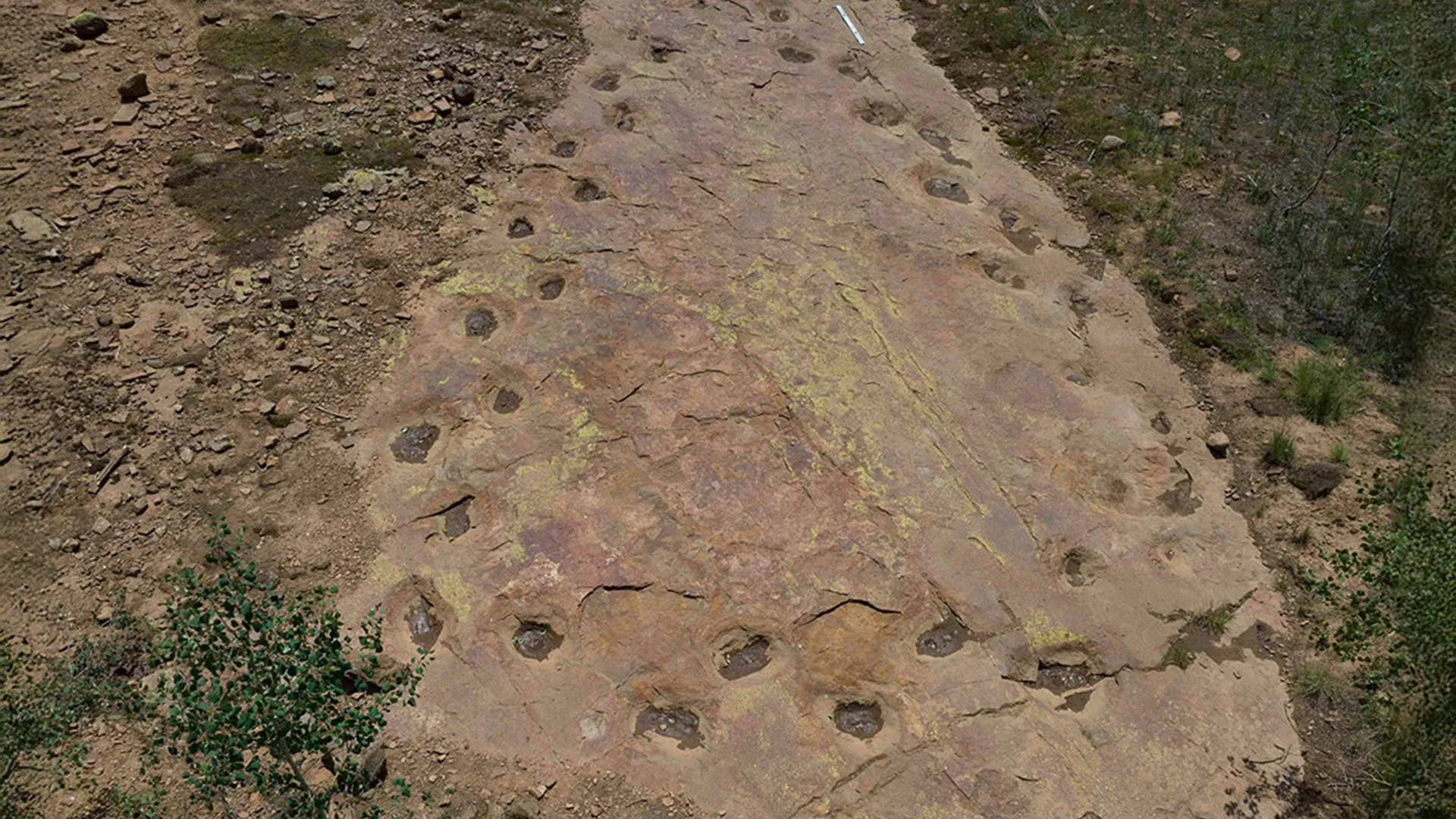
A rare loop of fossilized dinosaur footprints in Colorado is giving scientists new insight into how giant sauropods moved 150 million years ago—and may even indicate that the dinosaur walked with a limp.
Located near Ouray, Colorado, the West Gold Hill trackway is one of the longest, most continuous, and tightly curved sauropod trackways ever discovered.
Dr. Anthony Romilio of the University of Queensland’s Dinosaur Laboratory analyzed more than 130 footprints along the 95.5-meter track.
“This trackway dates to the Late Jurassic period, when long-necked dinosaurs such as Diplodocus and Camarasaurus roamed North America,” Dr. Romilio said.
“This trackway is unique because it forms a complete circle.
“We may never know why the dinosaur turned around, but the trackway provides an extremely rare opportunity to study how a giant sauropod made a sharp turn before returning to its original direction.”
Drone imagery reveals the full dinosaur trackway
The West Gold Hill dinosaur track site is so extensive that surveying the entire trackway from the ground was challenging.
Co-author Dr. Paul Murphy of the San Diego Museum of Natural History said researchers needed a new method to document the site.
“Because of the size and extent of the trackway, the footprints were difficult to record from the ground,” Dr. Murphy said.
“We used a drone to photograph the entire trackway in high resolution.
“These images were then used to create detailed 3D models that could be digitally analyzed in the laboratory with millimeter-scale precision.”
The resulting virtual reconstruction enabled researchers to follow the sauropod’s movements across the entire trackway.
“It was clear from the beginning that the animal started by walking northeast, curved around in a loop, and finished facing the same direction,” Dr. Romilio said.
“Within that loop, we identified subtle but consistent clues about the dinosaur’s behavior.”
Fossil footprints reveal changes in dinosaur movement
One of the clearest patterns involved the spacing between the dinosaur’s left and right footprints.
“One of the most noticeable patterns was a change in the trackway width, from very narrow to distinctly wide.
“This shift suggests that the width of a dinosaur’s trackway can change naturally as it moves. As a result, shorter sections that appear to show a consistent walking style may not accurately represent the animal’s normal movement.”
Researchers also identified small but consistent differences in the dinosaur’s left and right stride lengths.
“We detected a persistent difference in stride length of approximately 10 centimeters, or 4 inches, from one side to the other.
“It is difficult to determine whether this difference reflects a limp or simply a preference for one side.”
The discovery suggests that long dinosaur trackways can preserve behavioral details that may not be visible in shorter fossilized footprint sequences.
“There are many long dinosaur trackways around the world where this method could be used to uncover previously inaccessible information about dinosaur behavior.”
The survey of the railroad-site trackway was supported by the U.S. Forest Service.
Source: www.sciencedaily.com