


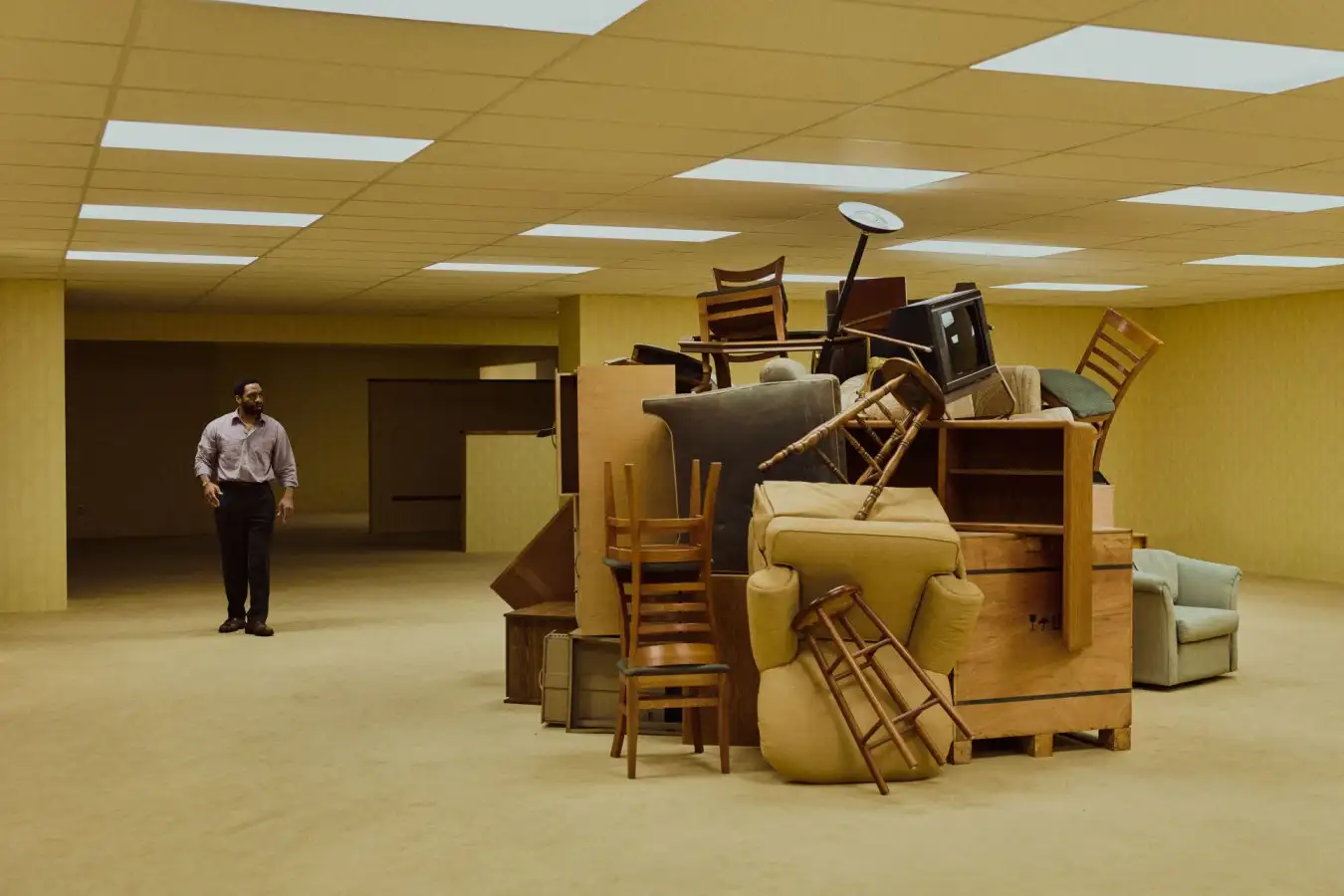
Clark (Chiwetel Ejiofor) unveils a series of disturbing rooms in a furniture store.
A24
Back Room
Now playing in theaters
There’s an eeriness in spaces that defy purpose—a hallway with no endpoint, a chair partially buried in the ground. Just one misplaced sofa can evoke a sense of danger. In Back Room, 20-year-old Kane Parsons’ feature debut, ordinary objects are devoid of their common practicality, taking on an alien quality. Shadows, carpeted corridors, and buzzing fluorescent lights signal a reality that has lost its grip.
Initially conceptualized by Parsons, known online as Kane Pixels, Back Room drew inspiration from a 2019 image shared on 4chan of a room adorned with yellow wallpaper and fluorescent lighting. The original poster sought “disturbing images that induce discomfort,” igniting a discussion on the concept of an endless maze filled with bizarre, unsettling spaces. This sparked the viral phenomenon of internet horror.
The film, penned by Will Sudich, is set in June 1990, and stars Clark (Chiwetel Ejiofor), a struggling architect turned furniture store owner, alongside his psychologist, Dr. Mary Klein (Renate Reinsve). Clark, a man marked by a birthmark, stumbles upon a mysterious door in his store’s basement, leading to an infinite array of rooms, while Mary attempts to uncover his whereabouts.
Transitioning from a short web horror to a feature film might have diluted the original essence, but instead, Back Room preserves the foreboding atmosphere of the short and enhances it through evocative production design, methodical cinematography, and, notably, a haunting soundscape that seeps into your consciousness, ensuring a constant sense of unease.
The early 90s backdrop not only lends a nostalgic aesthetic but anchors the film in an era just preceding the digital age—where surveillance, simulation, and mapping began to feel commonplace. This historical context underscores that at its core, Back Room serves as a horror narrative about a chaotic, unstable universe.
The “Back Room” evolves into more than just a labyrinth; it becomes a reflection of the psyche influenced by the time spent within it, where perception molds the environment itself. Fears, memories, and attachments can alter spatial dynamics. This thematic depth provides Back Room with a rich narrative texture that transcends mere monster-in-the-dark tropes.
“
Back Room offers a texture deeper than a simple monster-in-the-dark narrative.
“
The film aligns itself with the recent trend of liminal space horror. It parallels Exit 8, an adaptation by Genki Kawamura, where a man finds himself ensnared in a subway loop. Both pieces highlight how repetition and minor oversights can evoke greater horror than violence, drawing from the fabric of viral digital culture. They transform mundane places into psychological traps. However, Back Room diverges by exploring a reality where rules can be dynamically reshaped, offering an expansive, chaotic experience compared to the minimal, game-like precision of Exit 8.
The film adeptly illustrates the trepidation involved in practicality. Conceptually, the vastness of the Back Room could address issues of storage, logistics, or urban congestion. Its infinite potential is enticing for companies and researchers. Yet, Parsons cleverly twists this notion into a source of dread—an endless warehouse can become a nightmare if the exit is elusive.
The performances further enhance this abstract horror. Renate Reinsve effectively encapsulates Mary, bringing warmth laced with an uncanny certainty. Conversely, Ejiofor portrays Clark as a weary individual, grappling with failure in one reality while ensnared in another.
The abrupt ending hints at potential sequels, leaving numerous questions unanswered— a deliberate choice echoing the film’s thematic exploration. By the conclusion, we share Clark’s desperation to dissect the enigma of the Back Room. Rarely do shadows, wallpaper, and cheap furnishings exude such hostility in modern horror. It all traces back to a singular image shared in a 4chan thread, crafting a compelling cinematic experience steeped in fear, space, and perception.
Davide Abbatesianni is a film critic based in Rome, Italy.
Topics:
Source: www.newscientist.com