


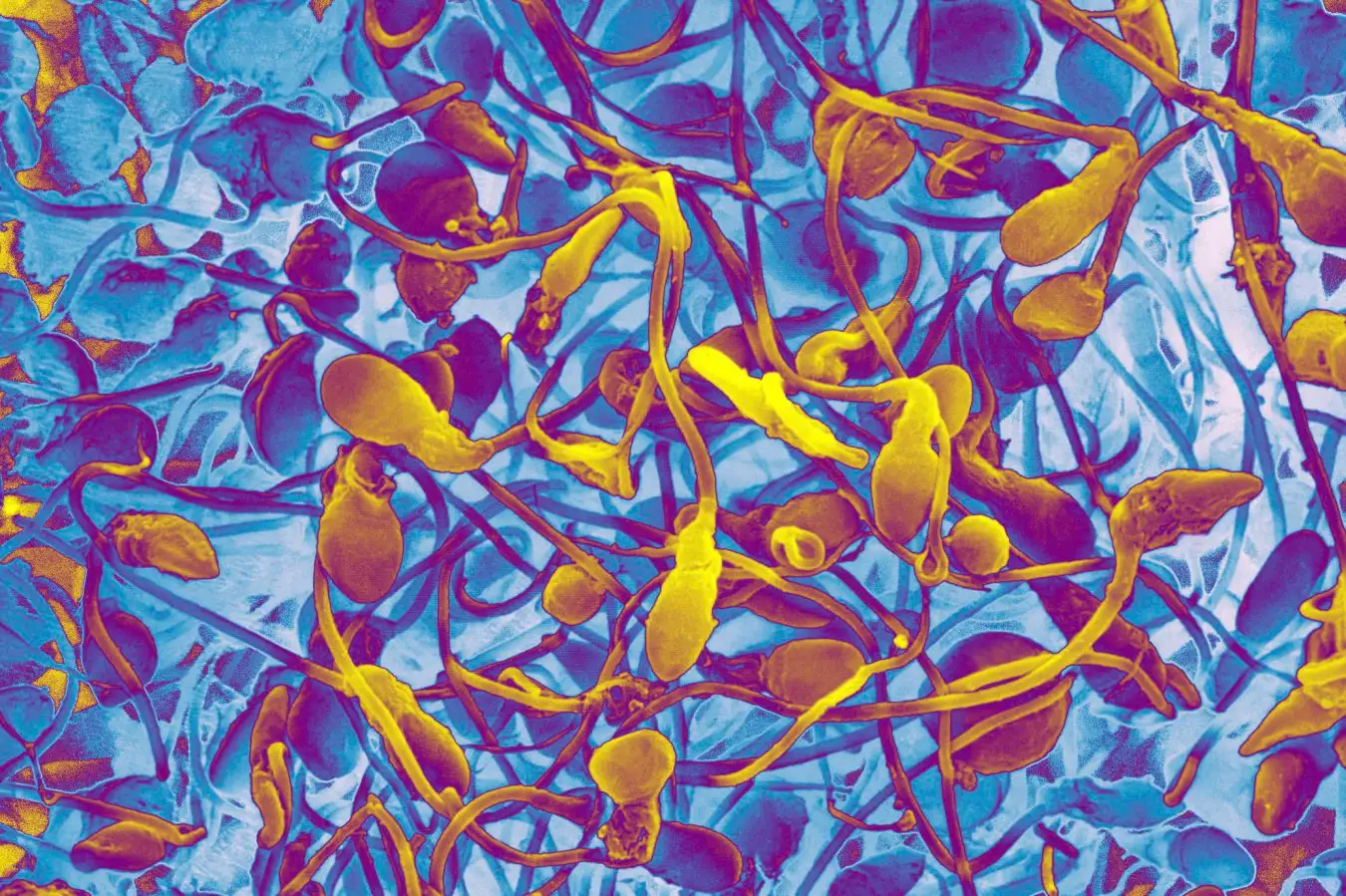
Color Scanning Electron Micrograph of Human Sperm Cells
PDC/Science Photo Library
Infertility in men is a sensitive topic that affects many, with around 1 in 10 couples experiencing challenges in conceiving. Notably, half of fertility issues are linked to sperm-related factors. Traditional fertility treatments often fail, but a promising US startup, Paterna Biosciences, is pioneering a novel approach.
Paterna claims it can extract stem cells from testicles and convert them into viable sperm cells in a lab setting. This breakthrough could potentially provide a solution for nearly all men who currently struggle with traditional fertility treatments.
However, some experts argue that the technology may only offer limited benefits for treating male infertility unless it is used in conjunction with CRISPR gene editing, raising ethical questions about gene-edited offspring.
Understanding the reasons behind male infertility is crucial. Low sperm counts, weak sperm motility, or an inability to penetrate the egg are common issues. In many instances, intracytoplasmic sperm injection (ICSI) applied during IVF can mitigate these problems effectively.
Approximately 1 in 100 men have semen devoid of sperm, which could be due to blockages preventing sperm from reaching the prostate. In such cases, obstructions can typically be addressed, or sperm can be collected directly from the testes.
Nonetheless, when sperm is absent from the semen, it’s often due to the testicles producing little to no sperm. According to Paterna Bioscience co-founder, Alex Pastuzak, they take small tissue samples from the testes to generate “from low single digits to tens of thousands of sperm” from each sample.
Paterna’s innovation stems from identifying a signaling mechanism that triggers sperm stem cells to develop into sperm, a process that takes around a month in laboratory conditions.
The key question remains: Is this assertion substantiated? Paterna has yet to disclose empirical evidence, citing the need to protect their intellectual property. As Pastuszak puts it, “I’m not going to release anything that’s going to be in the public domain until protections are established.”
Previously, similar claims were made by a French biotech firm, Callistem, in 2015, which published findings in 2016. However, those claims were met with skepticism by the scientific community.
Paterna asserts that their extracted sperm has successfully fertilized human eggs and progressed to early embryonic stages.
Independent experts acknowledge Paterna’s talented team and their potential achievements, yet they await concrete evidence to confirm these breakthroughs. “If they accomplish what they claim, it would signify a substantial advancement,” says Geert Hamer from the Amsterdam Institute of Reproductive Development in the Netherlands.
Potential Genetic Errors
Assuming Paterna is correct, the next essential consideration is the safety of this technique for men who do not produce sperm.
Sperm develop from stem cells within the testes. As these stem cells divide, one remains a stem cell while the other evolves into four spermatozoa through meiosis, involving genetic recombination.
“This presents a precarious situation,” cautions Miles Wilkinson from UC San Diego, who specializes in sperm stem cell research. Meiosis must occur flawlessly; any disruption can cause DNA issues that may not recover properly, especially if laboratory conditions fall short. Post-implantation, it’s possible to screen embryos for mutations stemming from meiotic failures.
Another concern involves imprinting errors; during sperm maturation, specific genes are silenced through chemical tagging. If imprinting malfunctions, it can lead to severe developmental disorders. Hamer points out that such faults are prevalent in lab-grown sperm derived from somatic cells, though Paterna believes its method minimizes these risks by using stem cells from testes.
According to Pastuzak, sperm cultured in their lab appears molecularly identical to that produced naturally in the testes and, in some cases, even superior.
Paterna aims to begin implanting embryos fertilized with lab-generated sperm into women as early as next year. “Our first significant clinical trial will likely take place outside the United States, still navigating regulatory approvals,” Pastuzak states.
The specific evidence regulators seek before permitting lab-grown sperm in IVF remains unclear. Historically, fertility practitioners have explored techniques like IVF and ICSI without fully understanding their safety implications.
If Paterna’s method proves safe, a pressing question is its efficacy for male infertility. A minority of men without sperm possess no sperm stem cells; thus, the method would be ineffective for them.
In others, sperm stem cells may fail to develop into sperm due to genetic mutations, confirming a long-held assumption that a significant proportion of male infertility results from genetic factors. Pastuzak concurs, suggesting that mutations seen in males with infertility should be examined.
Experts have raised concerns regarding Paterna’s ability to assist men with these genetic mutations. Wilkinson indicates that if a mutation hinders meiosis in the testes, the lab method may face similar challenges. However, individuals who became infertile due to chemotherapy as children and previously stored testicular samples could see benefits from this advancement.
“If successful, this would provide hope for boys rendered infertile due to chemotherapy,” Hamer adds, albeit recognizing this as only a small part of the male infertility landscape.
Wilkinson highlights that men experiencing limited spermatogenesis could also benefit. Currently, their only recourse is mTESE, a time-consuming and invasive procedure that entails dissecting the testicle to locate spermatogenesis areas.
“Avoiding mTESE would be fantastic, considering its invasive nature,” he concludes, presenting an intriguing niche for in vitro spermatogenesis.
Children Resulting from Lab-Grown Sperm

Lab-Grown Sperm Could Help Men Have Children, With Additional Genetic Techniques Required
Maite Torres/Getty Images
Pastuzak emphasizes that their team has successfully harvested sperm in the lab from men whose testes traditionally don’t produce sperm. “We found that most germ cells exhibit maturation potential. The defect seems to reside in the signaling pathways from supporting cells required for germ cell development,” he explains.
Still, skepticism remains due to the lack of supporting evidence; many share hopes that if Paterna succeeds, numerous families stand to benefit. “If Paterna can generate sperm from men with known mutations, the implications would be groundbreaking,” Wilkinson asserts.
However, it raises concerns regarding the potential for boys conceived from lab-grown sperm to inherit mutations, leading to infertility issues. This issue is also relevant for ICSI, with recent research indicating valid concerns about such genetic errors.
When questioned about these concerns, Pastuzak acknowledges, “It’s a possibility.” However, he reassures that pre-implantation tests could help identify and eliminate cells and embryos with detrimental mutations.
Yet, the question remains: What if Paterna’s method fails for men whose infertility stems from genetic mutations? CRISPR gene editing presents a potential avenue to rectify these mutations in sperm stem cells, enabling the creation of genetically normal sperm and, consequently, children.
This process entails complexities since the specific mutations responsible for infertility are not fully understood, and there are tenuous correlations identified. “Evidence remains scant,” Wilkinson points out.
Nevertheless, I believe that employing germline gene editing could be justified if we accurately pinpoint the mutations involved. Admittedly, the risks tied to CRISPR must be carefully considered, but genetic screening could be implemented to detect unintended variations.
Paterna maintains an open stance regarding future advancements, with Pastuzak mentioning, “We’ll keep all options available as technology evolves, with the aim of helping many.”
Topics:
Source: www.newscientist.com