


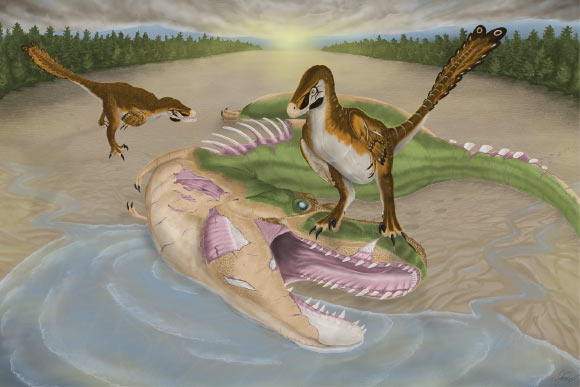
Small Raptor Dinosaurs May Have Scavenged on Young Albertosaurus Carcasses
New fossil evidence from Alberta, Canada, suggests that small, feathered raptor dinosaurs may have scavenged on the carcasses of much larger tyrannosaurs. The findings challenge the popular image of tyrannosaurs as untouchable apex predators.
“This turns everything upside down, because you’re going to have a very small dinosaur eating a very large, mean, nasty dinosaur like a tyrannosaurus,” said Dr. Philip Currie, a paleontologist at the University of Alberta.
Fossil bite marks on an Albertosaurus skull
In the new study, Currie and his colleagues examined the skull of a young Albertosaurus sarcophagus, a relative of Tyrannosaurus rex. The fossil was discovered in the Horseshoe Canyon Formation, a roughly 70-million-year-old rock formation along Alberta’s Red Deer River.
The specimen was not fully grown. Researchers estimate that it was approximately 6 meters (20 feet) long and weighed about 533 kilograms (1,175 pounds).
The dinosaur’s jaw bones preserve multiple sets of tooth impressions. These include three parallel marks on the splenial, a bone on the medial side of the mandible, and another tooth mark on the ventral jaw. The latter contains approximately 28 small, evenly spaced serrations.
Identifying the dinosaur that left the marks
To determine which dinosaur made the impressions, the researchers measured the spacing between the marks and compared it with the spacing of teeth and serrations from dinosaurs known in the region’s fossil record.
Because dragging a tooth across bone at an angle creates marks that appear closer together than the actual tooth spacing, the scientists developed a trigonometric correction to account for the tooth’s raking angle.
The results were most consistent with dromaeosaurids, a group of feathered dinosaurs commonly known as raptors. Atrociraptor marshali was the only dromaeosaurid species definitively identified from the Horseshoe Canyon Formation and was therefore considered the leading candidate.
A likely case of scavenging, not hunting
The researchers estimate that the animal responsible for the marks weighed approximately 16 to 18 kilograms. That represents a mass difference of roughly 30 to 1 compared with Tyrannosaurus rex.
Given this substantial size difference, Currie and his co-authors believe the marks are more likely evidence of scavenging than an attack on a living animal.
Although a dromaeosaurid, most likely Atrociraptor, is the best-supported trace maker, the researchers said that Richardoestesia and a very young tyrannosaurid, including Albertosaurus, cannot be completely ruled out.
The study, “Evidence for dromaeosaurid scavenging on Albertosaurus (Dinosauria: Tyrannosauridae),” was published online in the Journal of Paleontology on October 14, 2026.
Joshua Adam Doyon et al. Evidence for dromaeosaurid scavenging on Albertosaurus (Dinosauria: Tyrannosauridae). Journal of Paleontology, published online October 14, 2026. doi: 10.1017/jpa.2026.10269
Source: www.sci.news