


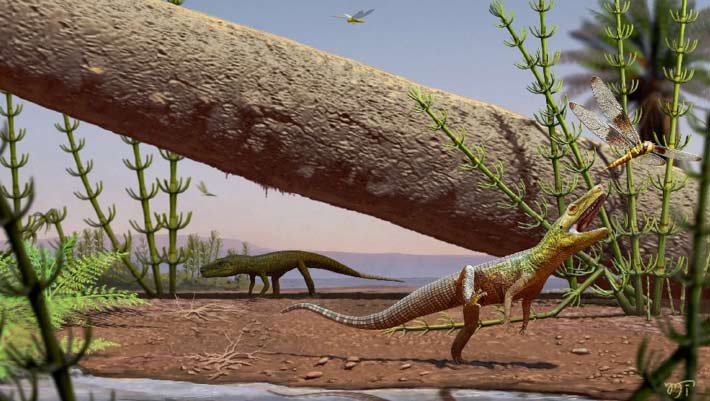
Paleontologists in Brazil have discovered a new archosauroid species, which existed approximately 240 million years ago. This species is likely part of a lesser-known group of ancient reptiles closely related to the ancestors of dinosaurs and crocodiles.
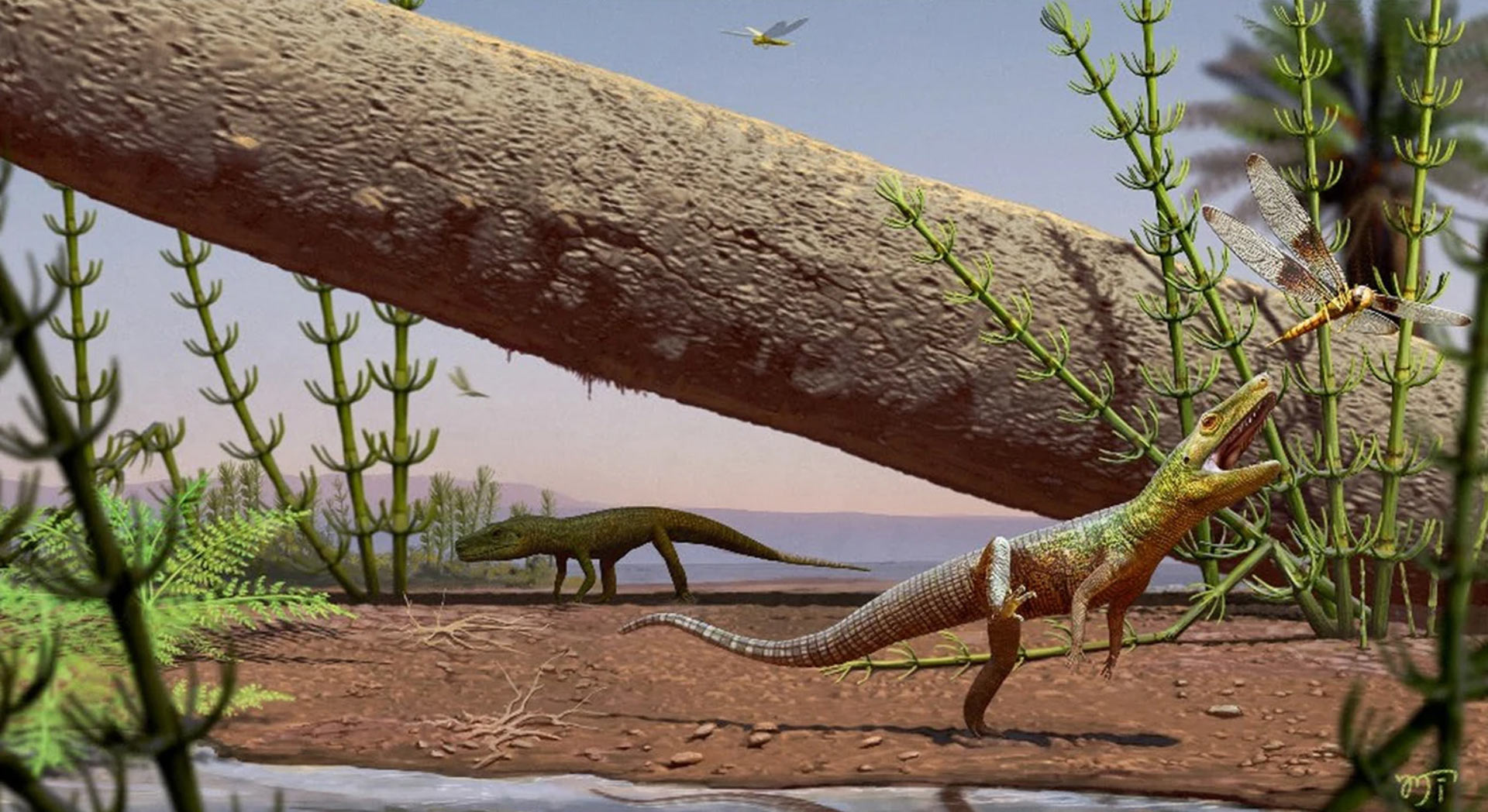
Reconstruction of Silescelida acristata. Image credit: Mateus Fernández Gadelha.
Silescelida acristata thrived in present-day Brazil during the Middle Triassic Period, a crucial time for the recovery and diversification of life following the Permian mass extinction.
During this era, archosaurs, a larger group of reptiles, began to dominate terrestrial ecosystems, eventually leading to the rise of dinosaurs and pterosaurs.
This newly identified species is likely related to the rare and poorly understood group known as Euparkeriidae.
One of the most notable species of Euparkeriidae is Eupacheria capensis, first described in South Africa in 1913, and remains the only confirmed member of this group.
“The Euparkeriidae are primarily known for their distinctive stalked archosaurs. Eupacheria capensis lived during the Early to Middle Triassic in South Africa and is currently the only well-defined member of this clade,” said lead author Mauricio García from the Federal University of Santa Maria and his research team.
“Other potential euparkerids have been found primarily in China and Europe.”
“Both Eupacheria capensis and Euparkeriidae rank as near relatives to archosaurs in all major modern phylogenetic analyses, demonstrating their significance in understanding the lineage,” García added.
Silescelida acristata was discovered from skeletal remains, including a left shoulder blade, right hip bone, and a left femur (approximately 17.3 cm long), found at a site in Doña Francisca, Rio Grande do Sul, Brazil.
This new species likely resembled a long-limbed, agile, lizard-like predator based on comparisons with closely related animals.
The discovery of Silescelida acristata enhances our understanding of the geographic range of the Euparkeriidae lineage.
Furthermore, it highlights that South America played a significant role in the early evolution of archosaurs.
“This discovery not only enriches our knowledge of the temporal and paleogeographical distribution of Euparkeriidae but also illuminates the early evolution of Eucrocopoda, representing the first record of this archosaur in the Brazilian Triassic,” concluded the paleontologists.
“More broadly, this new species underscores the importance of South American Triassic deposits in the evolutionary history of archosaurs.”
The team’s study was published in the journal Scientific Reports on June 10th.
_____
García, M. S. et al. 2026. A new euparkerid form from the mid-Triassic of southern Brazil, within the family Euparkeriidae. Scientific Reports 16, 16585; doi: 10.1038/s41598-026-53740-9
Source: www.sci.news