


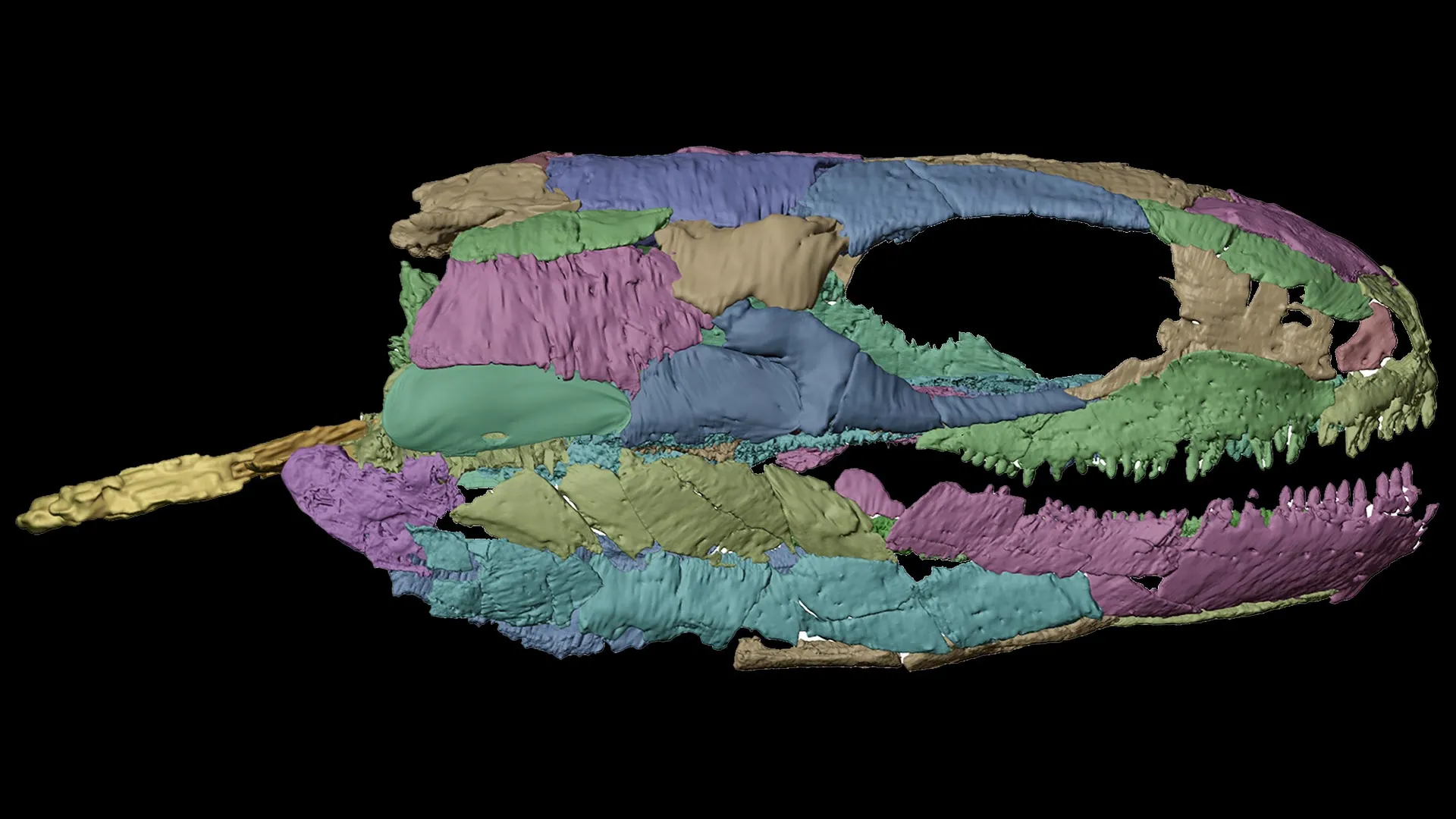
A 345-million-year-old fossil from Scotland that was long regarded as one of the oldest known reptiles has been reclassified as a far more ancient aquatic or amphibious animal. The finding, published in Nature, challenges decades of assumptions about the specimen’s place in evolution and suggests that features such as claws and five-toed limbs evolved in animals still closely associated with water.
The research was led by scientists from the American Museum of Natural History and the University of Oxford, in collaboration with the European Synchrotron Radiation Facility.
X-ray scans reveal Lizzie’s hidden anatomy
Discovered in 1984, the fossil belongs to a species called Westrotiana Ligier. Nicknamed “Lizzie” because of its lizard-like appearance, the specimen consists of a nearly complete skeleton preserved between two crushed slabs of rock.
Early descriptions focused mainly on visible anatomical features, including four limbs with fingers and toes that appeared to end in claw-like tips. These characteristics set Westrotiana apart from many other animals living at the time, whose limbs were more fin-like.
Although the fossil’s distorted condition made its anatomy difficult to interpret, researchers widely considered it the oldest known amniote adapted to life on land. Amniotes are a major group of vertebrates that includes reptiles, birds and mammals. After the fossil was scientifically described in 1990, Westrotiana became an important reference point for researchers studying when and how these animals first evolved.
“Lizzie has been a symbol of the early evolution of amniotes for decades,” said Xavier Jenkins, a postdoctoral fellow in the museum’s paleontology department and co-first author of the study. “But when we were finally able to look inside the fossil, we discovered an animal that looked completely different than what we expected.”
Using powerful X-ray imaging at the European Synchrotron Radiation Facility in Grenoble, France, the scientists examined structures hidden beneath the rock and reconstructed parts of the animal’s anatomy that had previously been inaccessible.
The results revealed features unlike those expected in an early reptile. Lizzie had a primitive skull, bony internal gills and a fish-like mouth containing thousands of tiny teeth. Together, these characteristics rule out the fossil’s previously proposed position on the evolutionary lineage leading to reptiles. Instead of living primarily on land, Westrotiana may have been aquatic or amphibious.
“The strikingly primitive skull features suggest that Lizzie was not only not a reptile, but belonged to an even more ancient lineage. Looks can be deceiving, and it turns out that Lizzie lived a very different lifestyle than we previously thought,” said study co-lead author Ben Igielman, who began the study while in graduate school at the University of Oxford.
Reptile-like features may have evolved in aquatic animals
The discovery also changes how scientists understand the origins of anatomical features traditionally associated with vertebrates adapted to life on land.
Researchers now believe that traits such as claws and the five-toed arrangement of the limbs—common in reptiles and mammals—were already present in early animals that remained closely connected to aquatic environments. These organisms belonged to an evolutionary lineage that led to tetrapods, the broader group of vertebrates that includes amphibians and amniotes.
“This is a big surprise,” said study co-author Roger Benson, the museum’s Macaulay curator of paleontology. “Today we think of amphibians as more ‘primitive’ than reptiles, but this shows that some of the reptilian features were already present in the ancestors of both amphibians and reptiles.”
Ancient footprints may need to be reinterpreted
The findings could also affect the interpretation of prehistoric fossil footprints. A recently discovered trail has been used as evidence that amniotes first appeared during the Devonian period, more than 359 million years ago.
The impressions clearly record the movements of tetrapods with clawed fingers. However, if distant relatives of Westrotiana also had claws, those footprints are no longer sufficient to identify their makers as amniotes.
Some tracks previously attributed to early amniotes may instead have been left by more ancient amphibians from the tetrapod evolutionary lineage.
“The broader lesson is that terrestrial-looking traits such as reptilian feet, weight-bearing forelimbs, and claw-like phalanges are not unique to quadrupeds, but rather accumulated over time in their relatives, animals that still lived in and out of water,” Jenkins said.
Other contributors to the study include Jason Head of the University of Cambridge, Vincent Fernandes of the European Synchrotron Radiation Facility, Lucy Roberts of the Natural History Museum, London, and Timothy Smithson of the University of Cambridge’s Zoological Museum.
The research was funded by the National Science Foundation through grant EAR-PF 2518154; the National Environmental Research Council through grants NE/S000739/1, NE/W007576/1 and NE/L002507/1; and the Biotechnology and Biological Sciences Research Council through grant BB/X014819/1.
Source: www.sciencedaily.com