


For decades, paleoanthropologists have posited that hominins, the ancestors of modern humans, evolved gradually over millions of years. However, new research from the University of Reading significantly complicates this narrative. The most substantial change in body size appears to have occurred between 2 million and 2.5 million years ago, with species like Homo rudolfensis and Homo erectus/ergaster. Meanwhile, smaller species such as Homo floresiensis and Homo naledi, along with early humans like Australopithecus, averaged only 40 kg in weight and reached heights similar to that of a child. In contrast, Homo erectus/ergaster marked the first humans to exceed an average weight of 60 kg, aligning more closely with many modern humans.

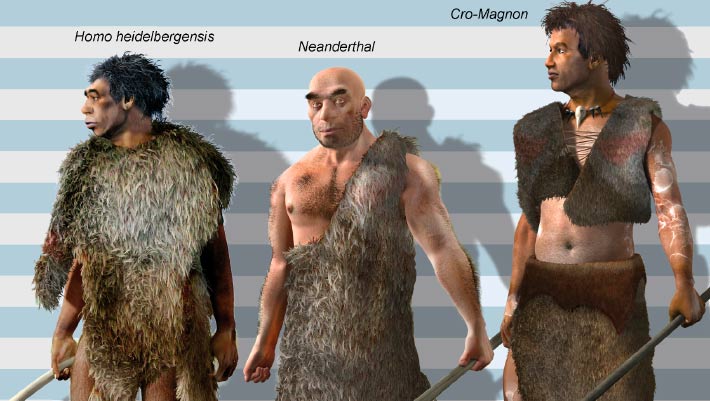
An illustration of Homo heidelbergensis, alongside Neanderthals and Cro-Magnons. Image credit: SINC / Jose Antonio Peñas.
Body size plays a crucial role in organismal biology, impacting aspects like ecology, life history, physiology, and neuroanatomy.
Within the framework of hominin evolution, an increase in body size correlates with larger brains, enhanced bipedalism, and a broader range of movement.
Despite its significance, there remains a lack of consensus on whether hominin body size consistently increased over time.
Recent studies present conflicting perspectives, with some challenging the general trend of evolutionary size increase, while others advocate for overall growth in weight and height.
Notably, the small-bodied species, such as Homo floresiensis and Homo naledi, are often cited as exceptions to the general trend.
Moreover, some researchers propose that increases in size may be species-specific or occur following certain evolutionary milestones within the genus Homo.
However, tests assessing lineage-specific size fluctuations alongside broader trends have not yet been implemented within a single model.
“Throughout the years, a variety of studies have produced divergent conclusions regarding whether our ancestors consistently grew in size or experienced rapid growth at critical junctures,” stated lead author Dr. Jacob Gardner from the University of Reading.
“The variation arises because researchers have been focusing on distinct aspects of a much larger narrative.”
“By synthesizing all available fossil evidence, evaluating multiple competing theories, and elucidating species relationships, a more coherent picture has emerged. It’s likely that the reality encompasses a blend of these theories.”
“The narrative of human evolution isn’t solely one of unbroken growth, but also of significant transformations within our genus, while other branches of our family tree, including some surprisingly diminutive relatives, followed their own unique trajectories.”
In the recent study, Dr. Gardner and colleagues analyzed estimated body weights from 386 fossil specimens encompassing 21 human species, from ancient australopiths to modern Homo sapiens.
Employing advanced statistical models to clarify evolutionary connections between species, researchers determined that the narrative of human body size is considerably more intricate than a straightforward upward trend.
The data highlights a distinct increase in size, particularly among later members of the genus Homo — roughly following Homo habilis — as opposed to a consistent rise throughout human history.
Species such as Homo ergaster and Homo erectus appear to exemplify a genuine leap in size, coinciding with pivotal evolutionary shifts, including improved bipedalism and carnivorous adaptations.
A more generalized and gradual increase in body size across all hominins garners only moderate support, heavily influenced by the fossil datasets and estimation techniques employed, which often leads to disagreements in the field.
Two notable exceptions are the species Homo floresiensis from Indonesia and Homo naledi, both of which fall significantly below their average body weight expectations for that era.
“Our findings indicate that the evolution of human body size is not merely a tale of gradual growth,” remarked co-author Dr. Thomas Pushell from the University of Oxford.
“While weight has generally escalated throughout our evolutionary journey, the most impactful changes transpired later within the genus Homo.”
“Such changes align with significant modifications in how our ancestors navigated their environments and exploited available resources, underscoring the tight interplay between body size and major ecological as well as behavioral developments.”
These findings are published in the latest issue of Proceedings of the National Academy of Sciences.
_____
Jacob D. Gardner et al. 2026. Competing models of human body size evolution. PNAS 123 (27): e2521732123; doi: 10.1073/pnas.2521732123
Source: www.sci.news