


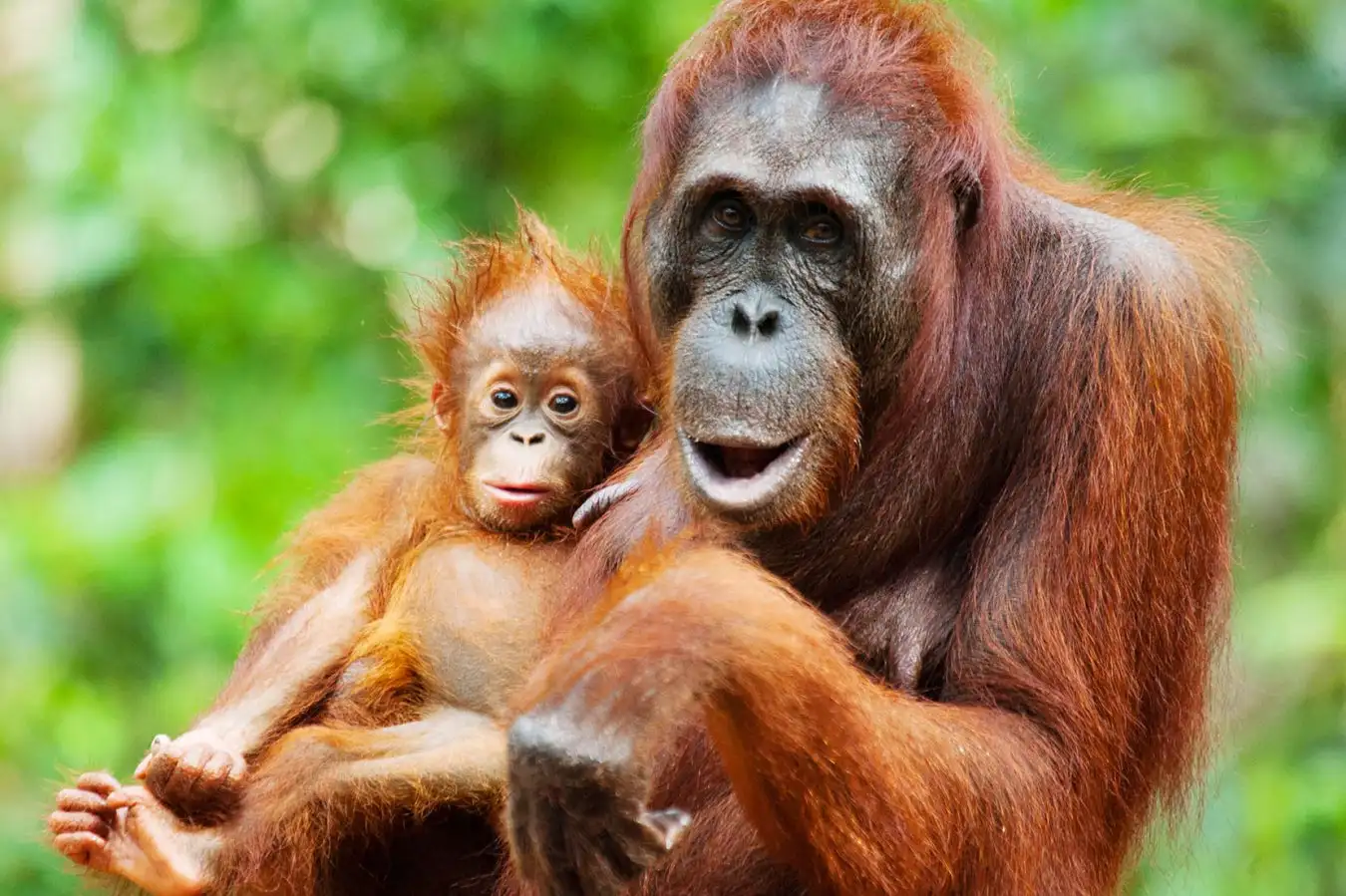

Female orangutans typically raise one baby at a time.
Andrei Gudkov/Alamy
Studies reveal that orangutan mothers may travel to the territories of other mothers with infants of similar ages, allowing their young ones to engage in vital social play.
Play is crucial for many species, aiding in the development of social and motor skills and teaching essential behaviors. Although orangutans are primarily solitary, with mothers rearing their young alone for up to 6-7 years, opportunities for socialization arise infrequently, raising questions about the frequency and nature of these encounters.
“One might assume orangutans require less play due to their more solitary nature compared to other great apes, yet male orangutans engage in fights, which necessitates practice,” explains Zarin Machanda from Tufts University, Massachusetts.
Further investigating this phenomenon, Odd Jacobson and colleagues from the Max Planck Institute for Animal Behavior analyzed 15 years of data on 31 wild Bornean orangutans (Pongo pygmaeus wurmbii), which encompassed around 30,000 hours of observational data detailing the animals’ locations, companionships, and activities.
Their findings indicated that mothers of similarly-aged offspring spent a significant amount of time together, creating shared environments conducive for play. The likelihood of children engaging in play increased substantially when their mothers maintained close social bonds.
The mothers’ mobility heightened around playdates, as they moved toward one another’s territories before returning home afterward.
“Our study provides robust evidence that wild Bornean orangutan mothers adjust their range behavior to enhance social play opportunities for their young,” stated Jacobson and his team in New Scientist.
Notably, the young orangutans may choose play locations near abundant fruit, akin to brown bear cubs that socialize while their mothers fish in salmon-rich rivers. However, these interactions occur irrespective of fruit availability, implying that mothers prioritize play over foraging opportunities.
Machanda points out that while interpreting intentionality from behavioral data can be challenging, “there is a distinct difference between maternal play with their infants and play among friends, suggesting mothers may strategically facilitate playdates for their young.”
According to Adriano Lameira at the University of Warwick, these findings align with our understanding of orangutan maternal investment and cognitive capacity.
However, Lameira speculates that orangutan mothers likely don’t arrange play sessions in advance. While male orangutans utilize long-distance calls for navigation, females aren’t believed to use such communication for social coordination, he notes.
The connections between these orangutans seem to be based on local knowledge, such as their ability to perceive the environment, track fruitful trees, and identify climbing vines, significantly affecting play engagement. They are also adept at understanding each other’s movements, as suggested by Lameira: “One mother can discern her companion’s potential resources based on their previous location and established range.”
Topics:
- Orangutan Behavior
- Social Play in Animals
- Maternal Investment in Primates
- Cognitive Abilities of Orangutans
Source: www.newscientist.com