



Did Homo sapiens and Neanderthals share a common culture?
S.Plailly/E.DAYNES/Science Photo Library
Approximately 59,000 years ago, Homo sapiens migrated to a cave along the coast of Türkiye, previously inhabited by Neanderthals. The tools and jewelry discovered in these caves suggest a remarkable consistency, hinting at a shared material culture among these ancient humans.
The Üçağızlı II Cave, located on Türkiye’s Mediterranean coast, spans 56 square meters—roughly the size of a modern studio apartment.
Naoki Morimoto, a professor from Kyoto University, spearheaded the first complete archaeological excavation of the site in 2020. Findings reveal that Neanderthals resided in this cave between 77,000 and 59,000 years ago, with Homo sapiens living there from 59,000 to 47,000 years ago.
A total of nearly 20,000 stone artifacts were unearthed, showcasing a remarkable consistency in the stone tool technology employed by both hominin species. This indicates a period of coexistence among Neanderthals and Homo sapiens.
“We cannot definitively establish the temporal or physical overlap between these two species on site,” says Morimoto. “However, this remains a key hypothesis for our research.”
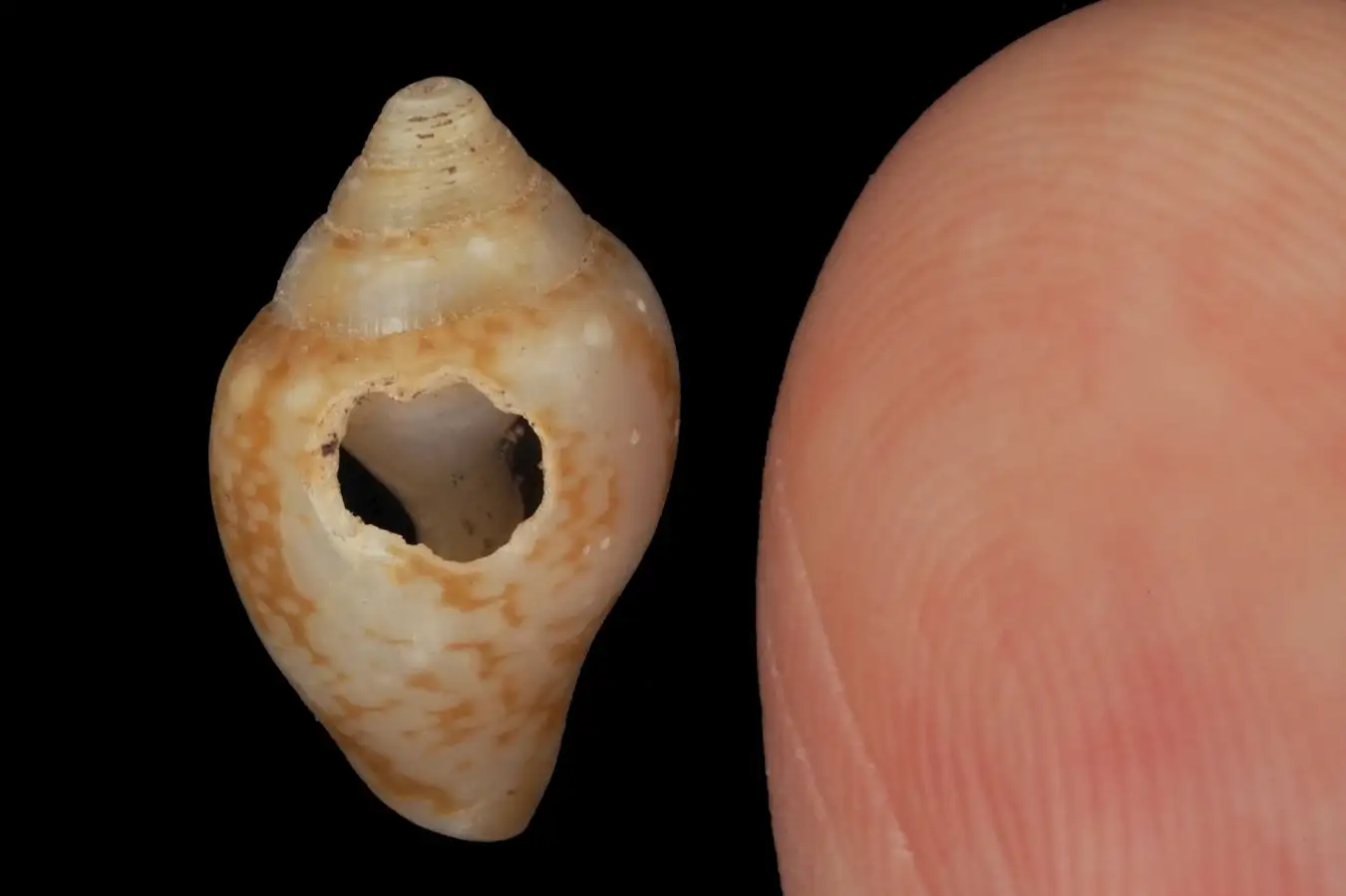
According to Morimoto, the basic toolkit was identical across all layers of human habitation within the cave. Notably, both Neanderthals and Homo sapiens collected shells that had no apparent utility as tools or food, suggesting a shared aesthetic appreciation.
Among the findings were nearly 30 examples of the small but attractive snail shells, Columbella rustica, consistently found across various sediment layers.
Some shells showed signs of being broken or perforated, implying a decorative function, while most were preserved intact, indicating they held significant value for both species.

Columbella rustica shells associated with Neanderthal remains
Naoki Morimoto
Although other shell types were discovered in the cave, Columbella rustica predominated throughout the excavation. Morimoto emphasizes, “This clear preference indicates that both human groups shared a cultural appreciation for this specific shell.”
The consistent evidence of stone tool technology and shell collection is “challenging to interpret as merely independent and parallel developments,” he asserts.
While there is no definitive proof of a friendly relationship between the two species, the research team leans towards that scenario. “We propose models that include regional contacts, cultural exchanges, or overlapping habitation areas as plausible explanations for the archaeological findings,” Morimoto concludes.
John Gowlett, a researcher at the University of Liverpool, highlights that the relationship puzzle between Neanderthals and modern humans has expanded significantly. “For over 200,000 years, modern human populations maintained a fluctuating boundary with Neanderthals,” he explains.
“Both species would have encountered each other regularly, likely fostering a strong ‘us and them’ distinction, yet this does not imply entirely separate material cultures or foraging behaviors,” Gowlett notes. “Both groups appeared to have a shared interest in shellfish, possibly predating current evidence.”
Additional findings indicate that Neanderthals and Homo sapiens may have shared cultural elements at other ancient sites in the Levant. Research by Chris Stringer from the Natural History Museum in London suggests interbreeding in the region around 100,000 years ago.
“Though the Uçazılı human sample is too limited to demonstrate significant population changes, interbreeding could have occurred at a later period,” Stringer asserts.
Topic:
Source: www.newscientist.com