


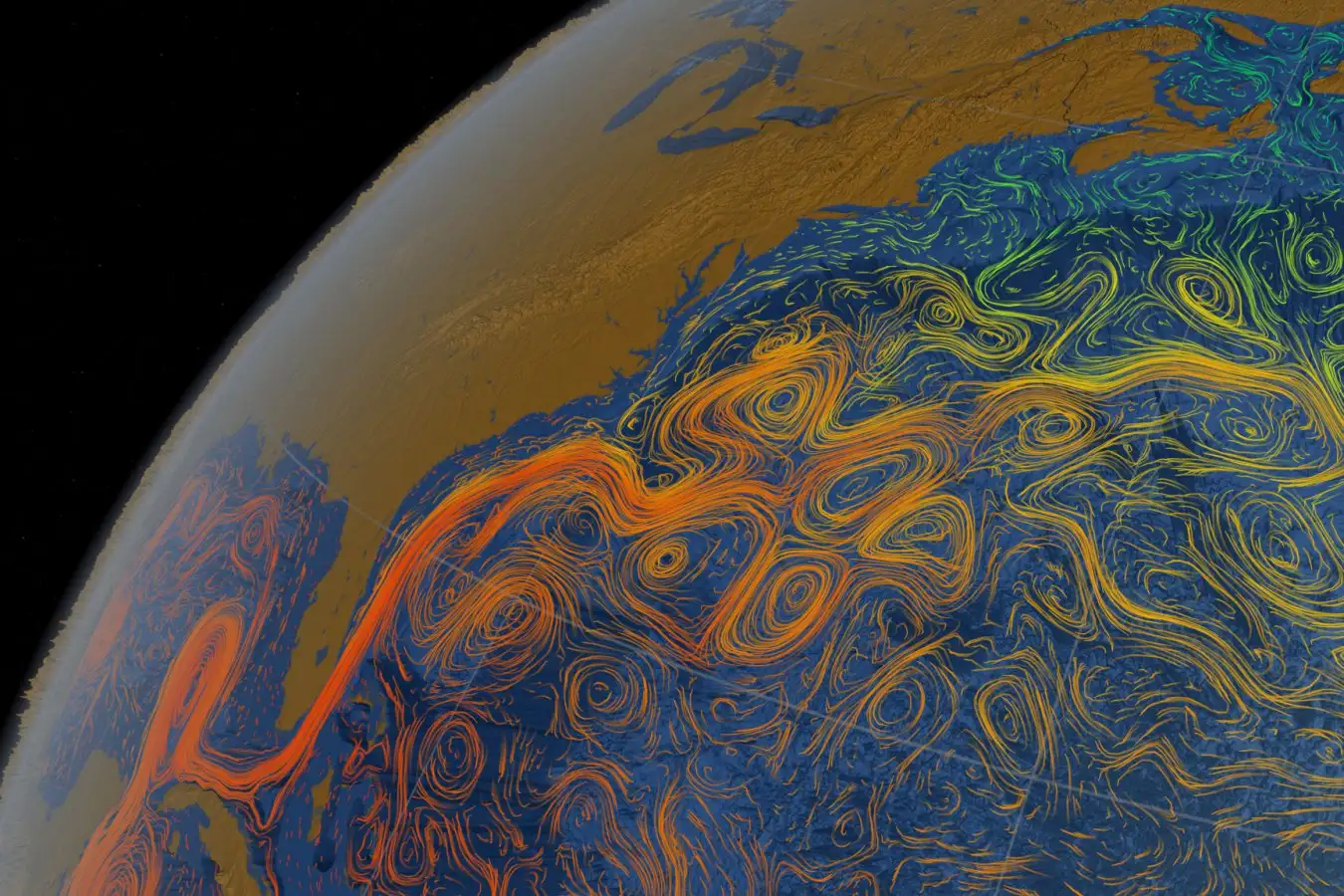

Atlantic Current Visualization Based on Sea Surface Temperature
Credit: NASA/Goddard Space Flight Center Science Visualization Studio
A potentially perilous collapse of the Atlantic Current, crucial for regulating Europe’s climate, may already be unavoidable. Recent model simulations indicate a 10 to 23 percent likelihood that this collapse will become permanent.
“We are already on the brink of collapse, and there’s nothing that can alter this trajectory,” states Phil Holden from the Open University, UK.
The Atlantic Meridional Overturning Circulation (AMOC) plays a critical role in transporting warm, salty water from the tropics to the North Atlantic. Here, it cools, sinks, and flows southward, regulating climate across Europe, Africa, and the Americas.
Recent observations reveal weakening patterns in this vital current system, with areas showing a slowdown. Climate change impacts, such as Greenland’s melting, result in less dense salt water, further inhibiting the necessary sinking processes.
Some researchers warn that the AMOC might collapse entirely, plunging Europe into conditions resembling the Arctic and destabilizing monsoon systems globally. A recent study suggests that the AMOC could hit a tipping point within a few decades, although the exact likelihood remains uncertain.
“The collapse of the AMOC is currently imperceptible,” notes Holden. “At this stage, there’s no clear quantification of the ‘when’ or ‘how’ this will occur.”
“Many uncertainties exist, and opinions vary widely within the scientific community,” adds Tim Renton from the University of Exeter, UK.
To explore the future of the AMOC, Holden, Renton, and colleagues conducted 21 computer simulations, examining scenarios at various intervals from 2005 to 2135, altering Greenland’s ice melt rates and peak emissions. The models were based on the assumption that greenhouse gas emissions would ultimately decline to net zero over 35 years, while the Greenland ice melt rate would remain steady. Each simulation ran for a span of 300 years.
Under conservative conditions—assuming emissions peak by 2025 and Greenland’s ice sheet contributes merely 54 millimeters to sea level rise by 2100—the model indicates a 10 percent probability that an AMOC collapse is unavoidable. This is defined as a shift where circulation only occurs at lower latitudes, halting the reverse currents that transport heat to higher latitudes.
If proactive measures towards net zero emissions aren’t taken by 2100, this probability could surge to 80 percent.
Under more severe predictions, ice melting in Greenland might elevate sea levels by 274 mm by 2100, resulting in a 23 percent likelihood of being already committed to an AMOC collapse.
Even if such collapse is deemed inevitable, it is expected to unfold over an extended period. The simulations reveal that the average delay between the initial collapse signal and the actual decline is approximately 84 years, with the earliest potential collapse occurring around 2060.
“Thinking in terms of a ‘committed collapse’ rather than a specific collapse timeline offers a fresh perspective for risk management,” remarks Up to Wagner. However, he cautions against making direct real-world applications. “The evidence indicates some weakening, yet the large-scale consequences remain largely uncertain.”
Jonathan Baker from the UK’s Met Office acknowledges that the simulation provides insights into AMOC responses to various scenarios, albeit with the caveat of lower model resolution potentially impacting risk assessments.
While advanced climate simulations typically operate on a 1° grid, extensive long-term simulations demand substantial computational resources. The model in this study utilized a 5° grid, a deliberate choice by Renton, who states, “The necessary computational capacity for high-resolution models was previously unavailable.” This might mean that risk estimates at higher resolutions could differ, though recent AMOC research shows that higher resolutions may actually increase risk estimates.
“Further exploration using various climate models and broader evidence is crucial before drawing reliable conclusions about the potential risks of AMOC collapse,” Baker emphasized.
If the world is, as indicated by the model, edging towards AMOC collapse, this underscores the urgent need for emissions reduction, according to Renton. The evidence shows that delaying net zero emissions significantly raises the risk of AMOC collapse. If emissions remain uncurbed for a decade longer than projected, the timeline for actual collapse moves from an average of 84 years to just 57 years.
“This model indicates the importance of rapid traversal toward net zero to maintain the risk of collapse around the 10 percent threshold,” noted Renton. This aligns with recent findings suggesting that a slowdown in the AMOC could potentially be reversed if carbon emissions sufficiently decrease.
Topics:
Source: www.newscientist.com