


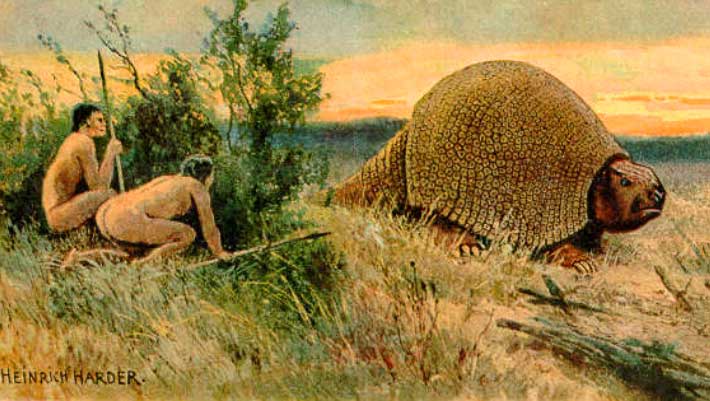
Recent research reveals that the earliest human cultures spreading across the Americas were not mere opportunistic foragers but rather professional big game hunters. These early inhabitants centered their lives around hunting large animals such as mammoths, elephant-like gomphotheres, giant ground sloths, and other Ice Age creatures.
Paleoindians hunting glyptodonts, Pleistocene relatives of armadillos. Artwork by Heinrich Harder, 1920.
For decades, archaeologists have debated whether these early Paleoindians specialized in megafauna hunting or adopted a generalist diet consisting of a variety of small game, fish, plants, and shellfish based on their environment.
In recent years, many scientists leaned toward the generalist hypothesis.
However, a groundbreaking study from the University of Alaska Fairbanks argues otherwise.
Ben Potter, a professor at the University of Alaska Fairbanks, noted, “One prevailing theory emphasizes dietary generalism, suggesting the exploitation of diverse resources that vary regionally.” On the contrary, “the specialization in megafauna hunting focuses on a limited number of large-bodied prey.”
The study evaluated 50 archaeological sites across three regions: Eastern Beringia (ancient Alaska, dating back 14,000 to 13,300 years ago), the Clovis Culture of North America (approximately 13,400 to 12,800 years ago), and the Fishtail Projectile Point Culture of South America (approximately 12,900 to 11,600 years ago).
These cultures represent the earliest expansive human societies throughout the Western Hemisphere.
Focusing on factors like species richness, minimum population size, and edible biomass, researchers found that 83% to 88% of the meat and fat consumed by these groups consisted of megafauna. Woolly mammoths were predominant in Beringia, Columbian mammoths in North America, and giant ground sloths and gomphotheres in South America.
Although evidence of smaller animals exists, their nutritional contribution was minimal.
“Assessing culinary skills involves more than just measuring the presence of specific animals at ancient sites,” Professor Potter explains. “A record of relative natural abundance should indicate that if early populations were dietary generalists, the most common animals would also be prevalent at their campsites.”
“Mammoths and sloths, while rare in the landscape, dominate the archaeological record. In contrast, rabbits and rodents were abundant but often overlooked.”
Further supporting their claims, the researchers highlight chemical analysis from the Clovis-era child known as Anzick-1, which revealed that approximately 96% of the mother’s protein intake came from megafauna, primarily mammoths.
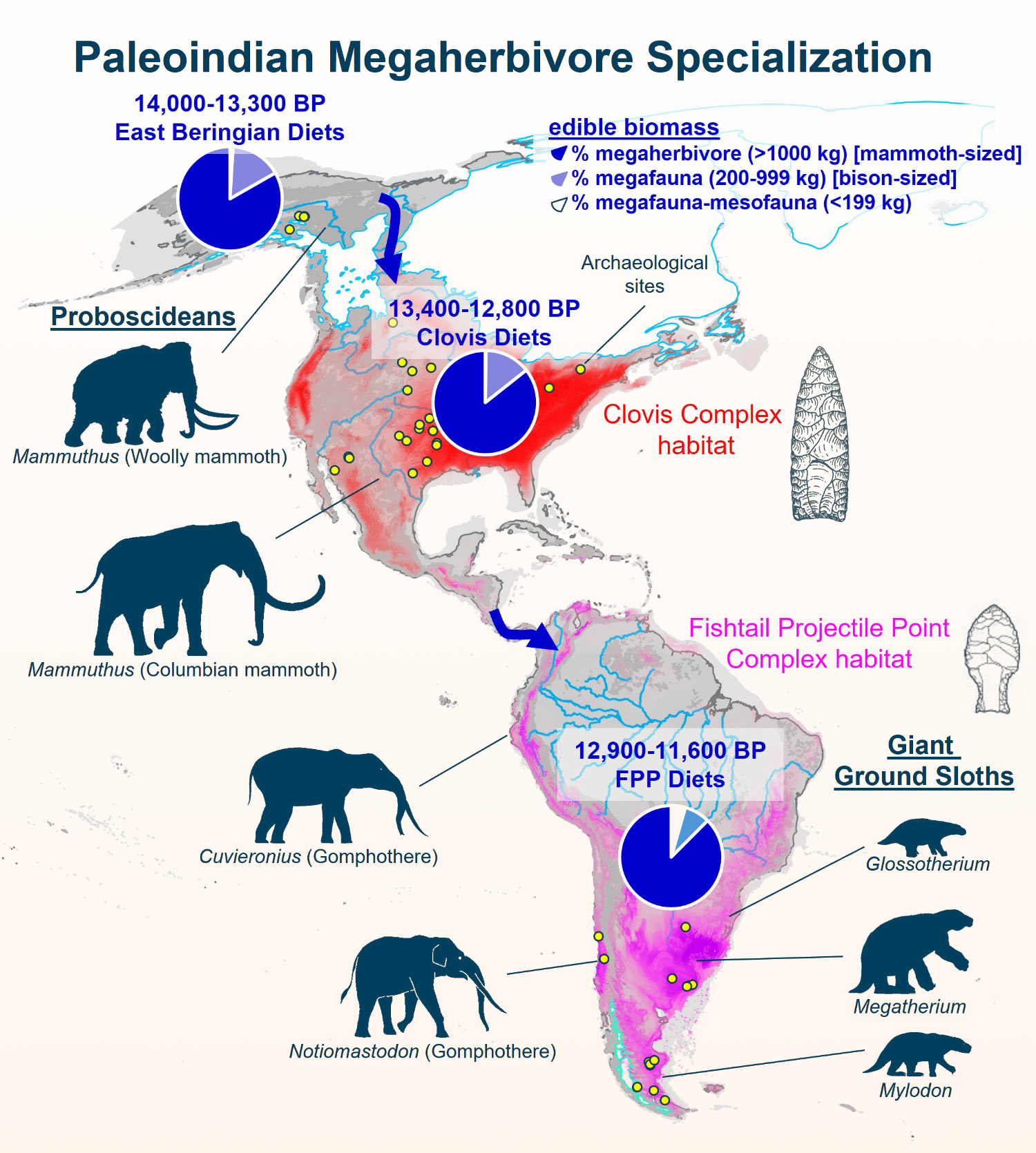
Maps and dietary analysis highlighting how three Paleoindian cultures—East Beringian, Clovis, and Fishtail Projectile Point—specialized in hunting megaherbivores across the Western Hemisphere approximately 14,000 to 11,600 years ago. Image credit: Ben Potter.
“The shared focus on large edible herbivores accounts for the striking similarities in toolkits found across sites from California to Maine and down to Florida,” stated Professor Potter. “Hunting similar animals in diverse landscapes negated the need for significant adaptation of techniques.”
“The archaeological finds included tools designed for large game hunting, such as fluted projectiles and specialized slaughtering implements, while fishing gear and plant processing tools were notably absent.”
This emphasis on hunting large prey also illustrates the rapid human migration from Alaska to South America. When hunter-gatherers ventured into unfamiliar territories, mastering local landscapes and understanding the small and medium-sized game took many generations. Consequently, focusing on large mammals altered this dynamics.
“Mammoths, for instance, are widely distributed and can inhabit extensive regions,” explained Matt Uhler, a professor at the University of Alaska Fairbanks. “In essence, expert hunter-gatherers leveraged their knowledge of megaherbivores, facilitating their expansion across the continents without needing to learn about each new ecosystem.”
The study also suggests that the specialization in hunting large herbivores may have destabilized broader ecological networks, contributing to the wave of megafauna extinctions that came with their expansion into southern territories.
Mammoths and horses vanished from Alaska around 13,300 years ago, coinciding with the earliest known human occupation. The Clovis-era megafauna in North America were gone by 12,800 years ago, while gomphotheres and giant ground sloths lingered in South America until about 11,600 years ago.
“The cycle of arrival, replication, and extinction likely repeated itself, each time moving farther south. This offers compelling circumstantial evidence for human hunting being a primary factor in megafauna extinctions, with climate change potentially exacerbating habitat loss and increasing susceptibility to hunting pressure,” Professor Potter added.
“Megaherbivores reproduce at a slow rate, have broad birthing ranges, and lack natural adult predators. Thus, they might not have developed a learned wariness of technologically advanced hunter-gatherers.”
For more details, refer to the study published on July 1, 2026, in Scientific Progress.
_____
Ben A. Potter et al. 2026. Hemispheric-scale evidence for early Paleoindian megaherbivore specialization. Scientific Progress 12(27); doi: 10.1126/sciadv.aef9628
Source: www.sci.news