


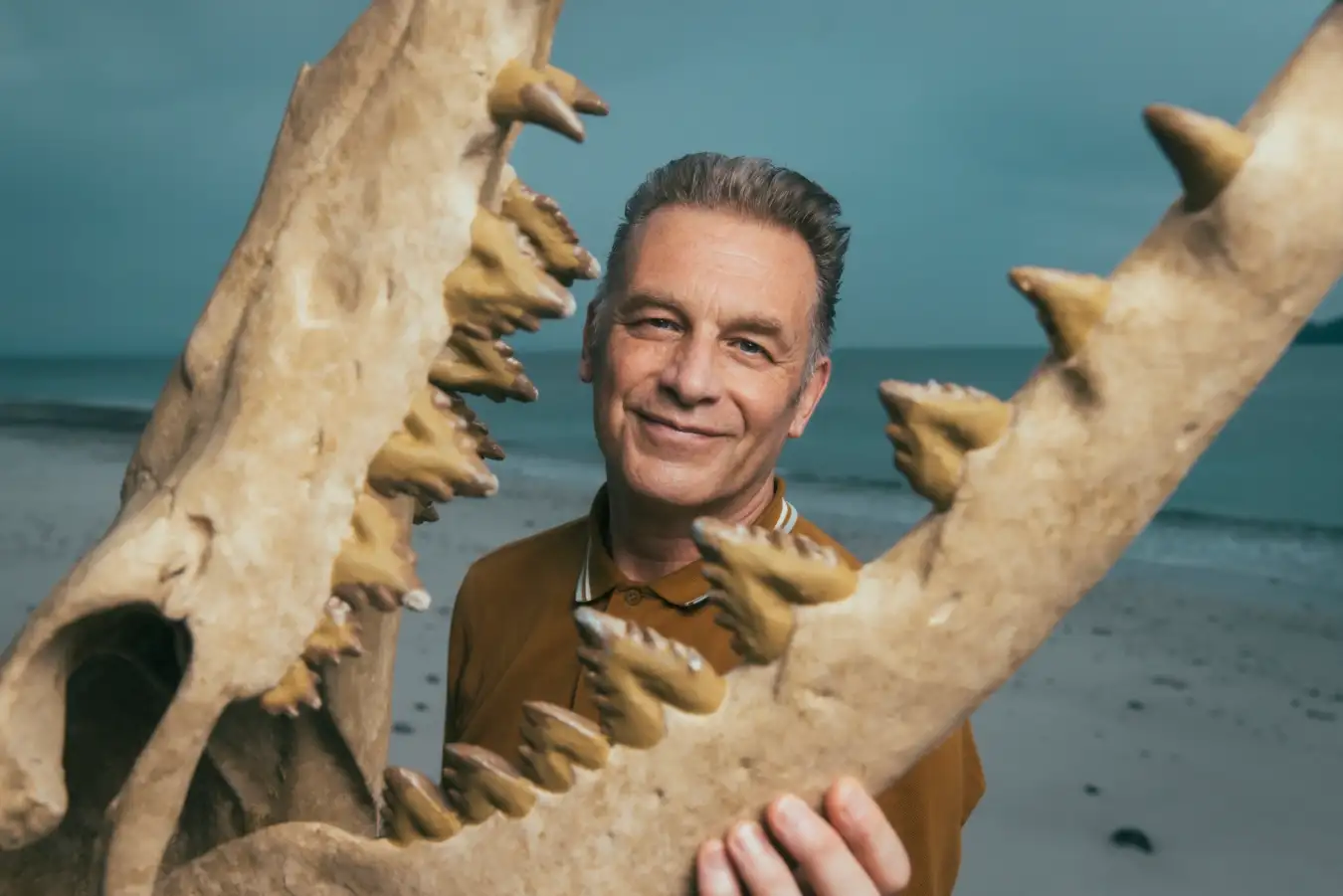
In Evolution, Chris Packham showcases a replica skull of Dorudon atrox, an ancient dolphin ancestor.
BBC Studios/Freddie Clare
Evolution is an exciting five-part series where renowned naturalist Chris Packham explores the evolutionary narratives of five captivating animals. From majestic elephants to fascinating ostriches, he leads us to the origins of all life on Earth and introduces key ancestors through stunning CGI visualizations.
In an interview with New Scientist, he shares how he aims to use cutting-edge science and advanced CGI to shift our perspective from merely appreciating nature to genuinely valuing its importance.
Penny Sarche: Congratulations, Chris! What drew you to this project centered on evolution?
Chris Packham: We thrive on challenges. After our previous series, Earth, which tackled vast time scales and complex events, we wanted to explore something equally intricate yet fascinating. The series was a success, and we felt ready to dive into the complexities of evolution.
Earth taught us valuable lessons. Instead of a traditional classroom approach, we focus on five iconic animals to illustrate the evolution of locomotion, intelligence, feeding, and reproduction among others.
This approach allows us to craft compelling, relatable stories. The goal is to spark excitement and discussions among viewers, encouraging them to share what they’ve learned with friends over coffee or at the pub.
I found the layered exploration of each animal captivating. For example, with bats, we not only investigate their evolution for nighttime flight but also delve into their larger ecological role.
What surprises most people is the simplicity of foundational questions we often overlook. As adults, we sometimes forget to ask why the sky is blue or why stars twinkle. By exploring these topics, we can reignite curiosity and wonder through a scientific lens.
Another aim is to make these iconic creatures pivotal to our understanding. Through CGI, we can vividly illustrate aspects of anatomy that would otherwise exist only in theory, presenting reconstructions of evolutionary transitions, like gills evolving into jaws.
For example, bats consume half their body weight nightly; understanding their adaptations, like echolocation, showcases our intricate connection to life.
Witnessing evolution come alive is exhilarating. My previous learnings were limited to textbooks, but now we blend CGI with scientific insight to create something truly engaging.
Science is ever-evolving. We leverage our storytelling to reflect the latest discoveries, acknowledging that some theories may differ among scientists. Embracing ambiguity enriches the narrative and invites viewers to explore possibilities.

Chris Packham alongside a Baird’s Tapir in Costa Rica, featured in Evolution
BBC Studios/Freddie Clare
What does deepening our understanding of evolution mean for our connection to wildlife?
There is a common misconception that evolution is a finished story, but we are remarkable beings—imaginative, creative, and adaptive. Evolution continues, shaping all life and reinforcing our interconnectedness with nature.
This understanding is crucial as we face environmental challenges. We cannot protect what we don’t care about. Sir David Attenborough has done wonders for inspiring a love of nature, but now, it’s time for us to cultivate a genuine responsibility towards it. The more we learn, the more we care.
If you could time travel for a moment, what would you want to see?
As a kid, I adored the Tyrannosaurus rex. Now, with advances in paleontology, I find myself fascinated by the discoveries transforming our understanding of these ancient creatures. If I could spend five minutes in the Cretaceous period, I would love to observe the T. rex in its natural habitat—its color, its behavior, and even how it hunted.
What an incredible thought!
This would make a fantastic epitaph.

Chris Packham with a rock monitor lizard in South Africa
BBC Studios/Will Edwards
It’s refreshing that Evolution doesn’t just focus on ‘star’ animals but includes their modern relatives and analogues. Do you have a favorite?
I was fascinated by the velvet worm. While I had only seen it in images before, encountering one was remarkable and unforgettable.
The lungfish also caught my attention. I had read about them, but seeing one live was incredible.
Absolutely! The lungfish is fascinating with its unique features. Behind the scenes, we had conversations with scientists, making the experience all the more enriching—I could have talked about it for hours.
You’ve always integrated science into Springwatch. How beneficial would it be to weave science throughout nature programming?
Starting my studies early, I was fortunate to learn from great scientists who inspired me. When approached about Springwatch, I prioritized merging scientific insights with our narratives.
Springwatch uniquely showcases species we’re familiar with, encouraging connections to local wildlife. For instance, a study found that swallows prefer white feathers for nesting, boosting chick survival rates because of their antibacterial properties. These insights bring excitement to viewing.
What do you hope viewers gain from watching Evolution?
My hope is for viewers to feel excitement and curiosity, prompting them to rethink the significance of evolution. Not only is it a fascinating journey of life, but it’s a testament to the incredible diversity on our little blue planet. Do we truly want to jeopardize that?
Evolution premieres in the UK on July 13th on BBC Two and BBC iPlayer.
Topics:
Source: www.newscientist.com