


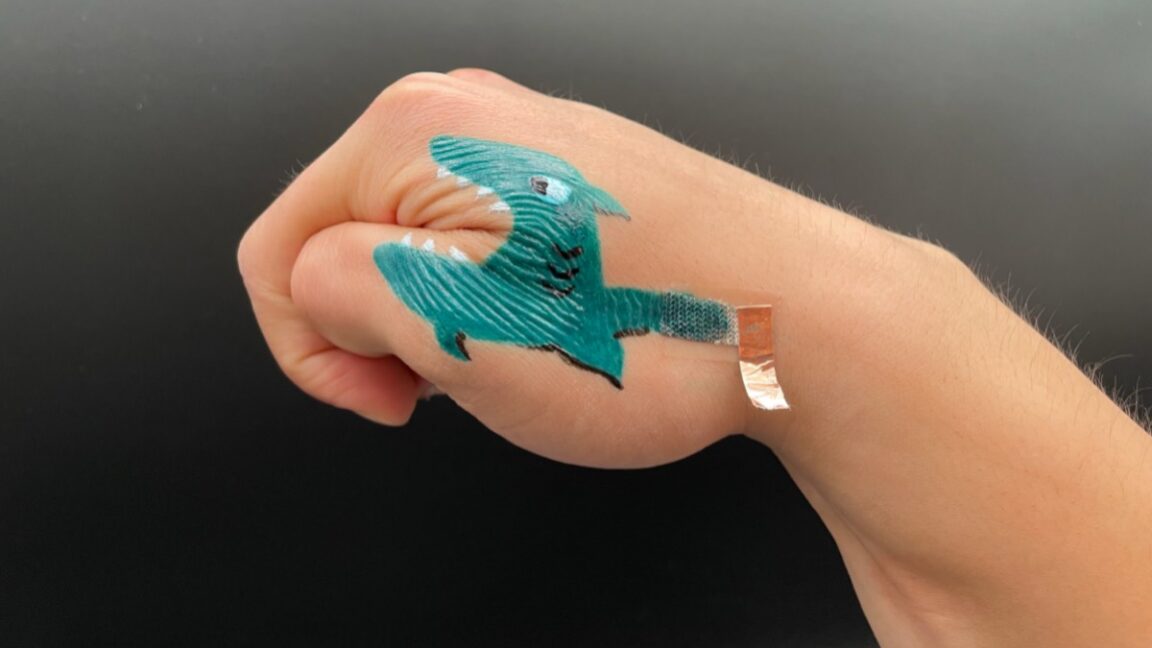
Researchers at Penn State University have engineered a revolutionary conductive ink that can be directly applied to the skin in vibrant, custom designs. Once dried, this innovative ink acts as a fully functional electrode for biological monitoring. Their findings were published in the prestigious Proceedings of the National Academy of Sciences (PNAS).
For over a decade, epidermal electronics, also known as temporary tattoos or e-tattoos, have been utilized to connect to the skin without adhesives. These tattoos are virtually invisible and employ ultrathin polymers embedded with circuit elements to perform electrical measurements, including temperature and strain.
Despite their benefits, current electronic tattoos face challenges, particularly when applied to curved or hairy surfaces. The spatial distribution of biosignals necessitates personalized electrode placement designs for larger areas. To overcome these limitations, scientists have taken innovative approaches. For instance, in 2024, a team developed a polymer-based conductive ink that can be printed onto the scalp to accurately measure brain waves, even with hair present. This advancement could pave the way for mobile EEG monitoring and other non-clinical applications in the future.
Penn State mechanical engineer Larry Chen, co-author of the recent PNAS study, has dedicated over a decade to designing electrodes for biomonitoring applications, including EEG, ECG (for cardiac measurements), and EMG (for muscle activity). Traditional materials like metals ensure stability but can detach easily during movement, particularly in active scenarios. In recent years, hydrogels have been explored as a more flexible alternative, as they can absorb moisture and adapt to the skin’s movement during exercise. However, hydrogels tend to degrade quickly and lose effectiveness over time.
As Easy as Face Painting
Factors such as sweat and hair can significantly impact the accuracy of biosignal recordings. Commercially available electrodes are often pre-made and applied to the skin, resulting in air gaps that compromise sensor effectiveness. To tackle this issue, Chen and his team developed a conductive ink. They combined several polymers and acidic additives in a water-based ethanol/polyvinyl alcohol solution. The inclusion of PEDOT:PSS (poly(3,4-ethylenedioxythiophene): poly(styrene sulfonate)) enhances electrical conductivity, while DBSA (4-dodecylbenzenesulfonic acid) serves as a plasticizer, ensuring the ink remains flexible.
Source: arstechnica.com