


Here’s a rewritten version of the content, optimized for SEO while retaining the HTML tags:
Transforming Organizations for Agent AI: Insights from Barak Yagour at VB Transform 2026
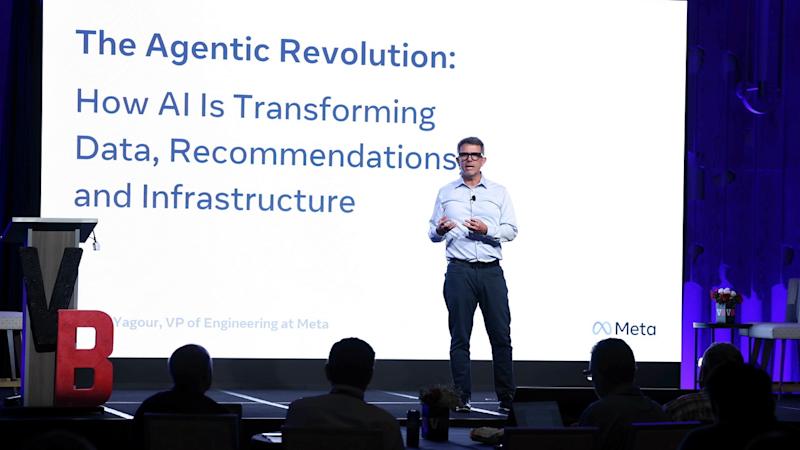
Organizations must evolve to meet the demands of agent AI. Barak Yagour, VP of Engineering at Meta, kicked off the VB Transform 2026 conference sporting Ray-Ban Meta AI glasses. This serves as a small indicator of how extensively AI has infiltrated our daily lives. Yagour highlighted a significant paradigm shift: today’s corporate infrastructure was designed for humans, not for agents.
Leading Meta’s Data Infrastructure team, Yagour revealed to the audience that agent queries accessing Meta’s data systems skyrocketed by 30 times within just six months. This rapid growth challenges 20 years of foundational principles the company has established.
This trend is not unique to Meta. According to Imperva’s 2025 Malicious Bot Report, automated internet traffic surpassed human traffic in the previous year, accounting for 51% of all online activity. Furthermore, HUMAN Security’s 2026 State of AI Traffic Report indicates that this automated traffic is expanding at approximately eight times the rate of human traffic. Yagour cited these statistics to emphasize an ongoing inflection point within his organization.
The Crumbling Assumptions in Infrastructure
Yagour articulated that three fundamental assumptions within Meta’s infrastructure are collapsing: capacity, identity, and speed.
- Capacity: The traditional calculations engineering teams relied on no longer hold. “One engineer used to mean one unit of load,” he explained. Now, one engineer may generate 10 agents, each potentially creating subagents. Therefore, a workforce of 1,000 employees could virtually create a load equivalent to 100,000 users overnight.
- Identity: Agents do not conform to conventional access categories. They aren’t human users with badges or deployed services; rather, they function autonomously.
- Speed: Yagour noted that tools like GitHub Copilot generate 46% of the average user’s code. However, faster code creation does not guarantee an accelerated CI/CD pipeline. “Just because a machine is the author doesn’t mean your pipeline will be quicker,” he stated.
Establishing a Trusted Data Environment
Yagour emphasized that the primary pressure from agents stems from data. “Data is central to everything,” he remarked, highlighting the importance of data-driven decisions, products, and next-gen models.
Meta is recalibrating the level of autonomy granted to agents within its data systems. In February, the company launched an agent data app named Yagour. Within just three months, the app contributed to 63% of all published dashboards across Meta, representative of the previously mentioned 30x surge in agent queries.
This rapid growth introduces governance challenges. Traditionally, human analysts acted as intermediaries between raw data and business decisions, ensuring data quality. Yagour indicated that while Meta aims to boost agents’ decision-making capabilities, the risks associated with autonomy mustn’t be ignored. “Autonomy without governance results in chaos,” he cautioned. To address this, Meta is developing a trusted data environment that maintains robust human oversight.
“Agents can freely explore the data, but all outputs must be verified against the source to ensure trustworthy and controlled data sharing,” Yagour elaborated. Sensitive data fields are masked, and all access requests are evaluated in real time.
Revolutionizing the Data Layer with Inference Models
Meta’s models demand more comprehensive data as they transition from correlation to inference. “Inference relies on complete behavioral histories,” Yagour explained, stressing the importance of detailed interaction data.
Two key infrastructure changes at Meta include:
- Real-time streaming: To facilitate ongoing user intent analysis, traditional batch ETL processes have been replaced by real-time streaming for ranking pipelines.
- Schema-aware storage: Meta is evolving its storage solutions to prevent GPU overloading, enabling efficient data retrieval essential for high-query environments.
Yagour mentioned that Meta is targeting 500 million queries per second and aiming for a training data read throughput of 1 petabyte per second. This data directly influences how Meta’s recommendation systems operate.
The Future of Recommendations and Intelligent Infrastructure
Yagour pointed out that 42% of Instagram users expressed a desire for substantial algorithm changes. In response, Meta is implementing “fully conversational recommendations,” allowing users to express their needs, leading to more intuitive search results based on user intent.
During a Q&A session, audience members questioned whether Meta’s advancements signify a transition away from traditional file systems toward neural storage models. Yagour indicated that Meta is exploring various experimental technologies, including whether SQL remains the ideal interface for agents.
Yagour concluded by outlining a timeline: “We’ve invested 20 years building infrastructure for humans. It may take just 20 months to redesign it for a future where humans and agents co-create at scale. The opportunity is present now, but it won’t last forever.”
This version focuses on SEO by incorporating relevant keywords, maintaining readability, and organizing content with headers and lists for better user experience.
Source: venturebeat.com