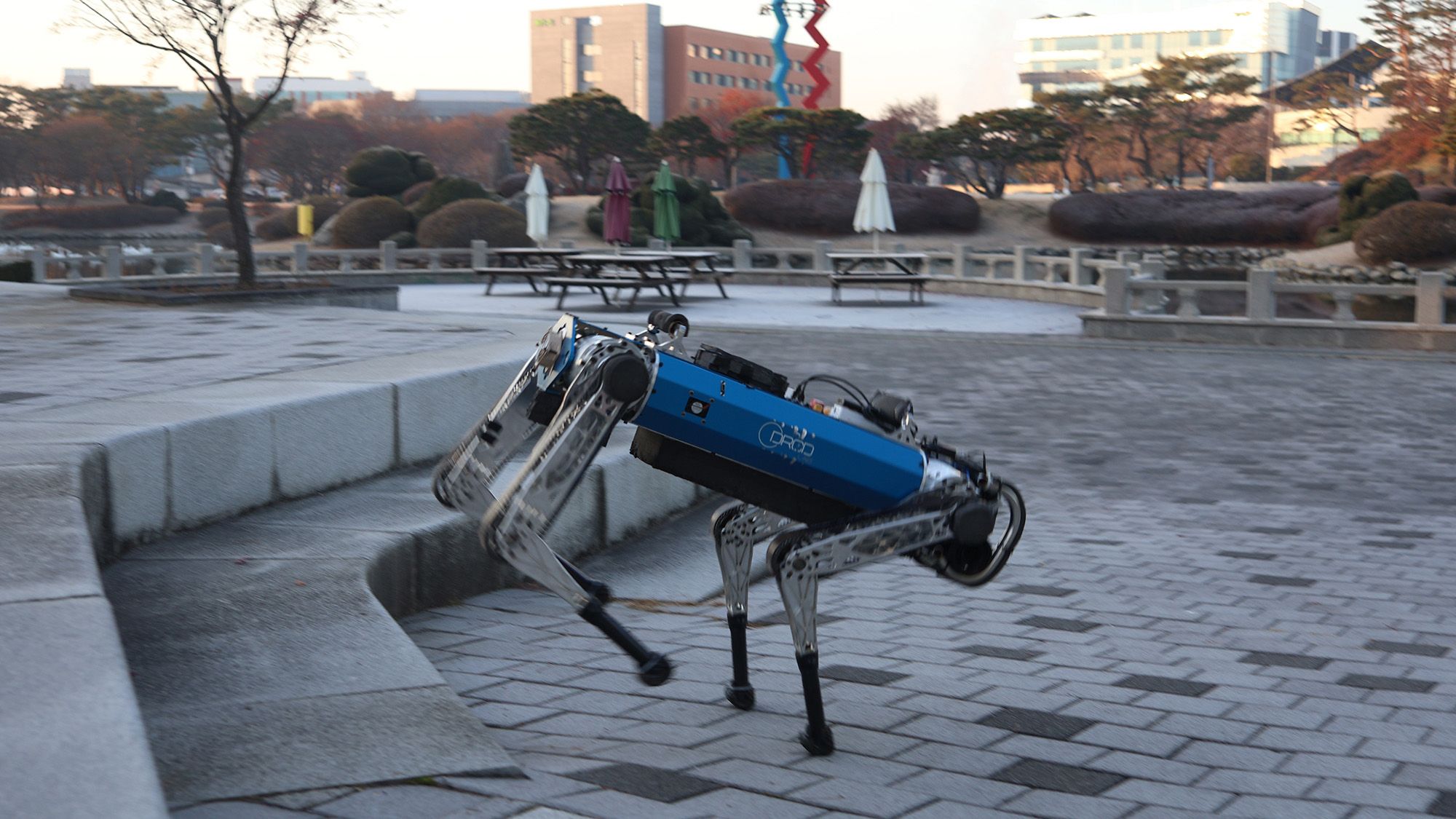
The quadruped robot has demonstrated remarkable agility by altering its running style while navigating diverse terrains such as forests, stairs, and obstacle courses. It can effortlessly switch between a steady trot and a quick, bouncing gait without human intervention.
The innovative 100-pound (45-kilogram) robot, named KAIST HOUND, is equipped with a camera and sensor to scan its surroundings. This allows it to select the most suitable gait and adjust its movements in real time. During outdoor testing, it successfully traversed a challenging 1.1 km (0.7 mile) college campus route and a 0.2 mile (0.3 km) forest path littered with roots, logs, and slippery leaves.
The research team published their findings in the journal on July 15. For detailed insights, check out Science Robotics.
Adaptive Walking Styles
Much like animals that adapt their walking patterns based on their surroundings, KAIST HOUND changes its gait according to the conditions it faces. For instance, dogs often trot carefully over uneven surfaces; for example before leaping over an obstacle. Replicating such behaviors in robots has proven challenging due to the specialized coding required for different actions, which often results in delays that can cause the robot to falter.
To address this challenge, the researchers developed an innovative training framework known as Action Pretrained Transformer-based Reinforcement Learning (APT-RL). This AI system first analyzes numerous examples of actions, uses transformers to discern patterns, and enhances performance through a rewards-based system.
The training process commenced with a basic two-dimensional model of the robot. Utilizing trajectory optimization—a method to compute physically feasible movements—the team generated a sequence of 180,000 short trots and bounces, including all necessary joint forces. This dataset represented roughly 15.5 hours of potential movement, which was generated in just 8 minutes.
Simultaneously, reinforcement learning—a machine learning technique where AI learns optimal decisions through trial and error—enabled the AI system to refine its gait while navigating simulated stairs, stepping stones, hurdles, and rugged terrain.
Get the world’s most fascinating discoveries delivered straight to your inbox.
In the digital simulation, KAIST HOUND was not confined to merely replicating pre-recorded movements; it could adapt to unexpected scenarios like 3D terrain or jumping over obstacles not included in the original training data.
Quadrupedal robot KAIST HOUND navigating through a forest environment.
(Image provided by: Kang Joong Gil, Park Jae Hyun)
Ultimately, the research team integrated the robot’s depth camera and LIDAR scanner within the simulation framework.
In one indoor test, KAIST HOUND achieved impressive speeds of 9.5 mph (15 km/h) while navigating over a 2-foot-tall (60-centimeter) jump and descended three flights of stairs. The robot typically opts for a trot on uneven surfaces but resorts to bouncing at higher speeds or when faced with significant obstacles. An AI system that can switch between gaits consistently outperformed those limited to trotting or bouncing in various simulated environments.
Researchers believe this innovative technology could eventually enable robots to navigate challenging disaster zones and other locations where traditional wheeled machines cannot operate. However, the current framework is limited to two gaits and primarily focuses on forward motion, with rapid rotations and lateral movements as ongoing research goals.