


250 Years of America: Spark of Revolution
a Smithsonian Magazine special report
The Kepler Telescope Revolutionized Our Understanding of the Universe. Explore the groundbreaking devices we send beyond Earth to delve into our solar system.
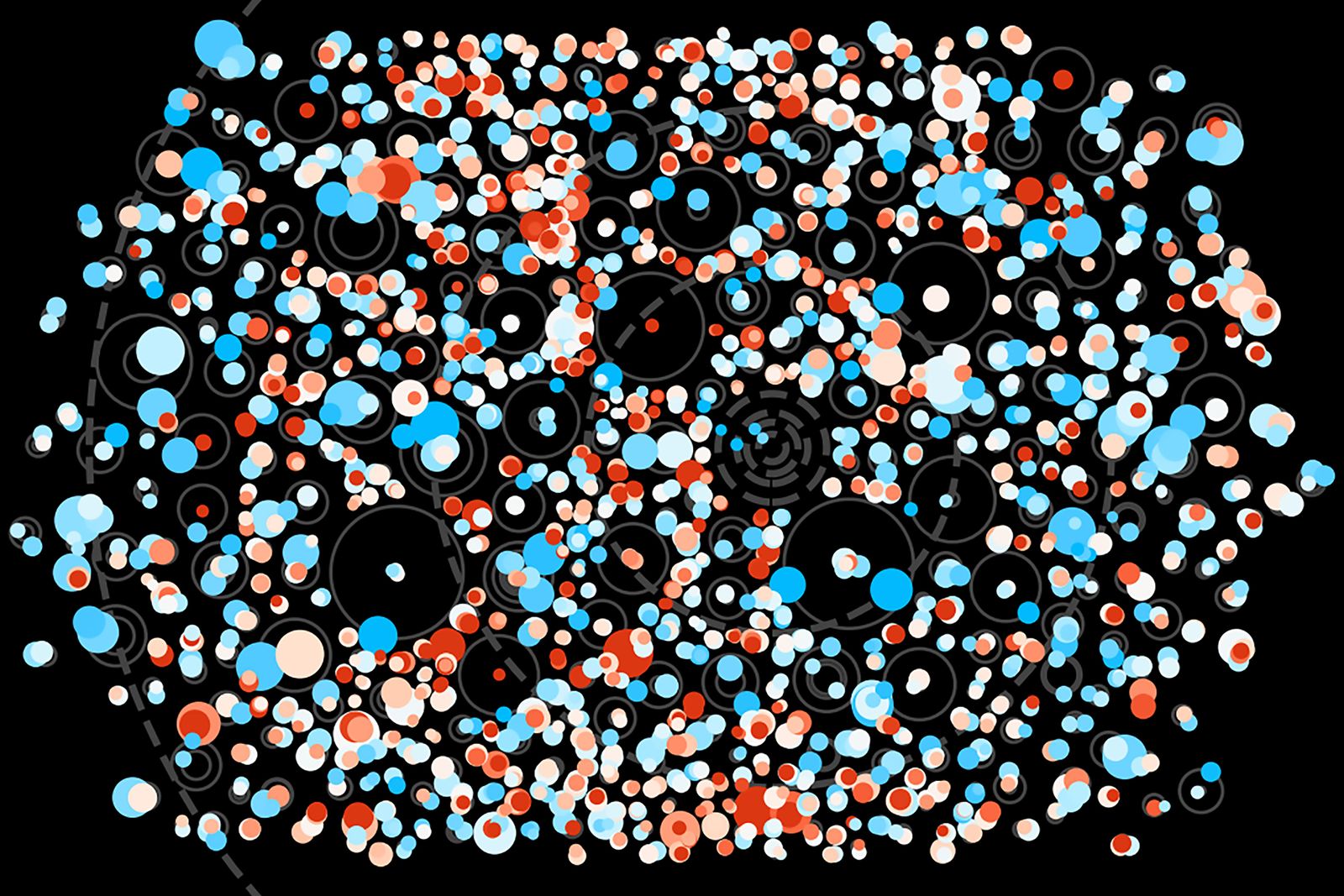
Data visualization by Ethan Kruse
On September 9, 1999, a 25-year-old Harvard graduate, David Charbonneau, achieved a pivotal astronomical milestone using a 4-inch telescope in a Colorado parking lot. Working with advisor Tim Brown, they focused on the star HD 209458, aiming to detect its orbiting planet through photometry, a method that measures starlight. At the time, NASA was contemplating funding the Kepler mission, and the odds were against them; photometry had never successfully found an exoplanet.
In 1999, confirmed exoplanets were rare and mostly gas giants like Jupiter, detected using Doppler spectroscopy. This method tracked color shifts in stars caused by orbiting planets but often struggled with smaller, more distant worlds. Around HD 209458, anomalous signals suggested a planet, although alternate explanations like stellar activity existed.
Charbonneau and Brown’s photometric approach could confirm planetary existence more conclusively. Unlike most telescopes, Brown engineered theirs to detect even minute 1% brightness variations from the star due to a transiting Jupiter-sized planet.
As they honed in on HD 209458, Charbonneau observed a predicted 1% dip in brightness. This milestone marked the first definitive photometric evidence of a planet transiting a star. Initially apprehensive, he later validated the finding when another team reported similar observations.
The Kepler astronomical observation device V

Many consider Charbonneau’s breakthrough the moment NASA greenlit the Kepler mission, which ultimately confirmed over 2,700 exoplanets. William Borucki, the mission’s lead, championed photometry as the best method for identifying rocky, potentially habitable worlds outside our solar system.
Navigating through development, the Kepler mission received official approval from NASA in 2001. The Kepler Space Telescope launched on March 6, 2009, aboard a Delta II rocket from Cape Canaveral, Florida. The telescope’s unique design allowed it to detect brightness changes as small as 0.002%. Over four years, it focused on around 200,000 stars, continuously monitoring their light as it orbited the sun.
The mission soon yielded astounding results, discovering five new exoplanets within six weeks of launch. By December 2011, scientists discovered the first planet within a star’s habitable zone—an area capable of supporting life. NASA officials successfully extended the mission’s scope in 2013 with phase two, known as K2, studying an additional 500,000 stars. In April 2014, researchers announced the detection of the first Earth-sized rocky planet.
Though the spacecraft ran out of fuel in 2018, its robust discoveries continued, including the identification of planets like Tatooine and gas giants with unusual densities. These findings propelled exoplanet research, leading to missions like NASA’s TESS spacecraft and the upcoming Nancy Grace Roman Telescope, which aims to detect smaller planets and capture images of distant worlds.
Viewed in context, Kepler’s mission was modest. Since 1958, NASA has dispatched probes to every planet, delivering invaluable data. Yet, Kepler transformed our understanding of planetary systems, revealing that exoplanets are not just anomalies but common throughout the cosmos, some potentially supporting life. With Kepler, humanity shifted from merely gazing at stars to understanding the vast possibilities within our galaxy.
/https://tf-cmsv2-smithsonianmag-media.s3.amazonaws.com/filer_public/41/81/41813f88-9653-4da4-863e-1c2099939eb8/mariner_2_and_mariner_4.jpg)
About the Pioneer and Voyager missions: Pioneer 10 launched in 1972, studying Jupiter’s radiation and magnetic fields. Its sister craft, Voyager 1, found volcanic activity on Io, while Voyager 2 discovered new rings around Uranus and Neptune.
/https://tf-cmsv2-smithsonianmag-media.s3.amazonaws.com/filer_public/d0/9e/d09e1fa4-f125-4114-a51b-62567c725238/the_pioneers_and_voyagers.jpg)
Galileo, Cassini and Juno: Galileo gathered data about Jupiter and its moons from 1995-2003, demonstrating evidence of Europa’s subsurface ocean. Cassini studied Saturn from 2004, deploying the Huygens probe to Titan, while Juno, launched in 2011, revealed that Jupiter’s bands extend 1,900 miles deep.
/https://tf-cmsv2-smithsonianmag-media.s3.amazonaws.com/filer_public/c5/4e/c54e6677-e37c-41c9-b51d-8dda8ded5103/galileo_cassini_and_juno.jpg)
Mars Rovers: The 1997 Pathfinder mission deployed Sojourner, the first mobile vehicle on Mars, which analyzed rock samples. Subsequent missions Spirit and Opportunity confirmed ancient water flows, while Curiosity and Perseverance advanced exploration with groundbreaking technologies.
/https://tf-cmsv2-smithsonianmag-media.s3.amazonaws.com/filer_public/01/50/0150727e-8e37-4948-9b97-4b5433038a23/the_mars_rovers.jpg)
Europa Clipper and Dragonfly: Scheduled for 2030, Europa Clipper will analyze Jupiter’s moon environments for habitability, while Dragonfly, launching in 2028, will explore Saturn’s moon Titan, equipped with advanced imaging and sampling tools.
/https://tf-cmsv2-smithsonianmag-media.s3.amazonaws.com/filer_public/76/2f/762fd984-4164-4117-8931-77d7ce84a4ae/europa_clipper_and_dragonfly.jpg)

Source: www.smithsonianmag.com