


Scientists Discover 84 Mysterious Hypersoft X-Ray Sources in Six Galaxies
Astronomers have identified 84 extremely soft X-ray sources in six galaxies, revealing a previously unknown class of objects that emit low-energy X-rays and intense ultraviolet radiation.
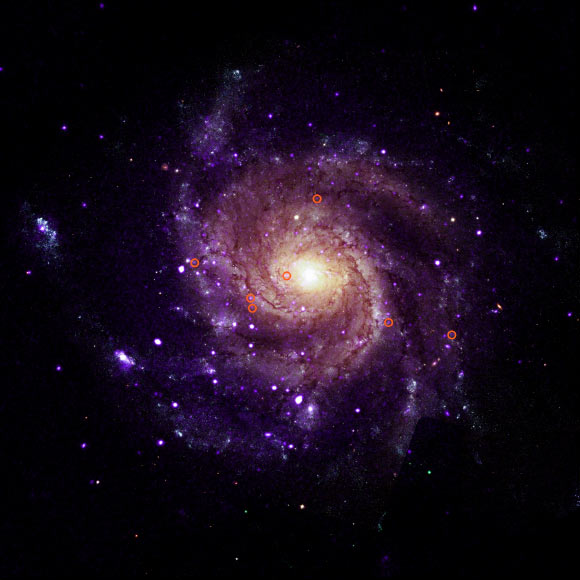
This composite image shows the location of an extremely soft X-ray source in the face-on spiral galaxy Messier 101. Image credit: NASA / CXC / University of Alabama / Muhibullah et al. / ESA / STScI / SAO / N. Walk.
What are hypersoft X-ray sources?
Dubbed “hypersoft X-ray sources,” these objects emit extremely low-energy X-rays that are difficult to detect. Although they are weak in the conventional X-ray band, some of them appear to be highly energetic.
“We’ve never encountered a group of objects that behave like this before,” said Dr. Mustafa Muhibullah, an astronomer at the University of Alabama. “The next step, of course, was to figure out what these were.”
84 sources found in six galaxies
For the study, astronomers analyzed archival data from NASA’s Chandra X-ray Observatory. They discovered 84 supersoft X-ray sources in six different galaxies.
Two of the galaxies—Andromeda and Messier 101—are spiral galaxies, while the other four are elliptical galaxies. The sources were found both in regions of active star formation and in areas populated by older stars.
Possible origins of the mysterious X-rays
Scientists believe the hypersoft sources may not represent a single type of astronomical object. Instead, they could be a mixture of different systems, including white dwarfs pulling material from companion stars, smoldering debris left after nova eruptions, and black holes accreting material.
Because low-energy X-rays are adjacent to high-energy ultraviolet radiation on the electromagnetic spectrum, the researchers determined that these sources also produce large amounts of high-energy ultraviolet radiation.
“We don’t know what types of objects are responsible for these low-energy X-rays or strong ultraviolet rays,” the researchers said. “We think they are most likely associated with black holes, neutron stars, or white dwarfs that pull material from their companion stars.”
Hidden binary systems could explain the discovery
The finding suggests that many previously undetected binary star systems may produce high-energy ultraviolet radiation.
“These secret X-ray sources are actually some of the most energetic objects in the galaxy and have the potential to solve two cosmic mysteries at once,” Dr. Muhibullah said.
The study, “Hypersoft X-ray sources as bright cosmic emitters of the low energy class,” was published online on September 9, 2026, in Nature Astronomy.
_____
M. Muhibullah et al. Hypersoft X-ray sources as bright cosmic emitters of the low energy class. Nature Astronomy, published online September 9, 2026. doi: 10.1038/s41550-026-02959-7
Source: www.sci.news