


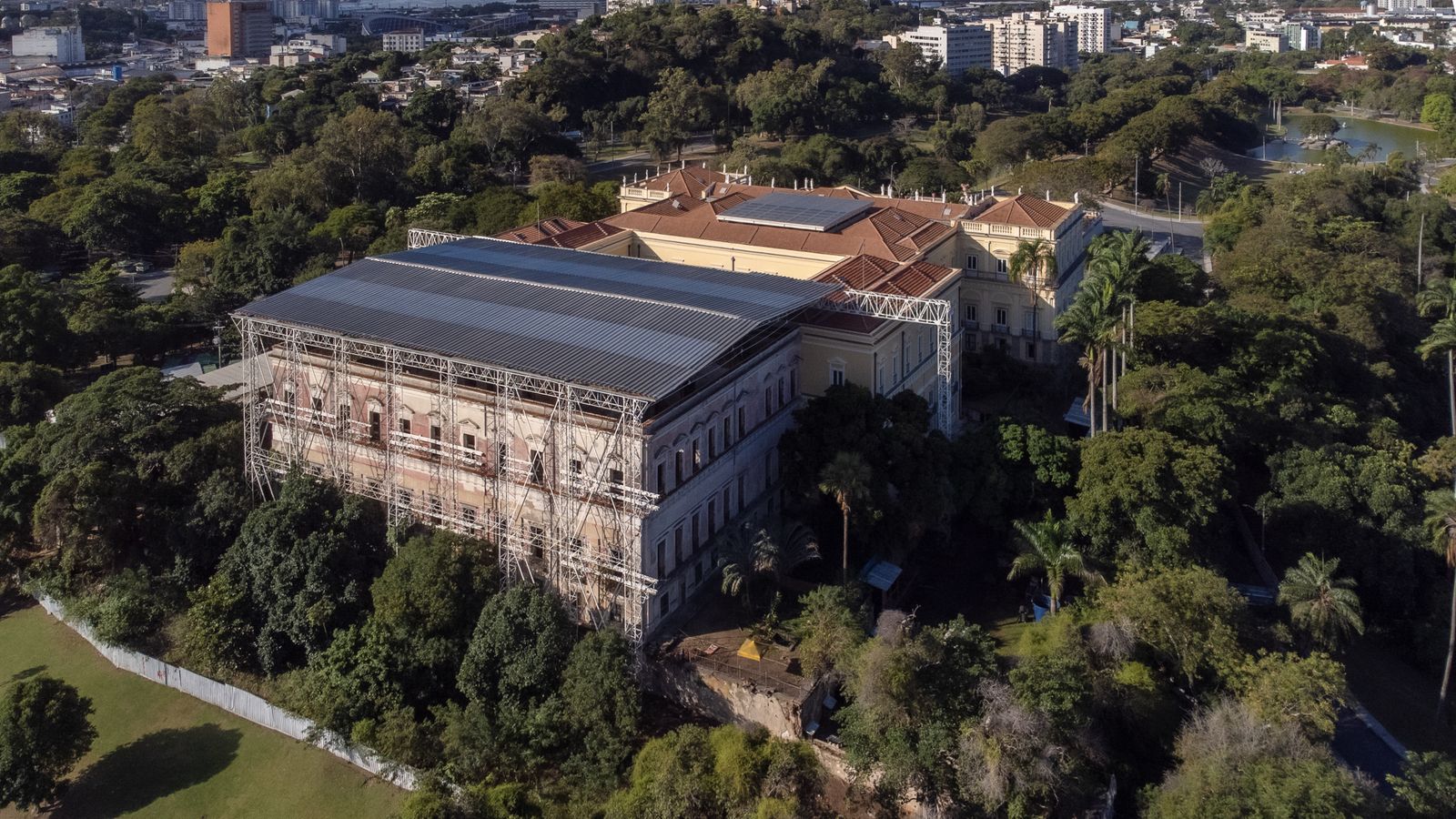
After a devastating fire in 2018 that consumed invaluable artifacts and critical specimens, the dedicated staff at Brazil’s National Museum have been tirelessly working to reopen their doors to the public.
:focal(2500x1429:2501x1430)/https://tf-cmsv2-smithsonianmag-media.s3.amazonaws.com/filer_public/8c/63/8c63d32b-0c6c-42d8-93a0-c3da48f7acd0/copia_de_dji_0151.jpg)
Felipe Cohen / Project Museum Nacional Vive
The news brought a mix of excitement and sorrow. The National Museum of Brazil, the oldest national history museum in the Americas, is set to partially reopen after the catastrophic fire in 2018 that consumed over 16 million objects, or 80% of its collection. “We released tickets, and they sold out within hours,” states Ronaldo Fernández, a manager at the esteemed institution.
Historically, around 300,000 Brazilian schoolchildren visited the museum annually. My partner was fortunate to be one of them, securing free tickets to a special exhibition. The museum’s building, Paso San Cristovan, once served as the residence of Portuguese and Brazilian monarchs, showcasing a magnificent yellow and white façade that has been restored, along with 30 statues of Greek deities gracing its rooftop. Notably, the Bendego meteorite, an 11,820-pound space rock unearthed in Brazil in 1784, miraculously endured the flames and remains on display.
Much of the museum still shows signs of damage, with blackened walls and twisted steel beams apparent throughout. However, on a brighter note, visitors can now behold a newly acquired 51-and-a-half-foot-long sperm whale skeleton, suspended under a modern 138-panel skylight. My curiosity was piqued, but I know I must wait; the museum is on a path to fully reopen by 2029.
The fire, which ignited on Sept. 2, 2018, was triggered by an electrical fault and worsened when a nearby fire hydrant was discovered to be dry. A comprehensive 160-page report compiled post-incident outlines the museum’s continuous struggle with funding. The museum’s founder, Alexander Kellner, noted that warnings about fire hazards had been raised as early as 2004.
“Just a week before the fire, we consulted with fire safety experts,” said Fernández, who was the assistant director at that time and took up the lead role earlier this year. Funding for maintenance arrived in light of the museum’s 200th anniversary, but the fire occurred before preventative measures could be implemented.
Did you know? What caused the fire?
Local authorities reported that the blaze originated from an improperly installed air conditioning unit, exacerbated by a lack of fire safety measures, including the absence of sprinklers and fire doors.
/https://tf-cmsv2-smithsonianmag-media.s3.amazonaws.com/filer_public/56/35/56359dcc-4bc2-426e-9de3-bbe1fd0739bb/img_0398.jpg)
Felipe Cohen / Project Museum Nacional Vive
The day after the fire, crowds gathered outside the museum, anxious to assess the damage. When an individual attempted to fence-jump, police reacted with tear gas and pepper spray. The outer structure, historically constructed by enslaved Africans, remained intact. However, historian Regina Dantas recalled her despair upon entering her office, finding everything incinerated. “I was heartbroken,” she shared. “I lost everything; I didn’t even have a pen.”
Fortunately, artifacts stored in a nearby building survived the fire. These include Torah scrolls from the 13th and 14th centuries, a variety of vertebrate and plant specimens, and a library containing 500,000 volumes. Some researchers rushed into the main structure during the early stages of the blaze, striving to salvage significant specimens vital for defining entire species. Regrettably, the losses were profound, including an Egyptian mummy, a Hawaiian royal feather cloak gifted to Brazil’s last regent, unique recordings of a now-extinct indigenous language, and the museum’s comprehensive insect collection.
A non-profit organization known as the National Vitality Project Museum—“The National Museum is Alive”—is actively seeking funds for the museum’s revival, with backing from UNESCO, the Federal University of Rio de Janeiro, and the Vale Institute of Culture. However, the initiative still faces a shortfall of approximately $29 million. Fundraising presents challenges unlike those faced during the reconstruction of Notre Dame Cathedral in Paris, where pledges nearing $1 billion were collected within two days post-fire in 2019, driven by substantial donations from wealthy families connected to luxury brands like Louis Vuitton. “In France, the culture of donating to restore and preserve heritage sites differs greatly from our own,” remarked Larissa Graça, the technical manager for the fundraising non-profit.
Brazil’s Ministry of Education allocated approximately $2.35 million to initiate reconstruction efforts. Workers meticulously treated the palace as if it were an archaeological site, layer by layer, in hopes of recovering items that may have survived the fire. Remarkably, fragments of a French vase gifted to Emperor Dom Pedro II and the skull of Luzia have been recovered—Luzia being the oldest human remains ever found in the Americas. Around 5,000 artifacts excavated from the debris are currently undergoing restoration, a lengthy process that could span decades. “Neither you nor I may witness their completion,” Fernández remarked.
Upon reaching the final layers of rubble, workers unearthed an unexpected discovery—the foundation of the chapel. “We always knew a chapel existed… and now we’ve found it,” Fernández stated. The fire also revealed historical brickwork and wallpaper thought to be hidden since the last Brazilian monarch’s exile in 1889.
“Surely, the fire was a catastrophe, but it also provided us with a deeper understanding of this building’s history and the people who constructed it,” Graça, who has worked on multiple museum projects in Brazil, including the museum in São Paulo—which was similarly damaged by fire in 2015—shared.
/https://tf-cmsv2-smithsonianmag-media.s3.amazonaws.com/filer_public/d6/0e/d60e5596-fe56-4c32-8821-b997426fe8c9/escavacao.jpg)
Felipe Cohen / Project Museum Nacional Vive
The revitalized museum will feature elements of the ruins, such as the chapel foundation. Plans include preserving charred walls and exposed beams to honor the tragedy. “This fire has become a significant part of this building’s legacy, and it should be preserved as such,” Fernández affirmed.
Simultaneously, new artifacts continue to arrive, with over 16,700 received thus far. Swiss-German collector Burkhard Pohl, who oversees one of the world’s largest fossil collections, generously donated 1,105 fossils from the 115 million-year-old Araripe Basin in northern Brazil. Additionally, the National Museum of Denmark has returned the Tupinamba’s feather cloak, which was taken from Brazil in 1689. “The cloak is considered an ancestor,” Fernández explained. “It is a crucial piece of Brazil’s cultural heritage, and we are thrilled to have it back.”
However, the museum’s aspirations are not only focused on rebuilding their collection. Historically, many institutions have exhibited numerous artifacts obtained through questionable means, failing to involve the indigenous peoples and enslaved Africans who have significantly impacted the nation’s history. “Throughout this process, we’ve engaged in substantive discussions about how to transition the museum away from colonial narratives and foster collective thinking,” Graça added.
/https://tf-cmsv2-smithsonianmag-media.s3.amazonaws.com/filer_public/0c/6c/0c6c2898-3fde-45bc-b0d8-7dc45e61b0e4/paco_nov25_felipecohen_pmnv.png)
Felipe Cohen / Project Museum Nacional Vive
Curators are leveraging the reconstruction as an opportunity to collaborate with indigenous leaders and Afro-Brazilian Quilombo leaders to enhance representation in upcoming exhibits. They are actively documenting these discussions on YouTube. Museum representatives are traveling nationwide to solicit donations directly. “We visit tribes and communities and ask: ‘Do you wish to be represented in a national museum? If so, how would you prefer to be represented?”
One challenge highlighted by Graça is weaving the narratives of the individuals who constructed the palace into the museum’s story. “We recognize that the official history we present is predominantly white, while the creation of this building involved black laborers. How can we acknowledge their contributions, stories, and significance?”
As restoration progresses, the museum has two major events planned for 2026: one in June to celebrate the 208th anniversary of its founding, and another in September to mark the eighth anniversary of the fire. “It’s essential to keep museums in public consciousness,” Fernández emphasizes.
Graça envisions that the revitalized National Museum will ignite curiosity and inspire a new wave of Brazilian schoolchildren. “Understanding our history is essential as we contemplate our future possibilities,” she concludes.
Source: www.smithsonianmag.com