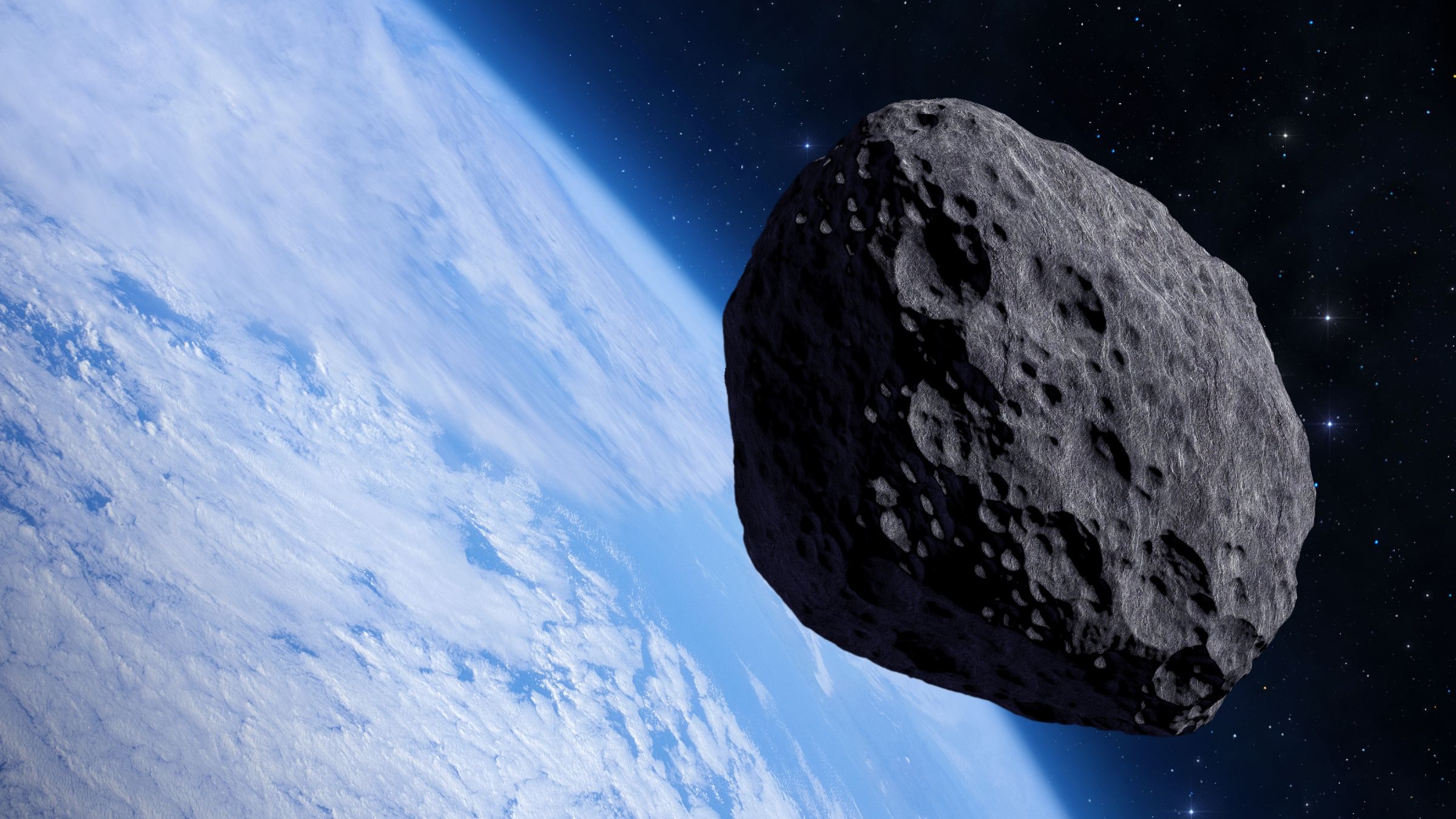
In just three years, up to 90% of the Earth’s population could witness the magnificent “God of Chaos” asteroid, Apophis, pass by our planet. This gargantuan space rock, comparable in size to a skyscraper, will be closer than many satellites and easily observable with the naked eye during its journey through space—an event described as a “once in 1,000 years” astronomical spectacle.
This historic approach marks the first time humanity can predict the visibility of an asteroid with the naked eye, creating a unique experience for nearly 7.6 billion people around the globe, as noted by scientists at the recent Apophis T-3 Year workshop held on June 18-19 at the University of Padua, Italy.
“Observing Apophis will evoke a sense of shared cosmic connection and highlight Earth’s insignificance in the vast universe,” stated Richard Binzel, a planetary scientist and asteroid specialist at MIT who contributed to the workshop’s organization.
Known as 99942 Apophis, this elongated asteroid measures approximately 1,500 feet (450 meters) in diameter—comparable in height to the Empire State Building. Large enough to potentially devastate a city, Apophis likely originates from the main asteroid belt situated between Mars and Jupiter, but currently resides between the orbits of Venus and Earth, completing a circuit around the sun roughly every 10.5 months. Its foreboding name comes from Apep, the Egyptian serpent god embodying chaos and darkness.
On April 13, 2029, Apophis is poised to approach Earth at an astonishingly close distance of about 19,000 miles (30,600 km)—much nearer than the International Space Station and thousands of other spacecraft. Thankfully, Apophis poses no threat to high-altitude satellites, as they can easily adjust their trajectories.
During the recent Apophis T-3 Years workshop, scientists presented a new map showing the potential observation range of the asteroid during its seven-hour flight around Earth.
There is currently zero probability that Apophis will impact Earth during its flyby or in the next 100 years; however, some experts point to a slight possibility that changes in its orbit could occur. Future flybys are a concern as they may alter the orbit of this space rock, potentially increasing impact chances.
Scientists are eager to closely monitor Apophis’s flyby and plan to coordinate global telescope observations to improve understanding of this potentially hazardous asteroid. Several spacecraft, including NASA’s Osiris-Rex, will aim to study Apophis’s structure and trajectory. The significance of this encounter has led the United Nations to declare 2029 as the International Year of Asteroid Awareness and Planetary Defense.
Stay updated on the world’s most captivating discoveries—subscribe to our newsletter!
Researchers hope that witnessing this flyby will inspire the next generation of space scientists. “I want people to realize that the Apophis flyby is exciting rather than frightening,” said Binzel. “Who knows how many young minds might ignite a passion for a career in space research?”
Who Will See Apophis?
A newly crafted map will help determine who can observe Apophis during its approximately seven-hour passage over Earth. The asteroid will be visible only to those within its path at dusk and at night, provided the skies are clear and light pollution is minimal.
Apophis will glide through the night sky across several well-known constellations, but its precise location will depend on your geographic location.
At the beginning of Apophis’s flyby, the asteroid could be visible to around 4.5 billion people in Australia and much of Asia. As it reaches its closest point, visibility may extend to about 1.9 billion people in eastern South America, northern Africa, and parts of Europe, according to updated maps.
Peak visibility will occur during the flyby when as many as 5.7 billion people across East Africa, southern Europe, Australia, and throughout Asia and the Middle East may see Apophis. Currently, an observatory in the Canary Islands, Spain, is expected to capture the best images of the asteroid’s approach, as reported by Live Science. Space.com.
North America is the only continent where Apophis won’t be easily viewable. For those fortunate enough to experience this astronomical event, the asteroid will appear as “a modest star slowly traversing the sky, akin to a drifting satellite”, glowing as brightly as a star in the Big Dipper, according to Binzel.