


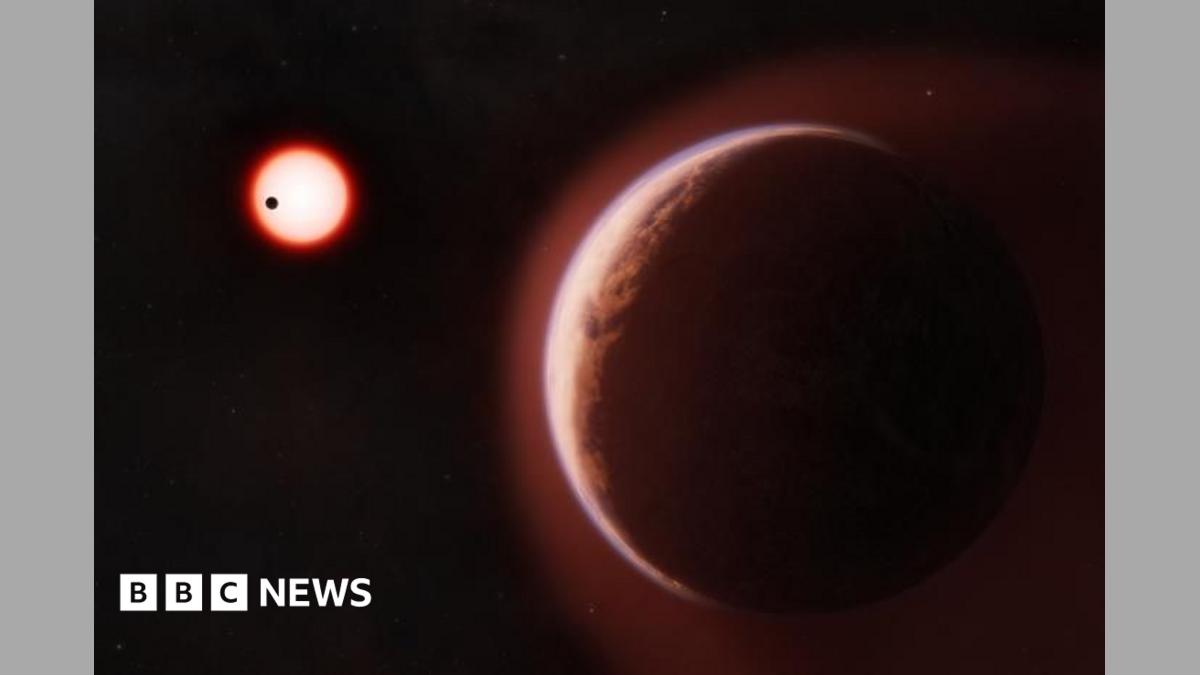
Researchers have made a groundbreaking discovery by identifying the first atmosphere surrounding a rocky, Earth-like planet located in the habitable zone of a distant star.
This discovery represents the strongest evidence to date that planets with Earth-like conditions may exist beyond our solar system.
The confirmed gas in the atmosphere is helium, which alone cannot sustain life, though additional gases may also be present.
Leading the research, Dr. Colin Cherubim from Harvard University described the finding as “a significant milestone.”
“This marks the first occasion we have detected the atmosphere of a rocky planet residing in the habitable zone of another star,” he noted.
The planet, designated LHS 1140 b, is located 48 light-years from Earth and orbits a cool, small red star.
Over 6,000 exoplanets have been cataloged orbiting distant stars, but this new finding brings us closer to realizing one of science’s greatest ambitions: identifying life on other planets.
According to the researchers published in Science Magazine, external, while no definitive evidence of life has been found yet, a planet must be situated at the right distance from its star to support liquid water—within the ‘just right’ temperature range.
Scientists refer to this ideal distance as the “Goldilocks zone,” inspired by the fairy tale character who favored the perfect porridge temperature.
Hundreds of planets have been detected in various Goldilocks zones, but only a select few are as small and rocky as Earth, which is crucial for the potential to host life.
Notably, none of these planets have previously been confirmed to possess atmospheres.
Until now.
Currently, the only gas identified in the atmosphere of LHS 1140 b is helium, which likely resides in the upper atmosphere and cannot support life on its own.
However, there may be other, more life-supporting gases deeper in the atmosphere. Dr. David Charbonneau, also from Harvard, emphasized the significance of this finding: an Earth-like planet with an atmosphere has now been documented beyond our solar system.
“People are inherently curious about profound questions: Are we alone? Is life possible beyond Earth or even in adjacent solar systems? This study confirms the first atmosphere on a rocky planet in a habitable zone beyond our own,” he stated.
LHS 1140 b is not the only celestial body under investigation in the quest for extraterrestrial life. K2-18b, a sub-Neptune planet suspected of having a water-rich interior, recently garnered attention due to potential signs of dimethyl sulfide, a gas linked to marine life on Earth.
However, a 2025 NASA-led reanalysis indicated that the signal was too weak to confirm biological origins, suggesting that the gas could exist independently of life.
Moreover, the seven rocky worlds of the TRAPPIST-1 system continue to intrigue researchers. While NASA’s James Webb Space Telescope dismissed the presence of an Earth-like atmosphere on TRAPPIST-1d, results for TRAPPIST-1e remain frustratingly inconclusive.
Source: www.bbc.co.uk