


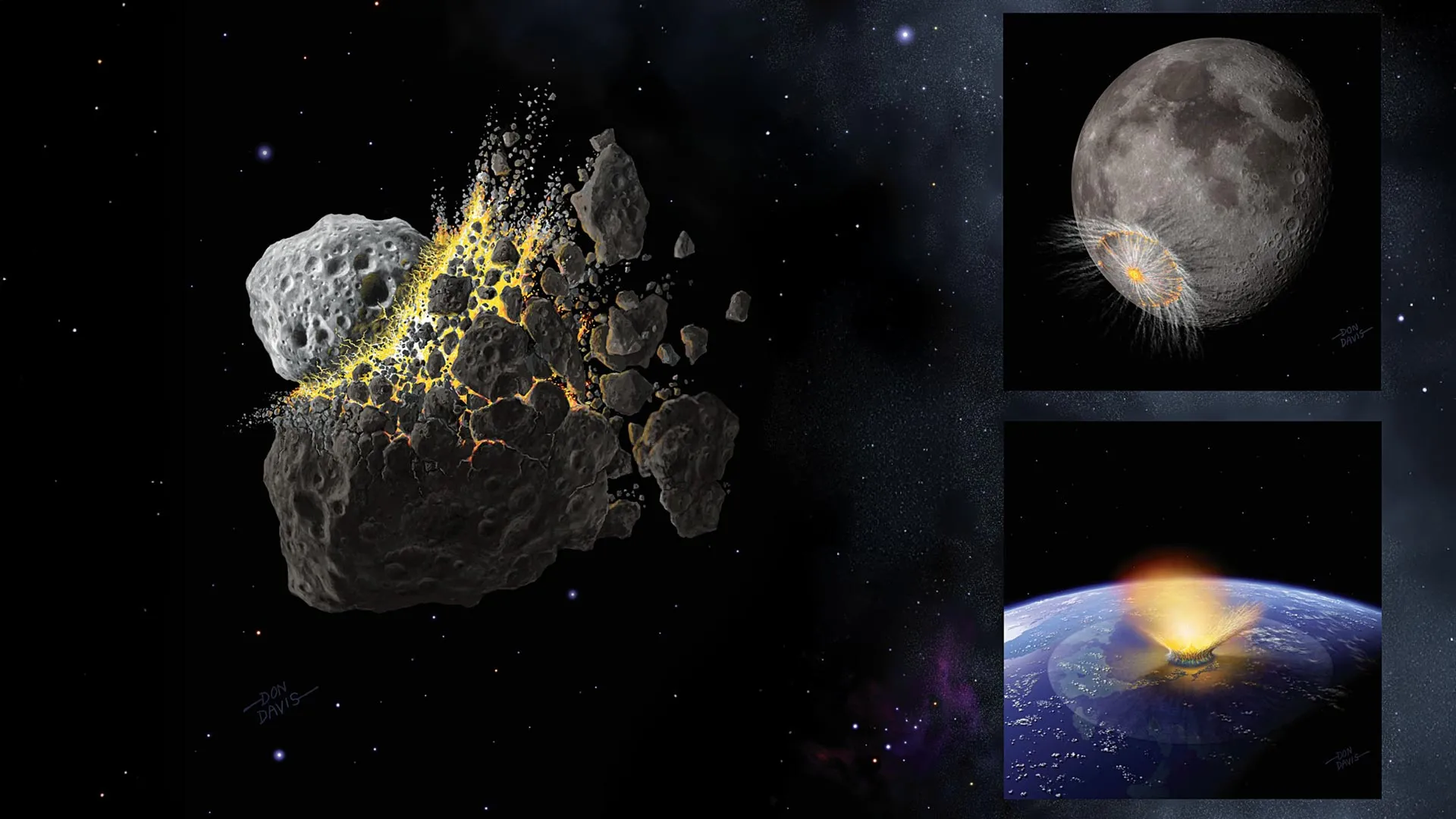
Approximately 800 million years ago, a violent collision in the asteroid belt may have instigated a cascade of destructive impacts in the inner solar system, as per groundbreaking research spearheaded by the Southwest Research Institute.
Researchers suggest that the disintegration of the parent body responsible for the Eulalia asteroid family propelled large debris towards Earth, the Moon, and Mars. If this theory holds, it could explain significant geological transformations on multiple planets and possibly affect Earth’s climate and biosphere.
Ancient Impacts and the Evolution of Life
“Our understanding of how impacts have shaped the origin and evolution of life within the solar system is still developing,” says Dr. William Bottke, the executive director of SwRI’s Solar System Science Exploration Division in Boulder, Colorado. He leads the Center for Lunar Origins and Evolution (CLOE) and is the principal author of the study. “The Moon’s cratered landscape reminds us of significant impacts in Earth’s history, yet only the Chicxulub event, occurring 66 million years ago, has a known link to a specific extinction event affecting life—the mass extinction of the dinosaurs.”
Chicxulub, a massive submerged impact crater in Mexico’s Yucatan Peninsula, is widely recognized for its connection to the extinction event that eradicated non-avian dinosaurs and numerous other species.
Unlike recent impacts, older collisions pose a challenge to reconstruct due to Earth’s continuously changing surface. Geological evidence from impacts older than 650 million years is minimal.
Volcanic activity produces new rocks, while plate tectonics reshape continents and ocean floors, and weathering gradually erodes old landforms. Collectively, these processes obscure or obliterate many ancient impact craters.
To delve into these lost historical chapters, scientists analyze asteroid showers—periods when debris from colossal collisions bombards planets and moons in the inner solar system.
“Such rare events stem from significant impacts in key regions of the asteroid belt, affecting entire celestial bodies in the inner solar system,” added Bottke. “The records preserved on the Moon’s unchanging surface can help us understand what transpired on Earth and Mars long ago.”
A Lunar Archive of Ancient Collisions
In contrast to Earth, the Moon lacks active plate tectonics, flowing water, and a dense atmosphere, making it a more comprehensive archive of ancient craters.
Previous studies suggest a notable uptick in large impacts on the Moon around 800 million years ago, deduced from the ages of the Moon’s primary craters and the impact glass retrieved during the Apollo missions.
Impact glass, formed when collisions generate intense heat to melt rocks, solidifies into glass, preserving essential chemical and temporal clues about the impact.
While lunar evidence hinted at an impact surge, researchers needed to pinpoint a realistic event in the asteroid belt that could account for this spike.
“Our astrophysical forensics team employed impact and dynamical models to connect these phenomena to the formation of the Eulalia asteroid family, triggered by a collision between primitive carbonaceous chondrite-like objects,” Bottke explained. “The positioning of the parent asteroid was crucial as it collapsed near a 3:1 gravitational mean motion resonance with Jupiter.”
Carbonaceous chondrites are ancient, carbon-rich meteorites that contain some of the solar system’s oldest materials, including minerals and water-bearing organic compounds.
Jupiter’s Gravitational Influence
The orbital area described by Bottke is known as the J3:1 resonance. Here, an asteroid orbits the Sun three times for each complete orbit of Jupiter.
Repeated gravitational interactions from Jupiter can gradually destabilize asteroids in this sector, acting as an escape route from the main asteroid belt and propelling objects into elongated orbits intersecting with the path of the inner planets.
Many asteroids currently near Earth are believed to have exited the asteroid belt via the J3:1 region.
Simulations indicate that Eulalia’s parent body was particularly pivotal, as about half of its fragments entered the J3:1 resonance almost instantaneously.
This resonance scattered fragments towards the inner solar system, boosting the frequency of impacts on the Moon, Earth, Mars, and potentially other rocky planets.
The bombardment did not cease abruptly; over the following 100 million to 150 million years, an additional 25% of the debris entered resonant states due to the Yarkovsky effect.
The Yarkovsky effect is a subtle force induced by heat. Asteroids capture sunlight and later release this energy as infrared radiation. This uneven heat distribution can gradually alter an asteroid’s orbit over millions of years.
A Cataclysmic Barrage Across the Inner Solar System
Modeling indicates that the disintegration of the Eulalia asteroid could credibly elucidate the spike in lunar cratering around 800 million years ago. Additionally, it intimates that the impacts might have had significant repercussions throughout the entire solar system.
Given that Earth is larger and possesses stronger gravity than the Moon, it would have experienced more substantial impacts. Researchers estimate that for every large object striking the Moon, approximately 20 similar or larger objects would collide with Earth.
While most physical evidence of these collisions has vanished, the timing coincides with a period of significant global cooling and substantial biological changes—suggesting that these impacts may have influenced the planet’s environment.
Although this study does not definitively establish that the asteroid bombardment caused these transformations, the correlation warrants further investigation.
“Considering that the peak of this bombardment aligns with an era of widespread cooling and significant biospheric alterations, it’s tempting to hypothesize a causal relationship,” Bottke stated. “On Mars, these impacts may have triggered notable seismic activity and coincided with volcanic surges. Collectively, these findings illustrate how muсh catastrophic impacts in the main asteroid belt could have lasting implications on the terrestrial planets’ histories.”
Source: www.sciencedaily.com