


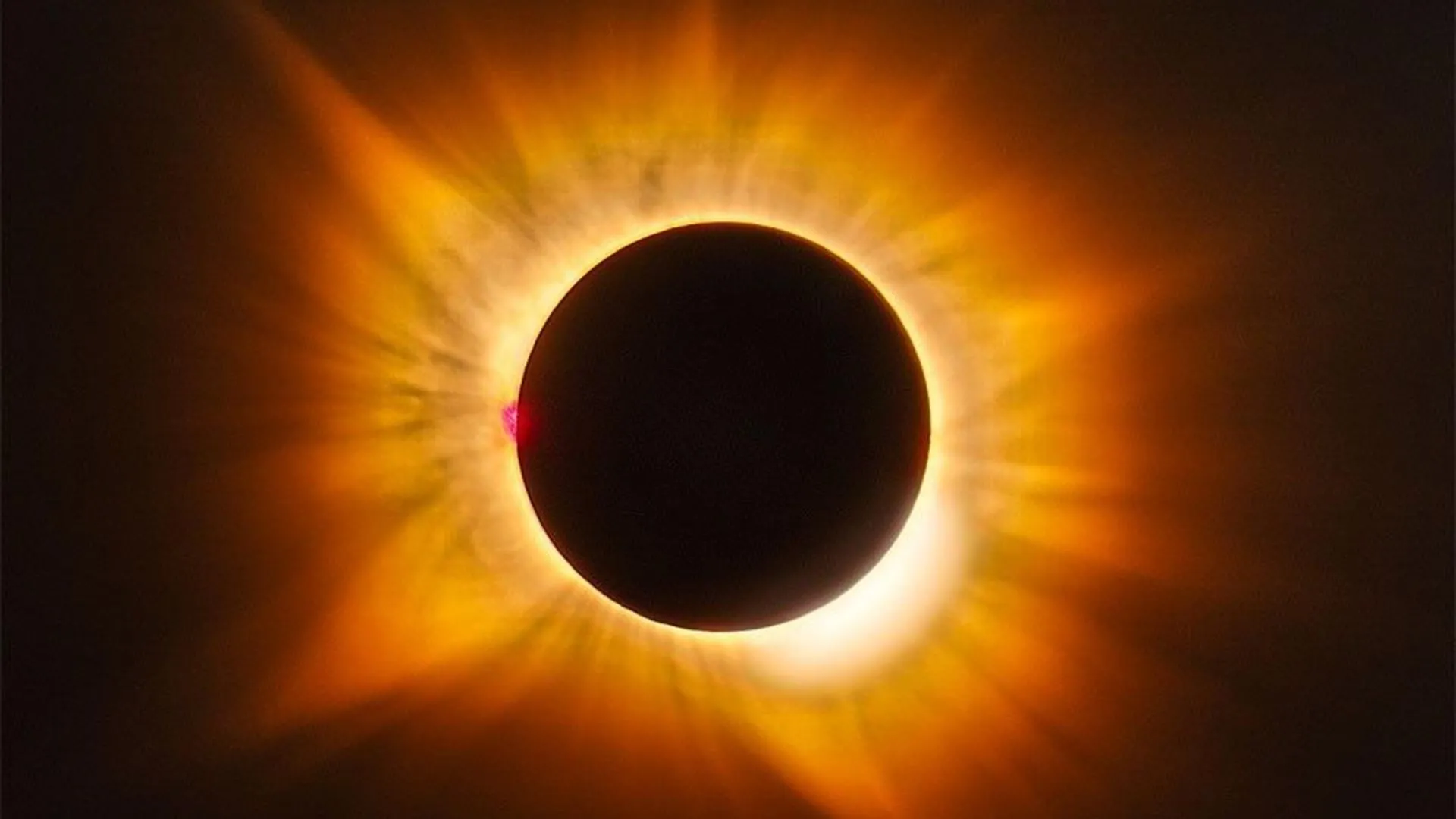
Last week’s total solar eclipse produced more than a breathtaking spectacle. In Spain, the eclipsed Sun displayed an unusual golden corona, created by the low position of the setting Sun and smoke-filled skies.
During a total solar eclipse, the Moon completely covers the Sun’s bright surface, revealing the solar corona—the Sun’s extremely hot outer atmosphere. The corona typically appears white or silver, and many eclipse viewers saw its familiar pearl-like glow last week. However, observers in Spain witnessed something different: a striking golden solar corona.
Why did the solar eclipse appear golden?
The eclipse’s timing was a key factor. In Spain, totality occurred while the Sun was close to the horizon. Sunlight traveling through the atmosphere at a low angle must pass through significantly more air before reaching observers on the ground.
As sunlight moves through this longer atmospheric path, air molecules scatter shorter wavelengths, particularly blue light. This process, known as atmospheric scattering, is also responsible for the orange and red colors seen during sunsets. With much of the blue light filtered out, warmer yellow, orange, and golden wavelengths became more prominent around the eclipsed Sun.
Smoke from nearby forest fires intensified the effect. The unusually smoky air acted as an additional atmospheric filter, scattering even more blue light and deepening the warm golden color of the visible solar corona.
A bright pink solar prominence added contrast.
The featured eclipse images were produced using multiple exposures and HDR, or High Dynamic Range, processing. This technique combines photographs taken at different brightness levels, allowing both the bright solar corona and faint surrounding details to appear in one image. The photograph was captured last week in Benavente, Spain.
Although the corona appeared golden, not every feature surrounding the Sun changed color. A large prominence remained visible along the Sun’s left edge. Solar prominences are enormous arcs of glowing plasma that extend from the Sun’s surface and are shaped by powerful magnetic fields.
The prominence emitted intense hydrogen-related light, allowing it to retain its vivid pink color despite the atmospheric filtering. The contrast between the bright pink solar prominence and the unusually golden corona made this total solar eclipse especially memorable.
Source: www.sciencedaily.com