


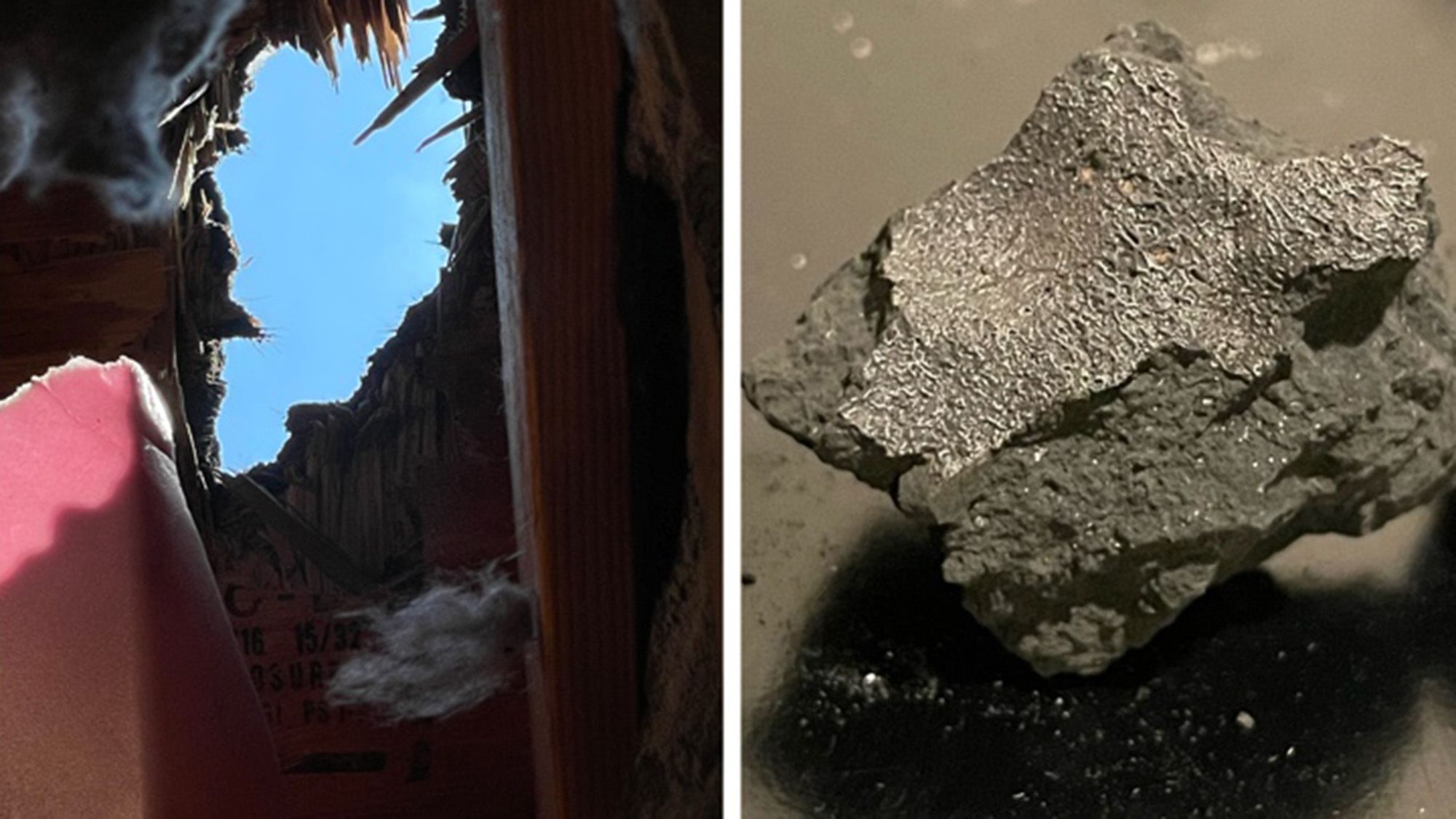
Recent scientific research has discovered vital building blocks of life within a meteorite that struck a home in New Jersey two years ago. This groundbreaking study reveals that this space rock harbors amino acids, carbon compounds, and other “prebiotic” molecules, which are similar to those that might have catalyzed the emergence of life on Earth.
The research team, spearheaded by Peter Jenniskens from the SETI Institute in collaboration with NASA’s Ames Research Center, commended a Hillsboro, N.J. homeowner for his swift action in securing a meteorite after it crashed onto his roof on July 16, 2024. The homeowner carefully collected fragments using disposable gloves and aluminum foil, placing them in a glass jar.
“I was home when I heard a loud crash and noticed a hole in my master bedroom ceiling,” the unidentified homeowner explained in a statement from the SETI Institute. “An intense sulfur-like odor filled the room, and I could see black debris covering the bed, carpet, and surrounding areas.”


A close-up of the Hillsboro meteorite’s surface.
(Image courtesy of SETI Institute)
These precious meteorite fragments likely originated from ancient planets within the solar system that never fully developed. “Forensic analysis revealed preserved fragments taken from near the surface of a small, primitive asteroid, subjected to concentrated salt-laden fluids, an unprecedented process in such protoplanetary environments,” stated Jenniskens.
This study was published on July 15 in the journal Scientific Progress. The meteor’s trajectory was traced back to sightings by over 60 observers in New York, New Jersey, and other Northeastern states before its descent at speeds reaching 32,000 mph (51,500 km/h), generating shockwaves felt by at least 16 people.
The meteor broke apart in the atmosphere, and reports ceased when it reached an altitude of 22 miles (35 kilometers). However, Newark Liberty International Airport managed to briefly monitor its descent using Doppler radar. Eventually, only one meteorite fragment, named the Hillsboro meteorite, was retrieved from the site.
The American Meteor Society employed cameras across Northford, Connecticut, and Douglasville, Pennsylvania, in addition to a doorbell camera in Wayne, New Jersey, to trace the meteor’s origins. Mike Hankey, operations manager for the American Meteor Society and co-author of the study, noted that the meteor’s path traced back to the low altitude of the asteroid belt.
Get the world’s most fascinating discoveries delivered straight to your inbox.
The Hillsboro meteorite is noteworthy as the second instance of a stony meteorite of its kind to be found post-fall. Subsequent analysis confirmed its richness in ancient brine, categorizing it as a carbonaceous chondrite.
Scientists are using mineral comparisons between the salt in this meteorite and samples from Asteroid Ryugu and Bennu, both of which possess life-friendly components, as they formed long before the Hillsboro. This research may ultimately illuminate the origins of life-supporting chemistry within the early solar system.
Jenniskens, P., Zolenski, M.E., Gordon, A., Gordon, J., Hankey, M., Silver, E.A., Giannone, M.R., Han, J., Lu, L., Freese, M.D., Ziegler, K., Zhang, Q.H.S., Behera, D., Watson, J.S., Sefton, M.A., Brakeley, J., Munday, B., Kebukawa, Y., Gainsforth, Z., . . Ebel, D. S. (2026). Meteor over New York City: The brine of a primitive CM asteroid. Scientific Progress, 12(29), eaea2105.
Source: www.livescience.com