


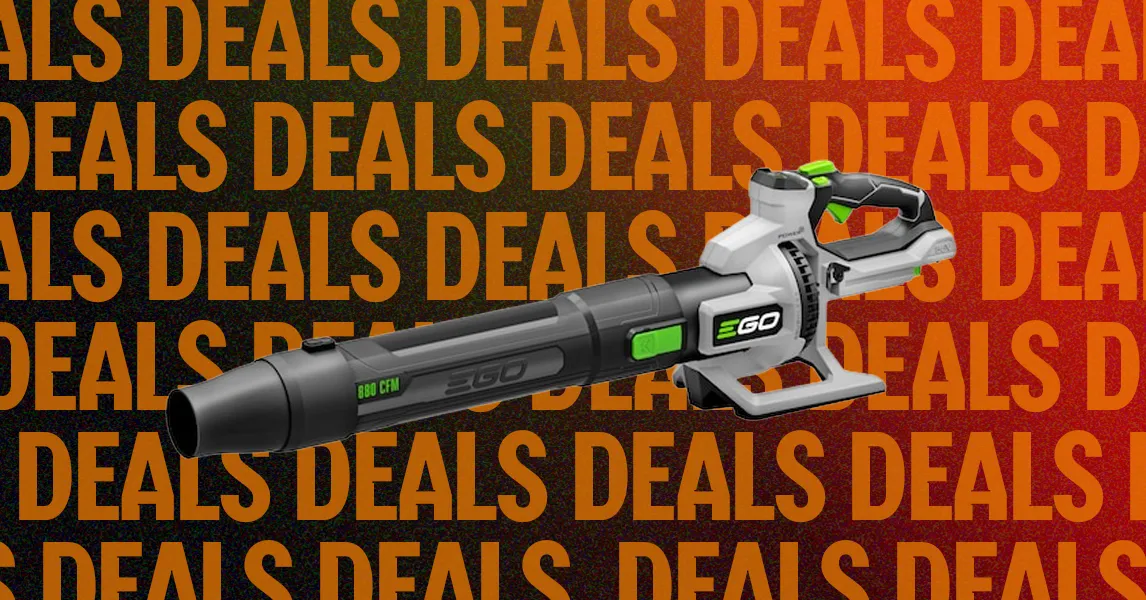
Autumn leaves are turning up in driveways, sidewalks, garages, and entryways, but the Ego Power+ 880 CFM battery-powered leaf blower can handle more than seasonal yard cleanup. In testing against fabric leaves and concrete blocks, it delivered gas-like power while remaining the quietest model tested. It was also the only blower that flipped a 5-pound brick paver without using turbo mode. The blower is currently on sale at Lowe’s, with additional batteries available for longer runtime.
For Halloween, Monkey demonstrates how to turn the blower into a homemade toilet paper cannon. The Lowe’s sale runs through November 4.
How the toilet paper cannon works
With a few hardware-store parts—and some items that may already be at home—the battery-powered blower can unroll one or two layers of toilet paper in seconds. Once assembled, it can be displayed at home or used as a novelty project for children.
Leaf blower performance is commonly described using cubic feet per minute (CFM) and miles per hour (mph). In this setup, fast-moving air creates a low-pressure flow, while the still air surrounding the roll pushes it toward that flow. As the air follows the roll’s curve, it lifts the roll and carries the paper forward through friction. Bernoulli’s principle contributes to the effect, along with lift from the curved surface and the airflow pulling the paper ahead.
Safran Wise, a vice principal at international engineering firm Thornton Tomasetti, which specializes in fluid mechanics, advised on the placement of the roll. “Putting a roll under the nozzle is a little better because you’re pulling the paper upwards toward the airflow, which does most of the work and forces the paper to move upwards,” she says.

Choosing a blower attachment
Leaf blowers typically include a tapered round tube, and the Ego model used here also includes a wide, flat attachment. Wise says tapered round tubes are the most stable option because they produce a high, wide airflow. For this project, however, the flat attachment may offer more speed.
“The narrow nozzle arrangement that tries to flatten the airflow probably gives you more power and more velocity, so it’s more likely to reach farther,” Wise says. If a blower does not include a flat attachment, a similar shape can be made with cardboard and duct tape.
How to make the toilet paper cannon
1. Prepare the roller
Use a mini paint roller made for standard nap rollers. Avoid foam-roller models, which are too narrow. Slide the toilet paper roll onto the roller cage. If the fit is loose, wrap the cage first with painter’s tape and then duct tape, adding layers until the roll is secure. The painter’s tape makes it possible to use the roller for painting later.
2. Attach the roller to the blower
Place the toilet paper roll on the roller and center it in the airflow beneath the blower nozzle, about 3 to 4 inches from the tip. Use 12 inches of duct tape to attach the roller handle to the blower, then measure the position again and add more tape to secure it. To help prevent adhesive residue on the nozzle, cover it with painter’s tape before applying the duct tape.
3. Launch the paper
Pull out the first few sheets of toilet paper, pull the blower’s trigger, and let the paper fly.
—Sal Vaglika
Source: www.wired.com