


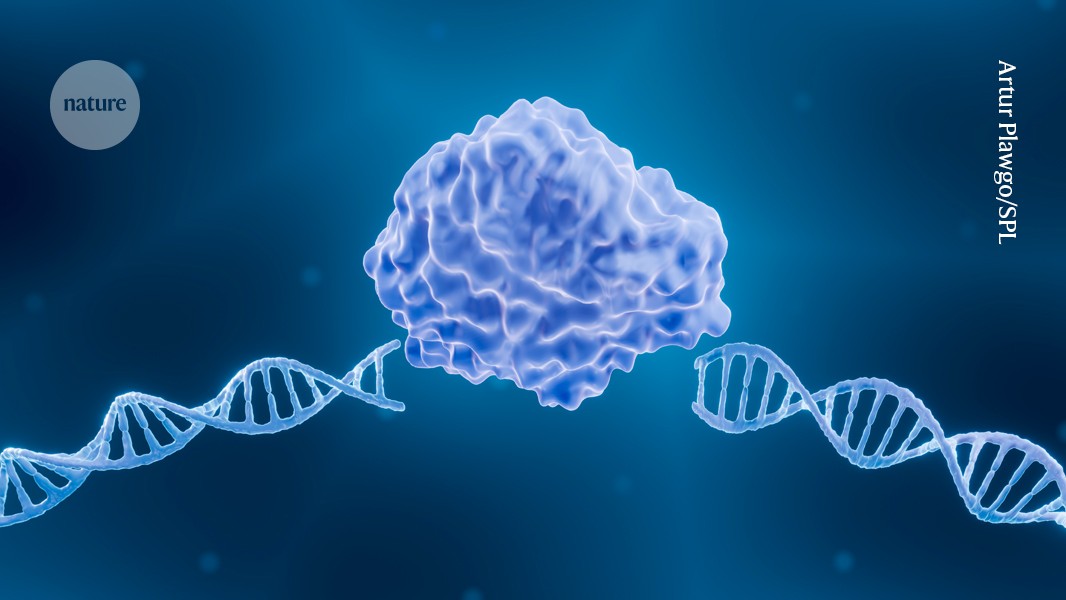
Innovative enzymes that cleave DNA (as envisioned by the author). A synthetic protein-cleaving enzyme was rapidly engineered using artificial intelligence technology.
Credit: Artur Plawgo/Science Photo Library
Recent advancements in artificial intelligence have empowered scientists to develop synthetic CRISPR proteins that edit genomes more effectively than their natural counterparts. These synthetic CRISPR systems could revolutionize research in various sectors, including medicine and agriculture.
result1 Published on July 16th Science.
As molecular biologist Soren Lienkamp from the University of Zurich observes, “Just as CRISPR democratized the ability to edit DNA, AI-driven protein design paves the way for anyone to craft entirely new properties in the protein arena.” Lienkamp emphasizes that the research integrates “two transformative domains”: AI-guided design and enzymes known as RNA-guided nucleases, capable of cutting DNA and RNA strands.
Revolutionizing Gene Editing
These RNA-guided nucleases are fundamental to the CRISPR gene editing system, employing a “guide RNA” to target specific DNA sequences. Acting as molecular scissors, the nuclease cuts out the designated material, allowing scientists to edit, delete, or insert genetic information. This CRISPR mechanism mirrors a defense strategy utilized by bacteria against viruses. Prominent CRISPR nucleases, such as Cas9 and Cas12, are derived from bacterial systems.
Despite its power, gene editing remains a complex endeavor. According to Jennifer Doudna, a biochemist at the University of California, Berkeley and the lead author of the published study, nucleases must navigate a series of well-orchestrated steps, rendering it challenging to surpass evolutionary designs. Doudna, who received the 2020 Nobel Prize in Chemistry for her contributions to the CRISPR system, notes, “When modifications are made, one often discovers that while changes may occur, the resulting product may not function effectively.”
Former Meta-scientist Unveils Giant AI Protein Design Model
AI tools present a valuable opportunity to streamline the identification of promising candidates for new functional nucleases. Instead of executing hundreds or thousands of exploratory experiments, researchers could leverage machine learning to conduct these evaluations. Doudna and her team aimed to synthesize new versions of a small nuclease group known as TnpB, the evolutionary precursor of the widely used Cas12, to determine how much they could alter a protein’s sequence while retaining its gene-editing capabilities.
To ensure functional proteins, it is crucial that they attain specific shapes or conformations. The researchers provided an AI model with the final 3D architecture of a TnpB variant and instructed it to reverse-engineer changes to the underlying DNA template that would uphold the protein’s final structure. This innovative approach yielded thousands of potential modifications, though it remains unclear whether the resulting proteins exhibit activity.
Source: www.nature.com